



Every autumn season, over 124,000 hopeful students apply to UC Irvine. Fewer than 3 in 10 are accepted. That sheer volume of applicants makes UCI one of the most popular public universities in the country — and one of the most competitive campuses in the University of California system.
So, what does it take to stand out as an applicant?
In this article, we’ll break down the latest UC Irvine admissions statistics, including acceptance rates, GPA ranges, and what these numbers mean for high school students and transfer applicants. But we’ll also look beyond the rankings and figure out what it really takes to get into UC Irvine in today’s cutthroat admissions landscape. Whether you’re building your college list or weighing your odds, this behind-the-scenes look will help you understand where you stand — and how to prepare better.
What makes UC Irvine unique?
Admittedly, the anteaters do make for an adorable mascot. But the cuteness (and the lovely Southern California weather) are not the only reasons students from around the world have sights set on UC Irvine’s particular college experience.
The University of California system at a glance
Irvine isn’t a standalone state school. The University of California (UC) system is made up of nine undergraduate campuses, all of which use a shared application and a holistic admissions review process. UC campuses are widely respected for their academic rigor, research output, and selectivity.
Each UC campus evaluates applicants based on multiple comprehensive review factors, including GPA, course rigor, extracurriculars, and personal insight responses. As a whole, the system does not consider SAT or ACT scores, following a permanent test-blind policy established in 2021.
UC Irvine: fast facts and rising reputation
Located in mild Orange County, California, UC Irvine (UCI) enrolls over 37,000 students across undergraduate and graduate programs. Known for its strengths in computer science, engineering, business, and social sciences, UCI has steadily climbed in national rankings for both research and undergraduate education.
Here are some of the school’s greatest individual highlights:
- Named a top 10 public university by U.S. News & World Report
- Designated as a Hispanic-Serving Institution (HSI)
- Over 85% of undergraduate students come from California
- Member of the prestigious Association of American Universities (AAU)
- R1 research university with over $700 million in annual research expenditures
Curious about the student perspective? This video takes you behind the scenes for an honest insight into daily life at UCI.
After all, admissions success isn’t just about getting in — it’s also about fitting in. So what’s it really like at UC Irvine?
UCI’s student body is best known for:
- A diverse, collaborative community
- A quieter, more suburban campus environment
- Strong commuter and transfer populations
- Research opportunities for undergrads
In your application, reflect on why this specific community, academic offerings, or campus vibe genuinely match your personality and goals.
For instance, students who thrive at this school often value academic focus and balance, enjoy a supportive, non-cutthroat vibe, or like structure and research-driven opportunities. Chances are, you appreciate SoCal weather, but don’t need a big city atmosphere, either.
UC Irvine’s admissions approach
Like its fellows, UCI employs a holistic review process in line with the overall UC admissions policy. This means they look at each applicant within the context of their opportunities. Admissions officers consider GPA, course rigor, leadership, special talents, and community contributions — not just numbers.
Importantly, UCI does not accept letters of recommendation, and applicants are required to respond to four personal insight questions (sometimes called PIQs). Demonstrated interest is not a factor, but academic performance and personal achievements absolutely are. Need help with your essays? Check out Empowerly’s guide to essays for a great primer on how to knock your personal statements out of the park.
For high-achieving applicants, you should also know about UCI’s Campuswide Honors Collegium (CHC), which offers a more intimate, rigorous academic environment with perks that can make the large public university feel smaller and more personal.
Honors students receive:
- Priority course registration
- Smaller class sizes
- Dedicated academic advisors
- Specialized research opportunities
- Access to an Honors residence hall
Wondering if you qualify? CHC applicants are usually in the top 5–10% of UCI’s admitted class. If you’re already competitive for UCI, applying to CHC is a great way to enrich your college experience and strengthen your case for merit scholarships.
UC Irvine admissions statistics: what the numbers show
So, you want the cold, hard facts, huh? Let’s take a closer look.
Demographic snapshot of the 2025 admitted classes
Here’s a breakdown of who gets to call Irvine home next fall.
- First-Year Applicants: 124,232
- First-Year Admits: 35,954
- First-Year Admission Rate: 28.94%
- Transfer Applicants: 25,484
- Transfer Admits: 10,030
- Transfer Admission Rate: 39.51%
This means that UCI admitted roughly 1 in 3 first-year applicants and 2 in 5 transfer applicants in 2025. Compared to the most selective UCs (like UCLA and UC Berkeley), these rates are higher, but they still reflect intense competition.
Now, here’s something worth pausing on: UCI’s admit rate has held remarkably steady at around 28-29% for two consecutive cycles, despite small fluctuations in application volume. That stability is actually informative — it tells you that admit rates aren’t likely to swing dramatically year over year. For Class of 2030 applicants, planning around the 28-29% range is the smart move.
Does residency matter?
It’s no secret: the UC schools prioritize California residents due to their mission as a state university system. But out-of-state students can succeed with compelling applications (especially if they bring geographic diversity or unique academic achievements). While data suggests that in-state students still make up a majority of UCI’s admits, the school still remains a top destination for transfer students from a variety of backgrounds.
Want to know one more interesting wrinkle? Out-of-state admit rates at UCI ran around 47.6% for the 2025 cycle — actually higher than the in-state rate. International applicants saw growth of 11.5% in applications and 10.8% in admits compared to the prior year. That’s a meaningful pattern: UCI is one of several UCs (along with Davis and Santa Barbara) where non-residents currently see a more favorable admit rate than in-state residents.
Empowerly Tip: Students applying to multiple UC campuses should diversify their list. UCI’s 28.94% admit rate is lower than many assume and not a true “safety” school.
GPA ranges for the 2025 admitted classes
Since the UC system doesn’t consider test scores, your GPA matters all the more. It’s not just your final grades that matter, though; your course rigor matters, too.
That’s right; UC Irvine doesn’t just evaluate your GPA in isolation. Admissions officers look at what classes you took to earn that GPA. A 4.20 GPA with mostly standard classes may be seen as less impressive than a 4.10 GPA filled with AP, IB, or dual enrollment courses.
Our advice? Take the most rigorous course load available at your school that you can handle while maintaining strong grades. The UCs do not accept letters of recommendation, so the application needs to speak for itself.
Weighted GPA
- First-Year Median: 4.19
- First-Year Middle 25% – 75%: 4.04-4.27
Unweighted GPA
- First-Year Median: 3.95
- First-Year Middle 25% – 75%: 3.84-4.00
Transfer GPA
- Median GPA of CA Community College admits: 3.79
These numbers paint a clear picture: UCI admits academically high-achieving students. Successful applicants typically take rigorous course loads throughout high school. Use the PIQs to provide context if your school doesn’t offer many honors or AP courses in the first place.
If you’re a CCC student with a strong academic GPA, you may be eligible for Transfer Admission Guarantee (TAG) — an agreement that provides a guaranteed spot if requirements are met. If this is you, be sure to apply by the September 30th TAG deadline.
Major-specific admissions: where you apply matters
Picture this: two students with identical 4.18 weighted GPAs apply to UCI. One applies to undeclared social sciences. The other applies to computer science. The CS applicant gets denied. The social sciences applicant gets in. Same school, same admissions cycle — wildly different outcomes.
Why? Because UCI’s admissions decisions are major-specific, and certain programs run dramatically tighter than the school-wide rate suggests. Here’s the deal:
- Computer Science (Donald Bren School of ICS) — One of the most competitive majors at UCI. Admit rates run significantly below the school-wide 28.94% — often estimated in the 5-10% range for direct admission.
- Engineering (Samueli School) — Specific engineering majors like biomedical, mechanical, and chemical engineering also trend tighter than the overall rate, especially for impacted concentrations.
- Nursing Science — Among UCI’s most selective programs, with admit rates often reported in the single digits. Direct entry is highly competitive.
- Business Administration (Merage School) — Selective; admit rates run lower than the school-wide rate.
- Public Health Sciences — Increasingly competitive due to growing applicant interest.
- Undeclared majors and most humanities/social science majors — Generally align more closely with the school-wide admit rate.
Now, here’s the kicker: switching majors after enrollment is possible at UCI, but it’s not always easy — especially moving INTO the most impacted programs (CS, engineering, nursing). If you genuinely want CS or engineering, applying directly is your best shot. If you’re undecided but interested in STEM, applying as undeclared and then switching is sometimes a workable strategy, though you’ll need to meet the school-internal change-of-major requirements.
The takeaway? Choose your major declaration on the UC application strategically. Match it to your actual interest, but understand the competitive context.
What UC Irvine admissions numbers mean for you
So, what do all these statistics mean for a prospective applicant?
If your weighted GPA is in the 4.0+ range, you’re academically competitive for UCI. But GPA is only part of the equation. The admissions team also values students who:
- Take challenging coursework relative to their school
- Lead initiatives or hold leadership roles
- Demonstrate impact in their communities
- Articulate goals clearly in personal insight responses
Empowerly Tip: If you fall slightly below UCI’s middle 50% range, a compelling narrative and strong extracurriculars can still give you a competitive edge.
This student provides peer-to-peer tips for applying to UCI to increase your odds:
How to write Personal Insight Questions that stand out
Want to know what really separates accepted applicants from rejected ones? It’s almost never the GPA — it’s the PIQs. Since UCI doesn’t accept recommendation letters or test scores, your four 350-word essays carry enormous weight in the holistic review.
Here’s what UCI admissions officers actually look for in PIQ responses:
1. Specificity over generalities. Don’t write “I love science.” Write about the specific moment you solved a calculus problem that had stumped your class for a week, or how you taught yourself Python to analyze data from your school’s recycling program. Concrete details show admissions officers who you actually are.
2. Reflection over chronology. Many students treat PIQs like resume bullet points expanded into paragraphs. Big mistake. The strongest essays show how an experience changed your thinking, not just what you did. A 200-word description of an event followed by 150 words of meaningful reflection beats a 350-word play-by-play every time.
3. Diversity across the four PIQs. UCI requires four responses out of eight prompts. The four you choose should collectively show different sides of who you are — academic, personal, community-focused, creative. If three of your responses focus on the same activity (say, debate team), you’re missing an opportunity to demonstrate range.
4. Authenticity over polish. UC admissions officers read tens of thousands of essays. They can spot generic, AI-assisted, or over-coached writing within the first paragraph. Your voice — even if imperfect — will outperform a polished but soulless response.
The eight UC PIQ prompts cover leadership, creativity, talent, educational opportunity, challenges overcome, academic interest, contribution to community, and what makes you a strong candidate. Your job? Pick the four that genuinely fit your story and answer them with specific, reflective, varied, authentic detail.
Your senior-year timeline for UC Irvine
Here’s the thing about UC applications — they don’t reward last-minute effort. Successful applicants typically work backward from the November 30 deadline. Here’s how that timeline looks for the 2026-27 cycle:
- Summer before senior year (June-August 2026) — Brainstorm and outline all four PIQs. Build your activities list. Confirm your senior course schedule. Visit campus virtually or in person if possible.
- September 2026 — Begin drafting your PIQs. Update your activities list with senior year leadership roles. Start any final standardized tests if useful for placement (UCs are test-blind for admissions but use scores for course placement).
- October 1, 2026 — UC application opens. Start filling in academic history.
- October-November 2026 — Heavy revision on PIQs. Get feedback from at least two readers (counselor, teacher, family member, advisor) — but make sure the voice stays YOURS.
- November 30, 2026 — UC application deadline. No extensions, no exceptions. Submit early to avoid system delays on the last day.
- January 31, 2027 — Update 7th-semester grades via UC’s Academic Update.
- March 2027 — Decision and waitlist invitations released.
- May 1, 2027 — Statement of Intent to Register due.
Costs and financial aid: the actual numbers
For starters, here’s the real story on UCI cost of attendance for 2025-26:
- California residents: approximately $42,000 per year (tuition + fees ~$17,400, plus housing/food ~$19,800, plus books/personal expenses)
- Non-residents (out-of-state and international): approximately $73,000 per year (add ~$33,500 in non-resident supplemental tuition)
Want to know the good news? UCI offers strong financial aid, especially for California families:
- Blue and Gold Opportunity Plan: California families earning $80,000 or less typically pay $0 in tuition and fees.
- Middle Class Scholarship: Sliding support extending up to roughly $217,000 in family income.
- Need-based grants: Average first-year grant package around $27,000+.
- Out-of-state aid: More limited; non-resident applicants should plan accordingly. Some merit awards exist, but they’re competitive.
The bottom line? File your FAFSA or California Dream Act Application by March 2, 2027 (priority deadline) for the 2027 cycle. Run UCI’s Net Price Calculator early in your application process to understand what you’d actually pay — the sticker price often differs significantly from your real out-of-pocket cost.
Want to go deeper into your UC Irvine application?
Empowerly’s team of former admissions officers and expert counselors helps students build UC-ready application strategies. Whether you’re polishing your essays or planning course selection in your sophomore year, our personalized approach can strengthen your odds.
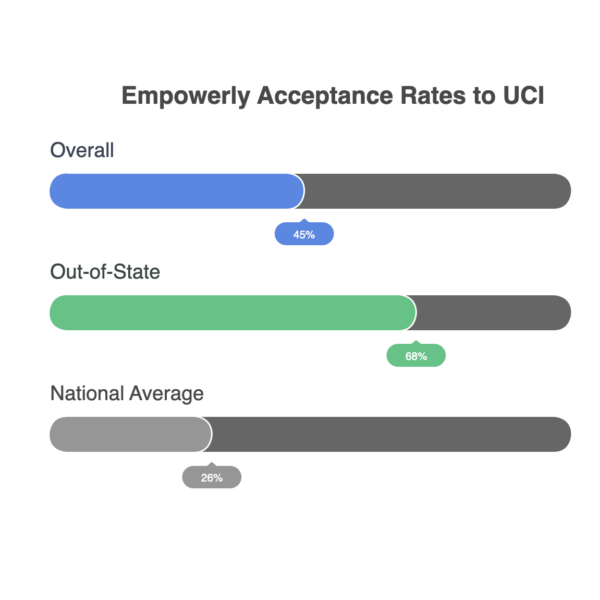
Curious about how the counseling process works? This past year alone, we helped hundreds of students put the finishing touches on their UC applications, 145 of which went straight to Irvine’s admissions office. In fact, UC Irvine was the second most popular UC campus for our students in 2025 (after Los Angeles) — and our students achieved amazing results. Empowerly’s Class of 2025 scored a record-smashing 45% overall acceptance rate (compared to the national average of 26%). Our out-of-state students scored a jaw-dropping 68%.
What does that mean for you?
Working with Empowerly provides a tangible, measurable benefit: Empowerly students are 2x as likely to be accepted to UCI compared to the average applicant. (And, out-of-state Empowerly applicants are 3x as likely to be accepted compared to the average applicant.) That’s major.
Finally, before you go, hear firsthand how our amazing counselors helped this former Empowerly student and intern on her college journey to UC San Diego:
Conclusion: Don’t just compete, prepare intentionally
UC Irvine is a top-tier public university with rising prestige and a highly competitive admissions process. But with the right preparation, it’s within reach for many motivated students.
For starters, here’s what you can do:
- Review your GPA against the latest admissions ranges.
- Build a smart UC list with a balance of safety, target, and reach schools.
- Choose your major declaration strategically based on competitive context.
- Start your PIQs the summer before senior year — not the week before the deadline.
- And make sure your application reflects who you are, not just what you’ve done.
Want to boost your chances at UC Irvine? Empowerly helps students create strong UC applications with expert advising, essay support, and data-driven strategy. Book a free consultation today and take the guesswork out of your college journey.
