



Every year the same story repeats itself: the pool of applicants grows and the number of seats does not, and admissions to a selective US college is just as hard, if not harder, to secure than it was twelve months before. Geography, feeder-school ties, institutional priorities: these factors shape outcomes in ways no applicant controls, and a strong transcript or a full extracurricular resume guarantees nothing on its own. That said, we see in every cycle amongst our applicants that those with both rigorous academics and extracurriculars can meaningfully improve the odds.
Through the sustained work that our students do and the careful planning and strategic guidance we provide, our students increase their chances of earning admission at their favorite college. The deliberate shaping of a student’s story around what genuinely interests them, the early conversations about fit, and the essay drafts that go through a dozen revisions, this is what the long runway looks like before an application is submitted.
And the outcome? Well, that is what we put into numbers here. This post provides a picture of where our students landed among the country’s most selective schools, what kind of academic and extracurricular profile tends to open those doors, and what the financial picture looked like once the acceptances came in.
Where our students outperform the average
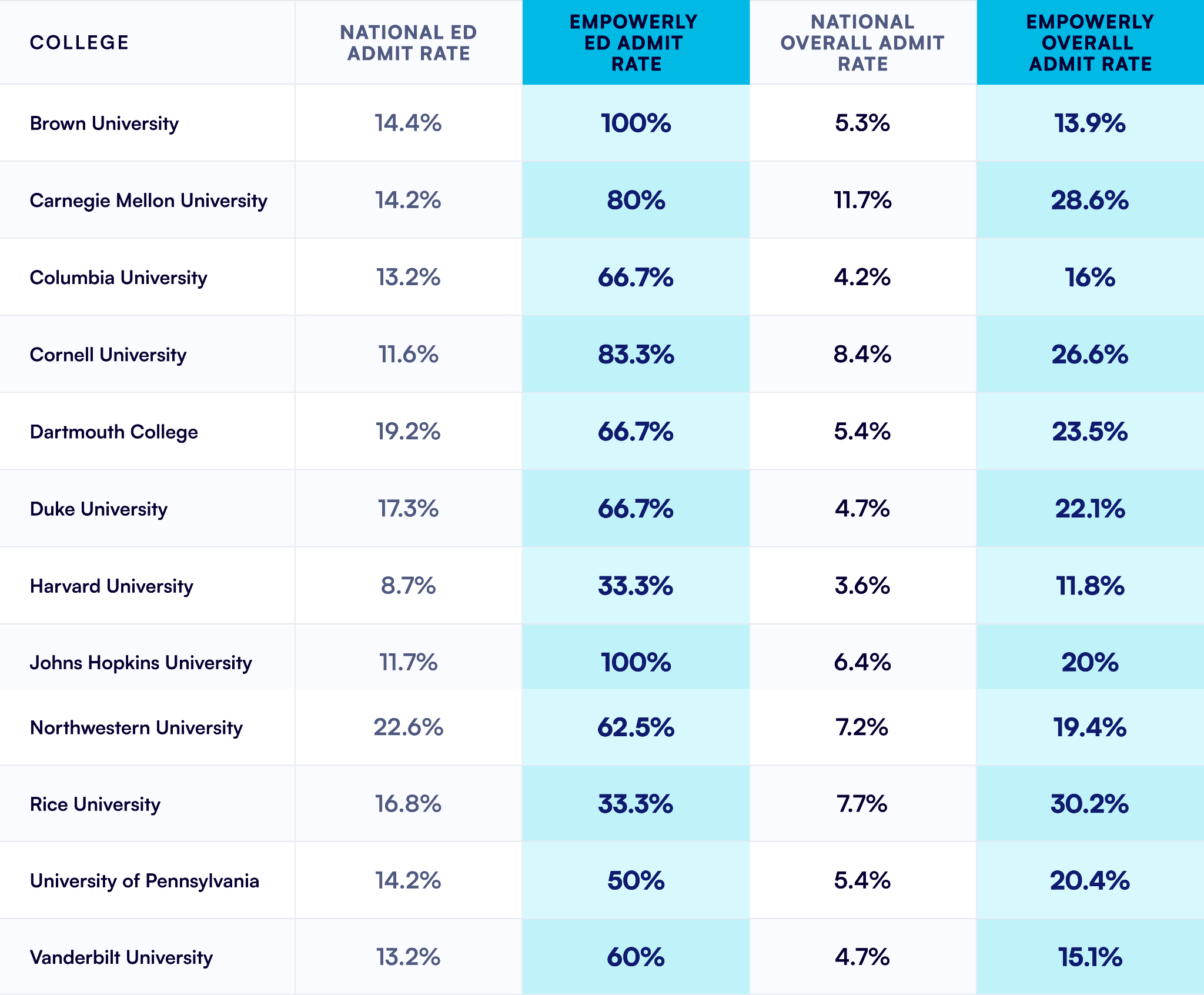
The widest gap of all between our students and the national average shows up in the Ivy League. Across all eight schools, 17% of our students were accepted, compared to a 5.4% national average, putting their odds at 3.2x the overall rate, with the widest gaps at Dartmouth (4.4x) and at both UPenn and Columbia (3.8x each).
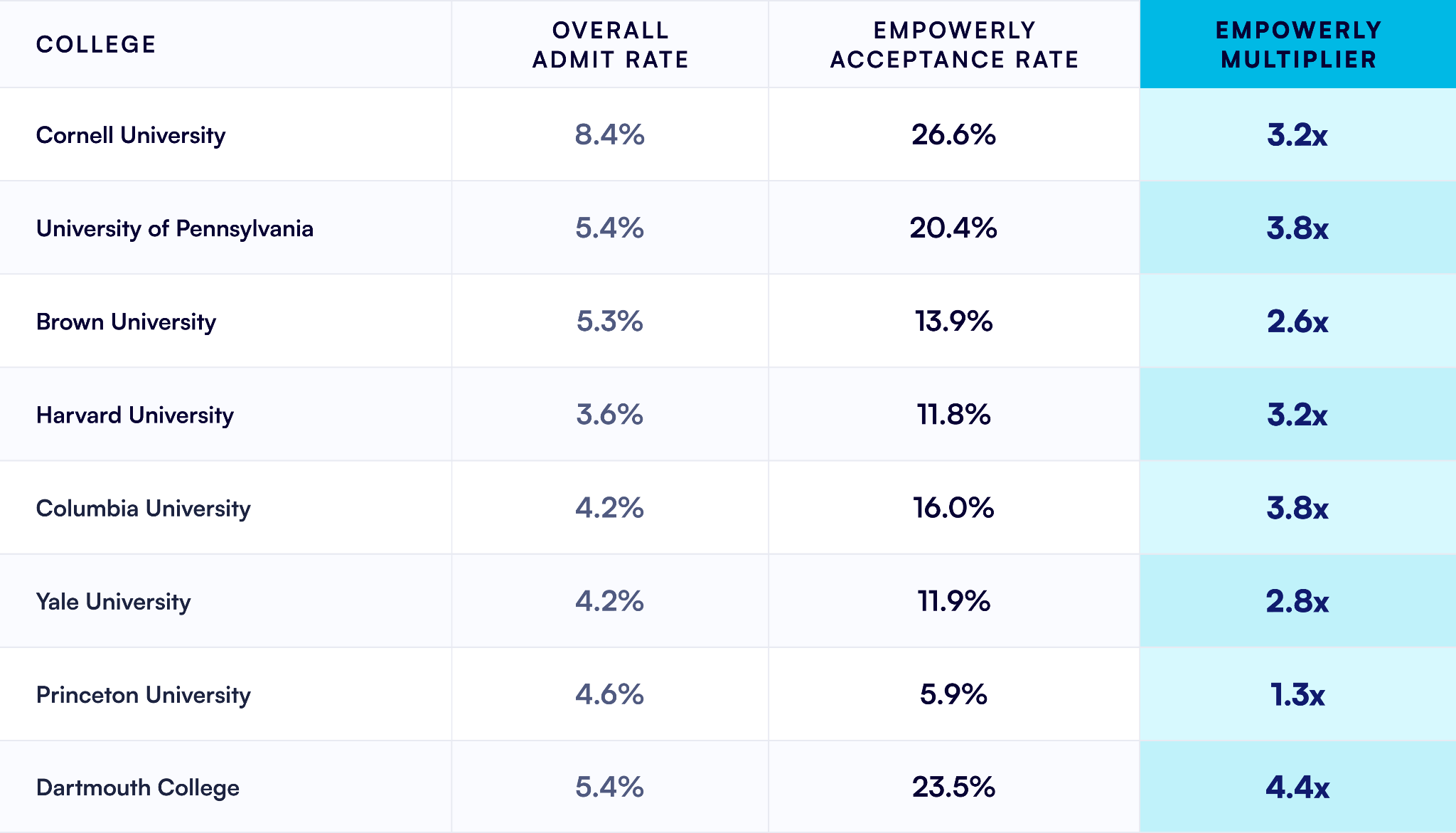
Results at the Ivy League tell you that the Empowerly approach matters most exactly where the odds are worst. But a multiplier alone doesn’t explain why it works. So what does that student actually look like? We tracked the outcomes of 544 students who applied to the Ivies this year, and the data shows a high-achieving cohort: an average 3.93 GPA and a 1520 test score.
But there is more to the picture than just academics: plenty of applicants with top scores were also turned away. When academic perfection is the baseline rather than the differentiator, which is what happens at this level of selectivity, the decision comes down to everything else. The essay. The choice of early decision vs. regular decisions. The depth and impact of the extracurricular list rather than its length.
Take two applicants to UPenn this cycle, nearly identical in GPA and test scores. One worked with us for 6 months and applied regular decision with a 3.96 GPA and a 1520; the other joined us as a 10th grader and applied early decision with almost identical scores. The first was rejected, the second accepted.
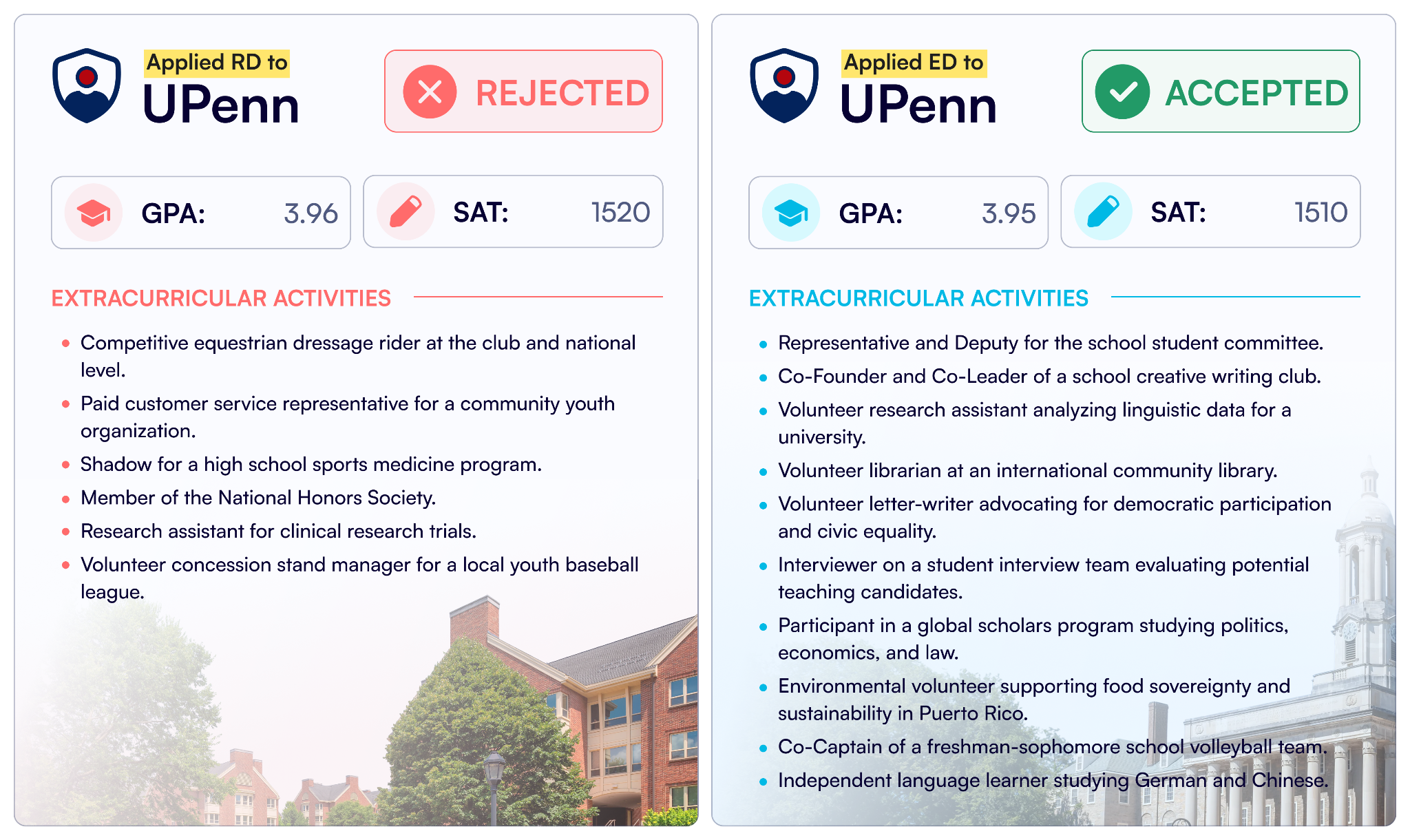
The rejected applicant’s activities were impressive on their own but disconnected from one another: competitive dressage, a sports-medicine shadowing program, clinical trials research, a customer-service job, concession-stand volunteering. Each one real, but very few speaking to the others.
The accepted applicant’s list reads much more cohesively, building on each other. In the civics bucket: leadership on the student government, civic advocacy letter-writing, sustainability volunteering in Puerto Rico and a global scholars program in politics and economics. Second the linguistic bucket: co-founding a creative writing club, volunteer linguistics research, self-directed study of German and Chinese and work at an international library.
That’s the difference a compelling extracurricular profile and an early start make. Students who work with us over a longer stretch of time have room to build something that holds together. Rather than showing a scattered list of activities, they have projects that connect and deepen over time, telling a clear story about who they are.
The top 25 colleges, by the numbers
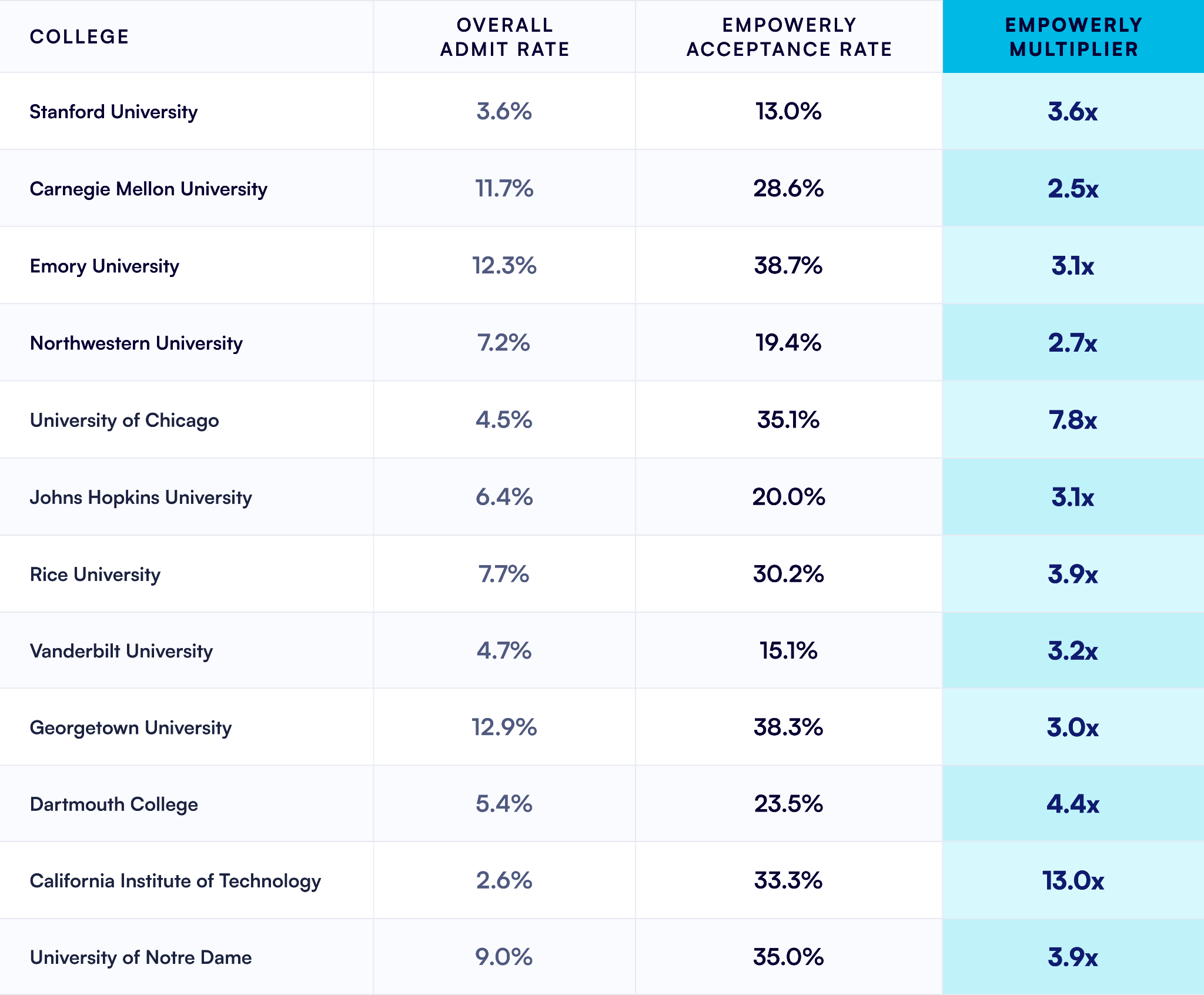
At the top 25 most selective colleges in the US, the national admit rate held close to where it’s been for years, under 10% for nearly every school on the list. But our students hit a much higher admit rate. Averaged across every application our students submitted to those same 25 schools, 24.4% were admitted, compared to a national average of 8%.
Our strongest suit: the University of California
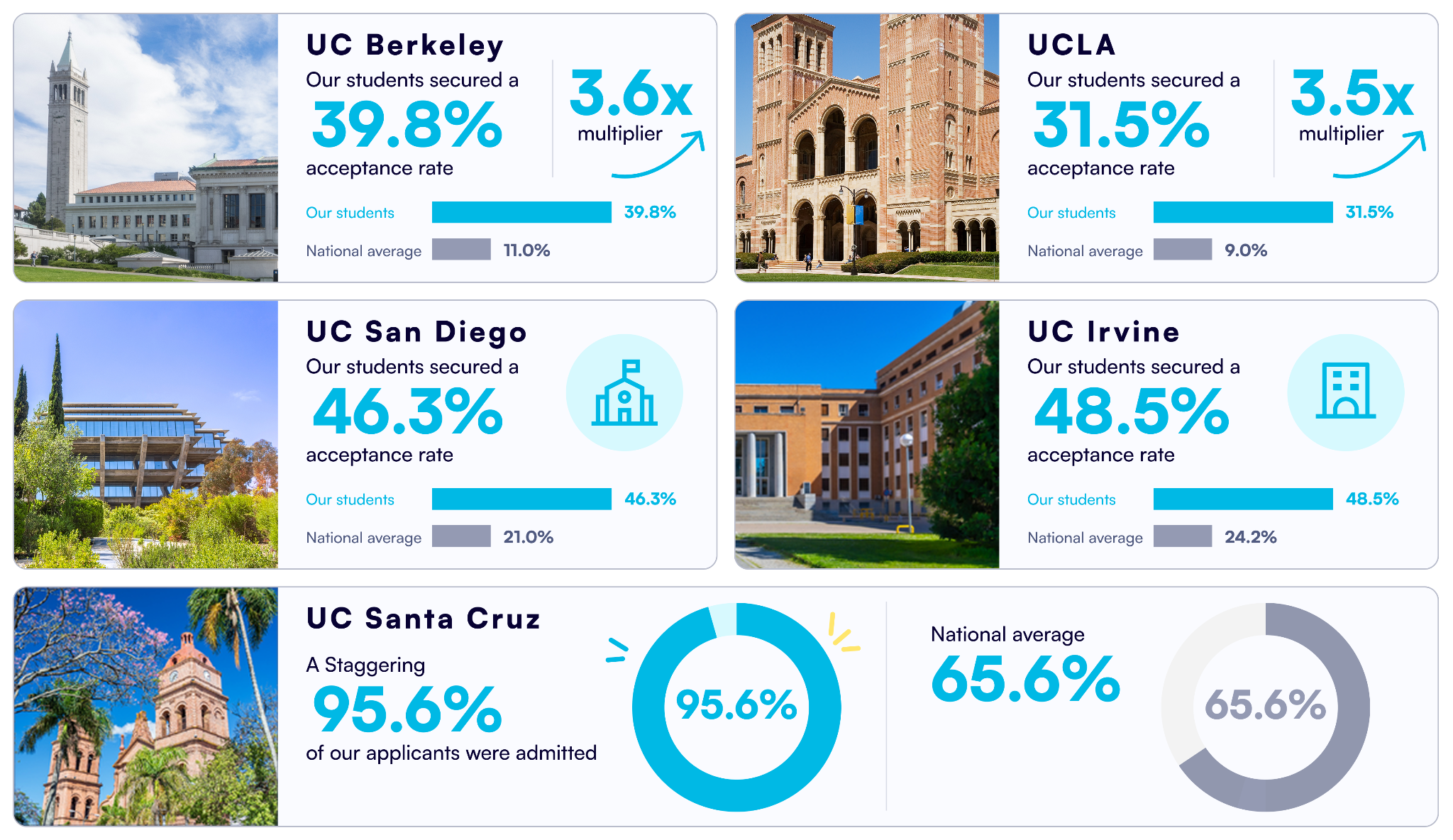
The University of California system remains one of the most impacted public university networks in the world with nine undergraduate campuses, each with its own admit rate, its own read of “fit,” and many with an increasingly narrow margin for error. It’s also where the largest share of our students apply, making it the system we know best.
Here is where our counselors made the difference, several of whom are former UC application readers and admissions officers themselves, bringing insight into how UC applications are read. With that guidance, our students navigated these campuses with a substantial advantage.
Timing matters
In college admissions, it’s not just what you’ve achieved that is important, but also when you apply. It’s no secret that applying and committing early tends to open more doors than in the regular round. Colleges use early decision to manage yield, filling a share of the incoming class with students who are committed, which means the applicant pool a school is choosing from in that round is smaller, and every seat carries less risk of rejection.
For Empowerly students, applying early decision doubled our students’ admit rate at 81% compared to our overall admission rate of 41% at these same colleges.
The financial payoffs
Admission is one half of the equation; affordability is the other, and this year’s merit scholarships held their own. Standout offers included: Vanderbilt’s full-tuition Chancellor’s Scholarship ($68,000/year), Barbara Jordan Scholarship at Rice ($60,000/year and only awarded to 15 students), UVirginia Jefferson Scholarship ($50,000/year) and Johns Hopkins’ Hodson Trust Scholarship ($42,500/year awarded to only 20 students).
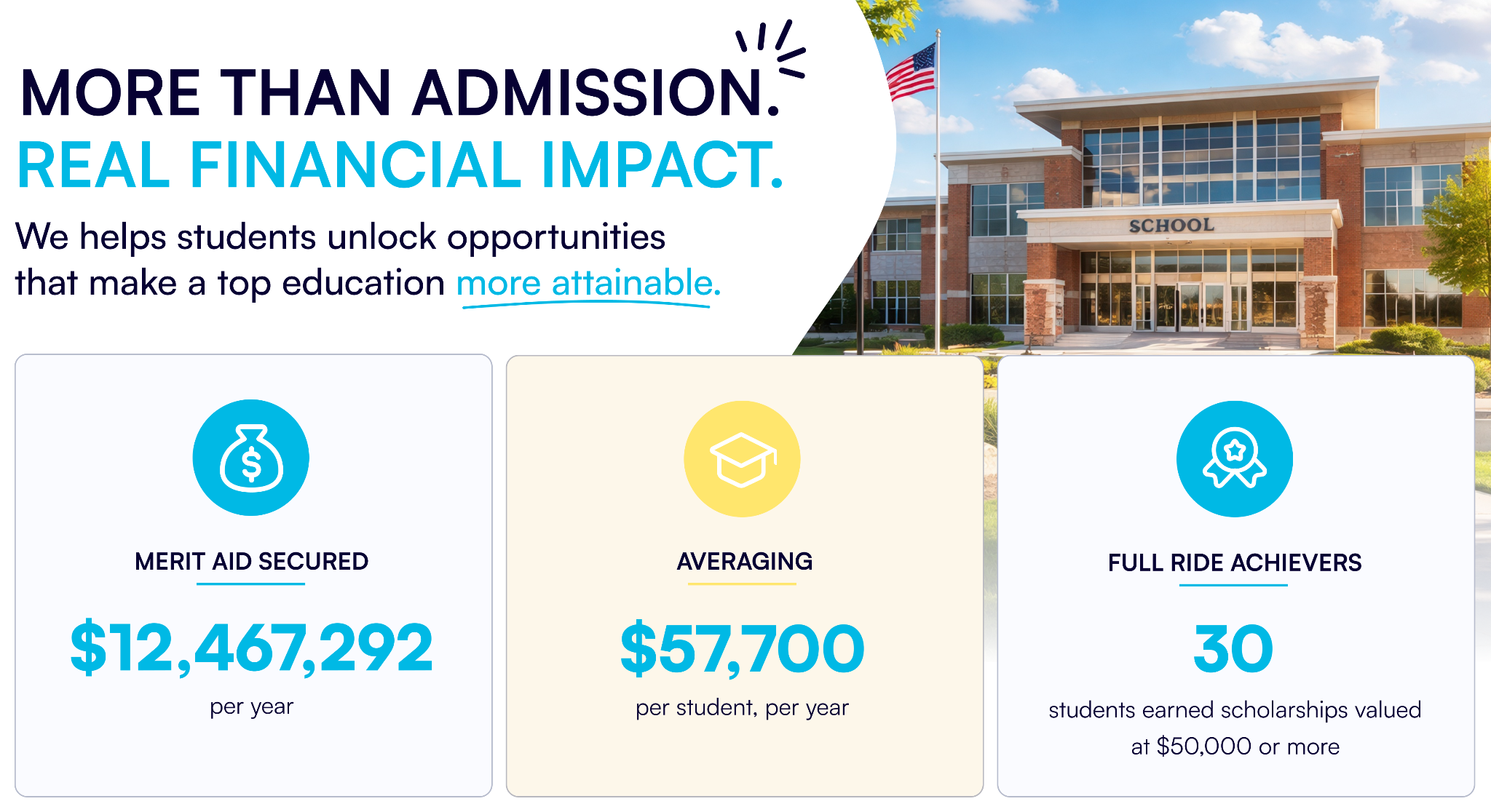
Add the merit aid, and our students brought in $12,467,292 per year. That averages to $57,700 per student, per year, with 30 students securing a full ride or scholarships valued at $50,000 or more.
This is the product of our team of counselors who treat scholarship applications with the same rigor as the admissions essays, coaching students through separate personal statements, interview prep, and portfolio requirements that many of these awards demand on top of the standard application.
BS/MD programs: defying national averages
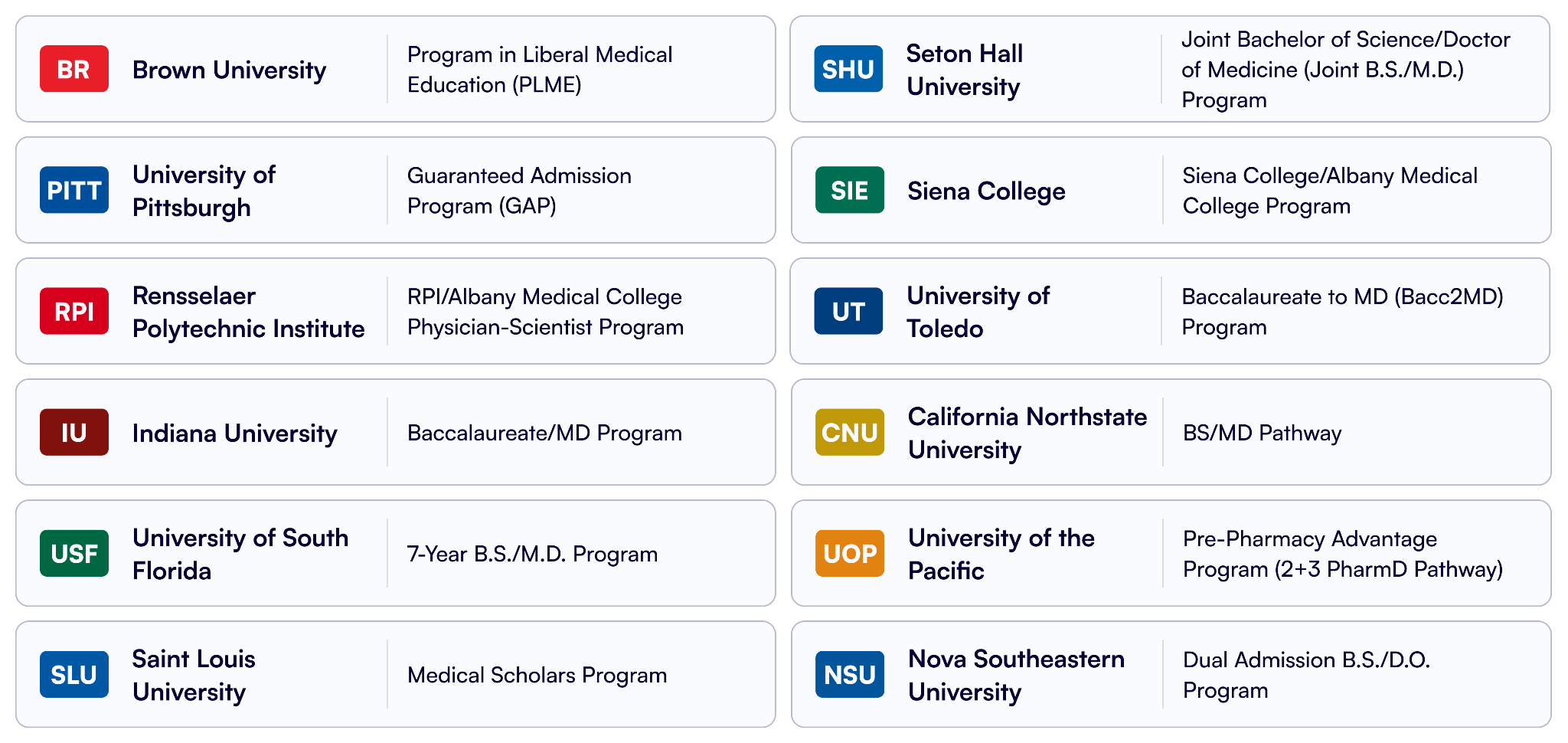
Accelerated medical programs are, by most measures, the least forgiving in college admissions. National acceptance rates typically sit between 1% and 5%, and a guaranteed path into medical school straight out of high school is rare enough that most counselors will only encourage their strongest students with the grades and a rigorous STEM profile to apply. That’s exactly why our BS/MD counseling is built as its own track: students get matched with a counselor who specializes in these programs, working with students to build their academic and clinical profile through research, shadowing, or clinical volunteering and identifying colleges that best fit their goals.
This year, we saw 70% of our students who applied get in, with several students receiving more than one offer.
These numbers aren’t luck. They’re the result of hard work put in by students under the guidance of counselors who know these schools from the inside and who build a strategy around their students’ actual fit rather than a generic playbook.
If you’re navigating college admissions, Empowerly can help you build an application strategy backed by the same insight that got our students these results.

