Uncategorized
The real danger of AI in education isn’t cheating

Roberto Serrano was feeling charitable. That was his first mistake.
When the Brown University economics professor moved his midterm to a take-home format this spring, it felt like the decent thing to do. His students were understandably rattled: a gunman had killed two of their classmates and wounded nine others in a December shooting on campus. Many were uneasy about sitting in a classroom again.
So for the first time in nearly two decades of teaching Welfare Economics and Social Choice Theory — a rigorous, proof-heavy course he’s led for most of his 34 years at Brown — Serrano let them take it home.
The class usually drew about 30 students. This spring, it enrolled 86, a jump Serrano now suspects had something to do with the promise of an unsupervised exam.
The trouble started with exam results. Several students had answered one question in an odd way, when a far simpler one was available. When a teaching assistant ran the problem through ChatGPT, the bot produced the same needlessly ornate response. Rather than void the midterm on the spot, Serrano gave a class a way to clear itself: he’d move the final into the classroom, and if the scores held, the midterm would stand.
Unsurprisingly, they didn’t hold. The take-home midterm averaged 96 percent, in a course whose historical average ran between 65 and 80. The in-person final came in at 48.6. More than a dozen students dropped the course. Many didn’t even show up for the exam. Of the students who skipped finals, most had earned a perfect score.
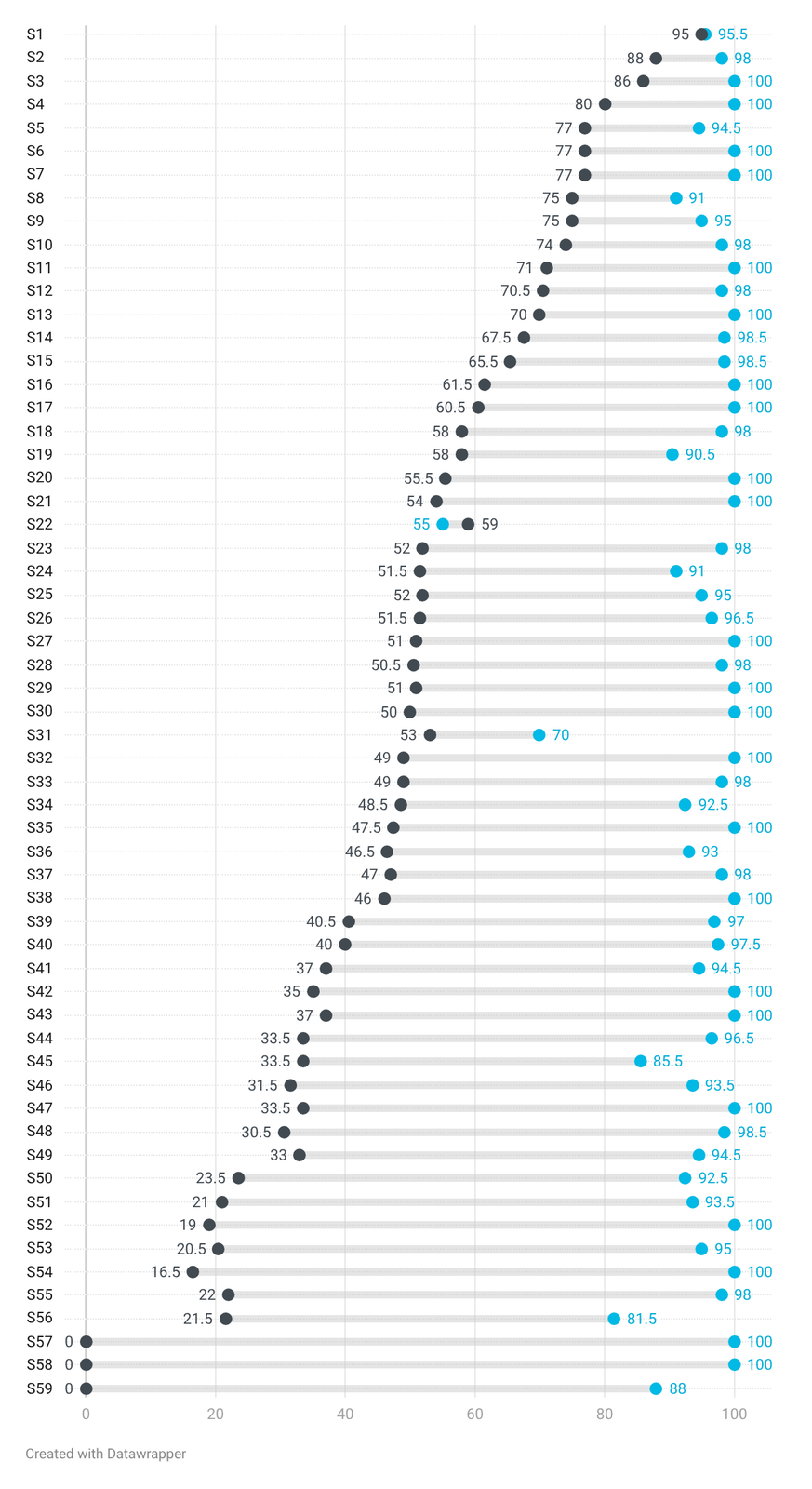
Serrano submitted the data above to Brown’s Standing Committee on the Academic Code. According to Brown’s published academic code: “Students who submit academic work that uses others’ ideas, words, research, or images without proper attribution and documentation are in violation of the academic code. Infringement of the academic code entails penalties ranging from reprimand to suspension, dismissal, or expulsion from the University.”
That was Serrano’s second error: assuming the university would stand by its words. His reported findings were met, at first, with silence. After he went public, the committee asked him to file a separate formal complaint against each suspected student, exam attached.
Which raises the question no one can answer: how do you prove a student used AI? Detectors throw off too many false positives to rely on. Catching it becomes a game of whack-a-mole, and plenty of teachers have simply quit trying.
Then there’s the word itself — cheating — that’s getting harder to pin down.
Is it even cheating?
College Board surveyed students, parents, and teachers: 84% of high schoolers said they used generative AI for schoolwork. Sixty-nine percent named ChatGPT as their bot of choice, with half saying they used it for tasks like brainstorming or revising essays. That doesn’t exactly scream misconduct.
A student asking ChattyG (as it's affectionately known) to sharpen a weak thesis is doing what us old timers tasked a smart roommate with decades ago. A student who pastes three paragraphs and inquires where the argument falls apart is looking for feedback — not cheating.
The trouble is the line between “fix this” and “do it for me.” It’s a definition that keeps sliding under everyone’s feet. Here’s the three-part test:
- Is it something in your own words?
- Are your ideas yours if you formed them by brainstorming with an AI the same way you might with a classmate?
- Where do citations come from when your source is a model that reads the entire internet and comes back with “original” ideas?
Parents might not be much help holding the line. Nearly six in ten parents of high schoolers said students should use AI rather than avoid it. Schools haven’t even settled the matter. Two in five districts ban it, about one in five permit it with zero guardrails. When the adults can’t agree on what counts as cheating, students fill in the gap — and they usually point themselves in the direction of whatever raises their GPA.
But we may be asking the wrong question (and here’s an example of the parallelism AI loves): it’s not whether students are technically cheating, but what happens when machines do the thinking.
Don’t turn off your brain
The most interesting thing Serrano noticed actually wasn’t the grades. It was how they were answered. Handed a question with a direct solution, AI-assisted students kept turning to something more baroque: technically correct, but completely overbuilt. They’d accepted a worse answer without noticing it was worse.
That’s the real stakes, and it's easy to lose behind a cheating scandal. A student who never answers a hard problem never builds the instinct to say: this is too complicated, there’s a cleaner path. The bot hands over a finished product, and the student loses both the ability to arrive at the correct answer and, more importantly, the judgment to tell a good one from a clumsy one.
This is where generative AI bids adieu to the tools that came before it. When Google took over the job of remembering stuff — the capital of Delaware, Mickey Mantle’s batting average, the year the Magna Carta was signed — we still had to decide what was worth looking up. We had to weigh sources and catch arguments that didn’t make sense.
Generative AI moves in a more dangerous direction, especially when we consider young people. It doesn’t fetch the pieces for you to build the thing — it builds the thing itself. Ask it for a thesis, and it gives you a thesis. Ask it for a proof, and it hands you proof. But how do students learn to discern a clumsy answer from a thoughtful one?
Academic honesty might be at stake, but it’s hardly the most important thing we sacrifice when it comes to AI. Think about the honest student: the one who worked out every hard problem and got it wrong a few times. Give it ten years, and they’re the only person in the room who can tell you when the machine is making stuff up.
We think that’s worth protecting at the cost of a few points of GPA. Use the tool. It’s helpful, and pretending otherwise is silly. But keep the part of your brain that can look at a bot’s outputs and say that’s not right. Or, even, that’s not good enough. It’s the skill we used to call critical thinking.
Serrano puts the stakes more bluntly: AI is leading us “to a declining society, a failed society.” We’d rather not find out if he’s right.