Applications
AP Classes Ranked by Difficulty (2026 Edition)

If you want a smarter schedule, start with the data. The College Board's 2025 AP score distributions show which exams students pass most often.
It's helpful to have the list of AP classes ranked by difficulty and see which one suits you best. It also helps you protect your GPA while staying rigorous.
Now, here's something most students don't realize about 2026: with a growing list of selective colleges reinstating standardized test requirements (MIT, Harvard, Yale, Caltech, Brown, Dartmouth, Stanford, and more), AP scores have taken on new weight as a signal of academic readiness. Picture this: when your transcript and AP scores both point the same direction, your application tells a much stronger story. The takeaway? Choosing the right AP classes isn't just about protecting your GPA — it's about building an academic profile that holds up under increasing scrutiny.
In this article, you'll see a clear list of AP classes. You'll also learn how to choose between tougher APs and more manageable options based on your goals and workload.
What Are AP Classes?

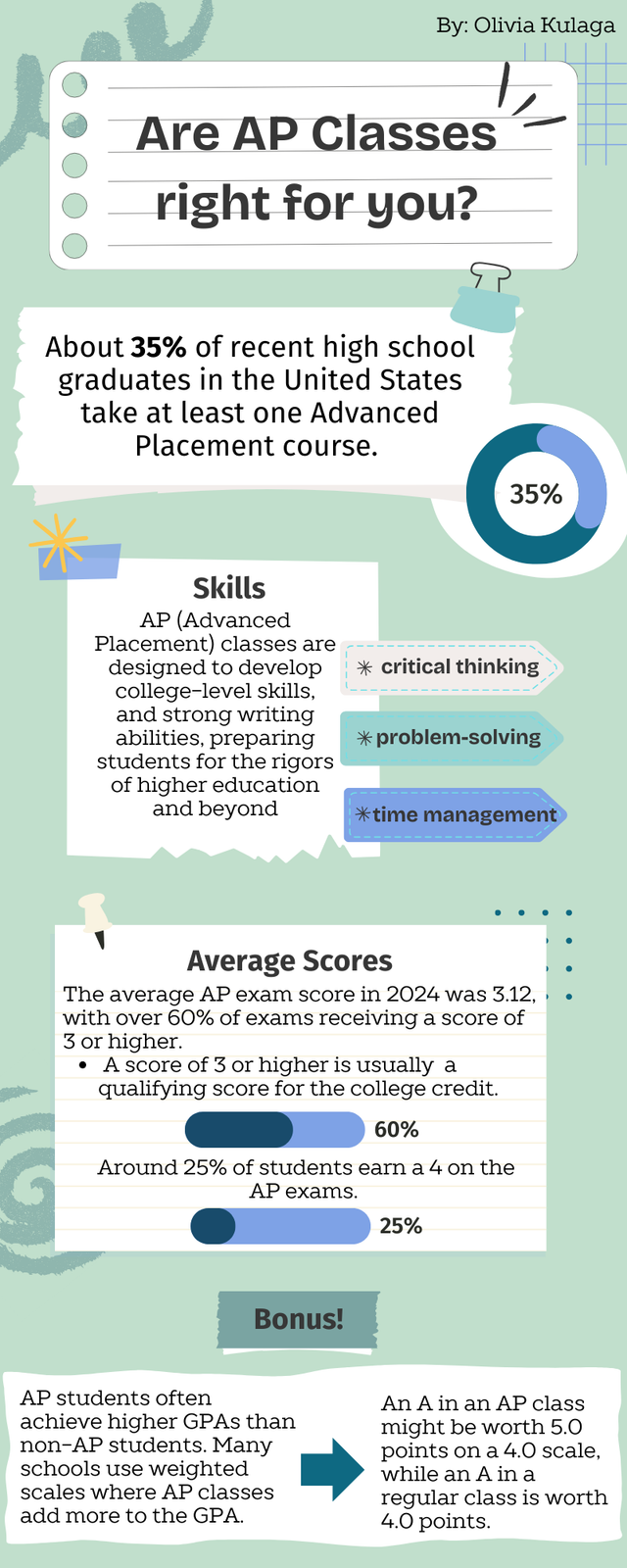
Advanced Placement classes are college-level courses you take in high school. They move faster than standard courses. They also expect more independent reading, writing, and problem-solving.
Most AP classes end with a standardized AP exam. Scores range from one to five. Many colleges consider three or higher for credit or placement. Always confirm each college's policy before you plan your AP path.
AP participation is also massive. In May 2025, students took 6,182,171 AP exams nationwide. That was 3,243,979 students across 23,664 schools.
How Are AP Classes Ranked?
AP difficulty feels different for everyone. Your teacher, your background, and your interests all matter. Still, one national signal helps. It's the share of students who score 3+ on each exam.
In the table below, you'll see the AP classes ranked by difficulty. We rank exams from easiest to hardest using the % scoring 3+ in May 2025.
Higher 3+ rates usually mean a more passable exam nationwide. We also show a % scoring a 5, since some exams have high pass rates but tougher top-end scoring.
One important note. World language results include many strong speakers. That can lift pass rates. Use those classes as "easier" only if you already have a solid foundation.
40 AP Classes Ranked by Difficulty
These AP classes ranked by difficulty run from Rank 1 (highest 3+ rate) to Rank 40 (lowest 3+ rate), using the College Board's 2025 score distributions.
| AP Class | % Scoring 3+ (2025) | % Scoring 5 (2025) | |
|---|---|---|---|
| 1 | AP Chinese Language and Culture | 89.2% | 54.9% |
| 2 | AP Research | 88.5% | 14.8% |
| 3 | AP Spanish Language and Culture | 85.0% | 21.9% |
| 4 | AP Drawing | 84.2% | 17.1% |
| 5 | AP Seminar | 83.4% | 9.4% |
| 6 | AP 2D Art and Design | 83.0% | 11.9% |
| 7 | AP Precalculus | 80.8% | 28.1% |
| 8 | AP African American Studies | 79.2% | 17.3% |
| 9 | AP Calculus BC | 78.6% | 44.0% |
| 10 | AP Chemistry | 77.9% | 17.9% |
| 11 | AP Italian Language and Culture | 75.2% | 24.6% |
| 12 | AP Japanese Language and Culture | 74.7% | 43.3% |
| 13 | AP English Language and Composition | 74.3% | 13.4% |
| 14 | AP English Literature and Composition | 74.2% | 16.2% |
| 15 | AP United States History | 73.7% | 14.2% |
| 16 | AP French Language and Culture | 73.5% | 14.0% |
| 17 | AP Physics C: Mechanics | 73.2% | 21.7% |
| 18 | AP Physics C: Electricity and Magnetism | 72.9% | 25.2% |
| 19 | AP European History | 72.6% | 14.0% |
| 20 | AP Physics 2 | 72.6% | 21.8% |
| 21 | AP Comparative Government and Politics | 71.8% | 16.3% |
| 22 | AP United States Government and Politics | 71.7% | 23.7% |
| 23 | AP 3D Art and Design | 71.6% | 6.7% |
| 24 | AP German Language and Culture | 71.5% | 21.3% |
| 25 | AP Psychology | 70.5% | 14.4% |
| 26 | AP Biology | 70.4% | 18.9% |
| 27 | AP Spanish Literature and Culture | 70.3% | 9.1% |
| 28 | AP Environmental Science | 69.2% | 12.6% |
| 29 | AP Microeconomics | 68.2% | 21.6% |
| 30 | AP Computer Science A | 67.2% | 25.6% |
| 31 | AP Macroeconomics | 67.3% | 20.4% |
| 32 | AP Physics 1 | 67.3% | 19.8% |
| 33 | AP Art History | 65.6% | 16.0% |
| 34 | AP Human Geography | 64.7% | 17.0% |
| 35 | AP World History | 64.3% | 13.9% |
| 36 | AP Calculus AB | 64.2% | 20.3% |
| 37 | AP Computer Science Principles | 61.9% | 10.7% |
| 38 | AP Music Theory | 60.5% | 18.8% |
| 39 | AP Statistics | 60.3% | 17.0% |
| 40 | AP Latin | 58.6% | 12.5% |
Top 7 Easiest AP Classes
The easiest AP classes below come from the 2025 AP score distributions, ranked by % scoring 3+.
That metric does not mean the class feels easy every week. It means students nationwide earn passing scores more often.
Use this AP classes ranked by difficulty list to build a schedule that stays rigorous without risking your GPA.
1. AP Chinese Language and Culture
AP Chinese is a communication course, not a vocabulary quiz. You'll work across listening, reading, writing, and speaking, often at a fast pace. The exam is built around those same skills, including spoken responses and written tasks.
If you already think in Mandarin, the class can feel straightforward. If you still translate sentence-by-sentence, it gets hard quickly.
In 2025, 89.2% scored 3+, and 54.9% scored a 5, which is unusually high for any AP.
- Best fit for you: You speak Mandarin comfortably and understand native-speed audio.
- Watch out for: High pass rates often reflect heritage or fluent speakers.
- Next step: Take a timed listening set now, not later.
2. AP Research
AP Research is a year-long project course with one big goal. You design a question, run a study, and write a formal academic paper. You also give a presentation and defend your work out loud.
The College Board assessment includes an academic paper of 4,000–5,000 words and a 15–20 minute presentation and oral defense. That format rewards students who can plan long timelines and revise calmly.
In 2025, 88.5% scored 3+, but the class can still feel intense if you fall behind.
- Best fit for you: You like independent projects and can manage deadlines weekly.
- Watch out for: Procrastination turns into rushed analysis and weak evidence.
- Next step: Build a month-by-month calendar before you choose a topic.
3. AP Spanish Language and Culture
AP Spanish is about real communication under time pressure. You'll interpret print and audio, write formal responses, and record spoken answers.
On the exam, you complete multiple-choice and written free-response work, then record your spoken free response on a device at school. This course often feels "easy" only when you already use Spanish comfortably in conversation and writing.
In 2025, 85.0% scored 3+, which is very high across the AP program. Use that as a signal, not a guarantee.
- Best fit for you: You can speak smoothly and write without constant grammar panic.
- Watch out for: Good class grades do not always match exam speaking speed.
- Next step: Record one speaking prompt weekly and track your hesitation points.
4. AP Drawing
AP Drawing is portfolio-based, not a sit-down written exam. You create work throughout the year and submit it digitally.
The College Board portfolio has two sections: Sustained Investigation and Selected Works.
Sustained Investigation includes 15 digital images and accounts for 60% of the portfolio score.
Selected Works includes five works and counts for 40%. That structure rewards consistency and revision, not last-minute bursts.
In 2025, 84.2% scored 3+, which is strong for any AP assessment.
- Best fit for you: You already draw often and enjoy improving through feedback.
- Watch out for: Weak planning leads to rushed work and thin investigation themes.
- Next step: Set a weekly production goal and track finished pieces by month.
5. AP Seminar
AP Seminar is the first course in AP Capstone. It trains you to read sources critically, build arguments, and communicate clearly. Your score is not based on a single test. It includes performance tasks throughout the year and an end-of-course exam.
The end-of-course exam is fully digital in Bluebook, and your work is submitted at the end of the exam session.
That setup favors students who can research, cite, and explain reasoning instead of memorizing facts.
In 2025, 83.4% scored 3+.
- Best fit for you: You like discussion, writing, and using sources to prove a point.
- Watch out for: Vague claims and weak citations get punished fast by rubrics.
- Next step: Practice turning each claim into evidence plus explanation every week.
6. AP 2D Art and Design
AP 2D Art and Design is also portfolio-driven and process-focused. You build a body of work that shows experimentation, revision, and intentional choices.
Like AP Drawing, the portfolio has two sections: Sustained Investigation and Selected Works.
Sustained Investigation requires 15 digital images and counts for 60% of your score.
Selected Works includes five works and counts for 40%. This format can feel manageable because you control your workflow, but only if you plan it.
In 2025, 83.0% scored 3+.
- Best fit for you: You like visual storytelling and can revise work repeatedly.
- Watch out for: A scattered theme makes your portfolio look unfocused.
- Next step: Choose a clear inquiry question early and build work around it.
7. AP Precalculus
AP Precalculus builds strong function thinking for calculus and STEM courses. You'll spend time on polynomial, rational, exponential, logarithmic, and trigonometric functions, plus modeling.
The exam is a hybrid digital test. You complete multiple-choice and view free-response questions in Bluebook, then handwrite free-response answers in paper booklets that get scored. That format rewards students who can show reasoning clearly, not just pick an answer.
In 2025, 80.8% scored 3+, which is high for a math AP.
- Best fit for you: You're solid in algebra and want a cleaner path to calculus.
- Watch out for: Weak algebra foundations will slow every unit down.
- Next step: Fix gaps in functions and transformations before the first test.
If you pick from this list, you still want a reality check. These AP classes can still be time-heavy, especially for portfolios and long projects.
Top 10 Hardest AP Classes
These courses sit near the bottom of the 2025 AP score distributions by % scoring 3+. That usually signals tougher exams nationwide.
Some are hard because they demand precision. Others are hard because the exam rewards writing, reasoning, and time control more than memorization.
Use this section to decide fit, then choose a survival plan before the first unit test.
1. AP Latin
AP Latin combines translation, grammar, and literary analysis. You read required authors, then interpret how language choices shape meaning.
The exam is fully digital in Bluebook, and it includes both multiple-choice and free-response questions. The pressure point is accuracy at speed, especially when you hit unfamiliar constructions.
In 2025, 58.6% scored 3+, which is the lowest pass rate in our ranking table.
- Why it's hard: One missed grammar cue can derail an entire translation.
- Who it fits: You enjoy grammar systems and careful close reading.
- How to survive: Translate daily in short sets. Keep an error log by rule.
2. AP Statistics
AP Statistics is writing plus math. You choose a method, justify it, and then interpret results in clear sentences.
Many students understand the concept but lose points for weak communication, missing conditions, or sloppy inference language.
The exam is a hybrid digital exam. You do multiple-choice in Bluebook, then handwrite free-response answers in a booklet.
In 2025, 60.3% scored 3+.
- Why it's hard: Vague explanations cost points, even with correct calculations.
- Who it fits: You like patterns and can explain decisions precisely.
- How to survive: Build a personal "FRQ sentence bank." Practice inference wording weekly.
3. AP Music Theory
AP Music Theory blends written theory with aural skills. You need to identify intervals, chords, and melodies by ear, then notate them correctly.
That skill builds slowly, so last-minute studying rarely works. The exam format rewards steady training and consistent practice habits.
In 2025, 60.5% scored 3+.
- Why it's hard: Ear training improves through repetition, not cramming.
- Who it fits: You already read music and practice most days.
- How to survive: Do daily listening drills. Treat it like instrument practice.
4. AP Computer Science Principles
AP CSP is not "easy coding." It tests how you think and how you explain. Your AP score includes the Create performance task plus an end-of-course exam.
The end-of-course exam is fully digital in Bluebook and includes multiple-choice plus written-response questions tied to your Create task understanding. Many students lose points because their written explanations do not match the rubric.
In 2025, 61.9% scored 3+.
- Why it's hard: Points come from clear evidence, correct terms, and rubric alignment.
- Who it fits: You like structured problem-solving and explaining steps clearly.
- How to survive: Write explanations like a grader. Save screenshots and notes while building.
5. AP Calculus AB
AP Calculus AB moves fast and builds continuously. If your algebra is shaky, calculus becomes a constant struggle, since every derivative and integral still depends on simplification and function behavior.
The exam also rewards fluency under time limits, not "I get it when I see it." Use the course to build repetition early, not late.
In 2025, 64.2% scored 3+.
- Why it's hard: One weak prerequisite skill can slow every unit.
- Who it fits: You're strong in algebra and practice math consistently.
- How to survive: Do a mixed review daily. Fix algebra gaps before they multiply.
6. AP World History: Modern
AP World is an argument course disguised as a content course. You do need historical knowledge, but you also need to write under pressure using the rubric.
The exam format includes multiple-choice plus several writing tasks, including document-based writing and long-form argumentation. Students struggle when they know facts but cannot deploy evidence quickly in a timed essay.
In 2025, 64.3% scored 3+.
- Why it's hard: The rubric rewards reasoning and evidence selection, not summaries.
- Who it fits: You like writing, debate, and connecting patterns across regions.
- How to survive: Drill thesis and contextualization. Time your DBQ practice every month.
7. AP Human Geography
AP Human Geography feels approachable at first, then gets dense. You learn many models and terms, then apply them to maps, migration patterns, urban change, agriculture, and cultural landscapes.
The exam expects you to interpret data and apply concepts to unfamiliar scenarios. Students often lose points because they memorize definitions without practicing application.
In 2025, 64.7% scored 3+.
- Why it's hard: You must apply vocabulary to real scenarios, not just define it.
- Who it fits: You enjoy social science patterns and real-world examples.
- How to survive: Build an "example bank." Pair every term with one real case.
8. AP Art History
AP Art History is heavy on both recall and analysis. You learn works from multiple cultures and time periods, then explain how form, function, content, and context connect.
The exam requires you to identify works and write clearly under time pressure, often comparing and supporting claims with visual evidence. The workload surprises students who expected a lighter humanities elective.
In 2025, 65.6% scored 3+.
- Why it's hard: You need fast recall plus strong writing with specific visual evidence.
- Who it fits: You like humanities writing and can study consistently.
- How to survive: Do daily image recall. Practice two-minute comparisons with a timer.
9. AP Macroeconomics
AP Macroeconomics is systems thinking. You move between graphs, cause-and-effect, and policy tradeoffs across inflation, unemployment, growth, and interest rates.
Many students can draw the graph, but cannot narrate the logic cleanly. The exam punishes sign errors, wrong shifts, and missing labels.
In 2025, 67.3% scored 3+.
- Why it's hard: Small graph mistakes can wipe out multiple points quickly.
- Who it fits: You like models and can explain steps out loud.
- How to survive: Narrate every shift verbally. Drill common policy scenarios weekly.
10. AP Physics 1: Algebra-Based
AP Physics 1 is concept-heavy and reasoning-heavy. You're expected to connect forces, motion, energy, momentum, waves, and circuits using evidence and models, not memorized formulas.
The exam rewards explanation, experimental thinking, and multi-step logic, which can feel unfamiliar if you're used to plug-and-chug math classes. Treat labs and reasoning practice as core study, not extras.
In 2025, 67.3% scored 3+.
- Why it's hard: The exam rewards reasoning and explanation over formulas.
- Who it fits: You like problem-solving and can handle multi-step logic calmly.
- How to survive: Keep a mistake log. Redo missed problems until you can teach them.
How AP Scores Translate to College Credit
Want to know one of the most overlooked aspects of AP planning? The score you earn can literally save you thousands of dollars in college tuition — but only if you understand how credit works. Here's the deal.
Picture this: two students take the same five AP exams and earn identical scores. One researches credit policies in advance and enters college with a full semester of credit already banked. The other never checks, and discovers too late that their dream school only accepts 4s and 5s. The difference? Thousands of dollars and an entire semester of time.
For starters, here's how AP credit generally works in 2026:
- Score thresholds vary by college. Some schools grant credit for a 3, many require a 4, and the most selective schools often require a 5 — or grant no credit at all, offering only placement.
- Credit vs. placement are different. "Credit" means the AP score counts toward your degree (fewer classes to take). "Placement" means you can skip the intro course but still must take the same number of credits. Always confirm which one a school offers.
- Credit caps exist. Many universities cap the total number of AP credits they'll accept (often around 30-45 credits, or roughly one year). Earning 12 AP scores doesn't mean 12 courses' worth of credit everywhere.
- Some elite schools grant little or no credit. Several highly selective universities (and certain programs within them) award minimal AP credit, viewing their own intro courses as essential. Even then, high AP scores can fulfill prerequisites or enable advanced placement.
- STEM and language credits are often most valuable. High scores in Calculus BC, the sciences, and world languages frequently unlock the most credit and placement, since these map cleanly onto college sequences.
- In-state public universities are often generous. Many state flagship systems publish clear, generous AP credit charts — sometimes granting a full year of credit for strong scores, which can enable early graduation.
The takeaway? Before you commit to an AP-heavy schedule for the credit, use the College Board's AP Credit Policy Search to check each target college. If your top schools don't grant credit for a given exam, take it for rigor and skill-building — just don't build your graduation timeline around credit you might not receive.
AP Exam Fees and Financial Considerations
Now, here's something most families don't budget for until the bill arrives. AP exams cost money, and a heavy AP load adds up fast. Want to know what to expect in 2026?
Here's the deal on AP exam costs:
- Standard exam fee: Each AP exam costs roughly $99 in the U.S. and Canada (slightly higher at some international locations). If you take five exams, that's nearly $500 in a single spring.
- Late fees apply. Registering after the fall deadline (typically November) can add a late fee per exam. Order your exams on time to avoid this.
- Cancellation/unused exam fees. If you register for an exam and then don't take it without a valid reason, the College Board may charge a fee. Plan your exam list carefully.
- Fee reductions are available. The College Board offers a fee reduction (typically around $36 off per exam) for students with demonstrated financial need. Many states and school districts stack additional subsidies on top, sometimes covering exams entirely.
- Ask your counselor about school/state subsidies. Some states fund AP exams for low-income students or for specific subjects (especially STEM). Your counselor can tell you what's available in your district.
The bottom line? AP exams are an investment. Weigh the cost against the potential credit savings: a single $99 exam that earns you 3 college credits can save you hundreds or even thousands in future tuition. But taking exams you're unlikely to pass — or that your target colleges won't accept — wastes money. Be strategic, not maximal.
AP Classes vs Regular High School Classes
AP classes ranked by difficulty matter most when you compare them to your baseline.
A hard AP can still be the right choice if the regular class feels too easy. A medium AP can also become a GPA risk if the workload suddenly doubles.
This comparison helps you pick with your eyes open.
| AP Class | Regular High School Class | |
|---|---|---|
| Level | College-level scope and pacing. | High school-level scope and pacing. |
| Main goal | Show rigor and earn credit or placement. | Build core skills and meet graduation requirements. |
| End-of-year exam | Optional for the class, but required for credit. Scores run 1–5. | Usually, teacher-made finals, not national exams. |
| Credit outcome | Many colleges give credit or placement for 3+. Policies vary by school. | Rarely gives college credit. |
| Workload | More reading, more writing, more practice problems. | Usually lighter and slower-paced. |
| Grading impact | Often weighted, but policies differ by high school. | Often unweighted, but policies differ by high school. |
A useful rule is to treat AP classes like a preview of college-level work, plus real schedule pressure. Build your plan around protecting your grades first. Then add academic stretch in the subjects that truly fit you.
Tips for Succeeding in AP Courses
Strong AP outcomes come from routine, not willpower. You want a system that survives busy weeks.
These strategies work across nearly every AP class, from writing-heavy courses to calculus-based sciences.
1. Build a weekly workload map in September
Don't wait for the first crisis. Review each AP syllabus early. Estimate your weekly time for reading, problem sets, and projects. Then block that time on your calendar, like practice or a job. This keeps you from assuming you can catch up later.
2. Study like the exam is a skill, not a test
AP exams reward patterns. You need repeated practice with the same question types. Start exam-format work early, even if it feels premature. Use timed sets, then review mistakes the same day.
3. Use an error log in every STEM AP class
For math and science, your mistakes repeat. Track each error with three lines: what you did, why it happened, and how you'll prevent it. If you do this weekly, your score climbs faster than with random extra problems.
4. Write templates for writing-heavy APs
For courses like AP Lang, AP Lit, and the history APs, structure wins points. Build paragraph templates for thesis, evidence, and commentary. Practice under time limits until your structure becomes automatic. That frees your brain for better ideas.
5. Get help at the first warning sign
Don't wait until March. If you bomb two quizzes in the same unit, act. Ask your teacher for targeted practice. Join a study group with a clear plan. If you need tutoring, start before gaps compound.
6. Choose your resources on purpose
More resources can create more chaos. Pick one main review source and one practice test source. Then commit. Consistency beats variety, especially when you're juggling multiple classes.
Choosing the Right AP Courses
AP classes ranked by difficulty are only step one. Your real goal is a schedule that is rigorous, stable, and aligned with your college plan.
Here are a few steps you can follow:
Step 1: Start with your academic anchor subjects
Pick the subjects where you already perform well. Those are your best candidates for an AP that won't crush your GPA. If you love a subject and you earn strong grades in it, you usually handle the AP version better.
Step 2: Check AP credit and placement rules early
Credit policies vary a lot by college. Some schools give credit for a three. Some want a four or five. Some give placement but no credit. Use the College Board's AP Credit Policy Search for each college on your list.
If your top schools do not award credit for an exam, you still might take it for rigor. You just won't plan your college timeline around that credit.
Step 3: Balance one stretch AP with one stabilizer AP
Most students do best with a mix. Pair a tougher AP in your intended area with a more passable AP that protects your semester grades. That balance also reads well to admissions because it looks intentional, not reckless.
Step 4: Match AP rigor to your life outside class
Your schedule is not just academics. Sports seasons, jobs, family responsibilities, and application deadlines all matter.
If you know fall is overloaded, avoid stacking multiple writing-heavy APs at once. If spring is your busy season, don't add an AP with a huge project component.
Step 5: Build a simple one-week decision plan
Use this plan before course registration closes:
- List your likely AP options for next year.
- Circle two that match your strengths and interests.
- Identify the hardest unit in each course.
- Ask current students how grading works at your school.
- Confirm the AP credit rule at your top colleges.
- Lock a final schedule with one stretch and one stabilizer.
How Many AP Classes Should You Take?
Here's the kicker — there's no magic number of AP classes that guarantees admission. The right number depends entirely on your school, your goals, and your capacity. Want to know how to think about it strategically?
For starters, here's a realistic framework by goal:
- Aiming for highly selective schools (Ivies, MIT, Stanford, top 20): Admissions officers want to see you take the most rigorous schedule available at your school. If your school offers 20 APs, taking 8-12 across your high school career signals strong rigor. But context matters — they evaluate you against what your school offers, not a national standard.
- Aiming for selective schools (top 50): A solid load of 5-8 APs in your areas of strength, with strong grades and scores, positions you well.
- Aiming for state flagships and strong regional schools: 3-5 APs, especially in core subjects, demonstrates readiness without overloading.
- If your school offers few or no APs: Colleges evaluate you in context. You won't be penalized for limited AP availability — take the most rigorous courses offered (honors, dual enrollment, IB if available).
Now, here's the part most students miss: quality beats quantity every time. Three APs with strong grades and 4-5 exam scores beat seven APs with B-minuses and 2-3 exam scores. Colleges would rather see you excel in a focused, rigorous load than drown in an unsustainable one.
Want to know the warning signs you've taken on too much?
- Your grades are dropping across multiple classes
- You're sleeping fewer than 6-7 hours regularly to keep up
- You've dropped extracurriculars you care about just to manage homework
- You feel constant anxiety about falling behind
The takeaway? Build your AP schedule around sustainability and fit, not around hitting a number. A balanced, rigorous-but-manageable schedule that protects your GPA and wellbeing will serve your application far better than a maxed-out schedule that breaks you. When in doubt, choose depth and excellence over sheer volume.
Plan Your Next Move With Empowerly
Use the AP classes ranked by difficulty table to choose smart, not maximal. Pick APs that match your strengths. Balance one stretch course with one stabilizer. Then confirm credit rules at the colleges you care about before you commit.
If you want a sanity check, we can help you build a balanced reach, match, and safety plan around your academics. We can also pressure-test your AP load against GPA goals, major fit, and application deadlines.
Frequently Asked Questions
These are the questions students ask when AP classes ranked by difficulty start affecting real decisions. Here are clear answers you can use right away.
What are the most difficult AP classes?
Difficulty depends on your strengths, but some courses are consistently demanding because they combine fast pacing with high-stakes problem solving or timed writing. Physics, calculus-based sciences, and writing-heavy history courses often feel toughest for students without strong foundations. Use the 2025 score distributions to see which exams have lower 3+ rates.
Which AP class is the easiest?
"Easiest" usually means the exam has a higher 3+ rate nationwide. In 2025, the highest 3+ rates include language exams like AP Chinese Language and Culture, plus AP Research and AP Seminar. These still require real skill, especially if you are not already strong in the subject.
What is a 75% in AP?
There is no universal answer, since percent grades are set by your teacher or school. A 75% could be a C in one school and a different outcome in another. The better question is how the grade affects your transcript and whether your school weights AP courses.
Is AP Physics C the hardest AP class?
AP Physics C is widely seen as one of the hardest because it is calculus-based and concept-heavy. It is best for students who are strong in math and planning for STEM majors. If you have not taken calculus, it usually feels much harder than AP Physics 1 or 2.
Which is harder, AP Physics 2 or AP Physics C?
AP Physics 2 is algebra-based, but it covers advanced topics and still requires strong reasoning. AP Physics C adds calculus, which raises the difficulty and speed. If you are comfortable with calculus, Physics C can feel more straightforward than Physics 2. If you are not, Physics C is usually harder.
Do colleges prefer AP or IB?
Most colleges value both as rigorous programs. What matters more is your course availability and how you used it. If your school offers IB, colleges expect you to take IB courses. If your school offers AP, colleges expect you to take AP courses that match your goals.
How much will three AP classes raise my GPA?
It depends on your school's weighting policy and your grades in each course. In many systems, an A in an AP adds an extra quality point, but that is not universal. The safer planning approach is this: only add APs if you can keep your grades strong.
What are the main benefits of taking AP classes?
AP classes can show academic rigor, help you build college-level skills, and sometimes earn college credit or placement. The credit part depends on the college and the score you earn.
Can regular high school classes provide college credits?
In most high schools, regular classes do not provide college credit. Dual enrollment is the more common path for credit outside AP, but it depends on your district and local colleges.
Are AP classes harder than regular high school classes?
Usually, yes. AP courses are designed as college-level classes, which means faster pacing and deeper expectations. That said, the "hardness" you feel depends on your teacher, your school, and your background in the subject.
How do AP exams impact college admissions?
AP exams are rarely a single deciding factor, but strong scores can support the story your transcript tells. They can also help if you apply test-optional, since they show performance on a standardized academic exam. Most importantly, your AP course grades and overall rigor are central signals in holistic review.