Applications
Is it time to retire the college essay?

What is even happening here?
Students are feeding prompts into chatbots and pasting polished essays. Certain colleges are feeding those same essays into AI for grading. UNC has been scoring essays for writing mechanics by machine since 2019. Virginia Tech now puts an AI reader on every essay.
So, if you’re keeping score, we now have machines writing for machines. It’s enough to ask: is the college essay worth keeping? And some schools have decided it’s not — at least not as many.
In the last few weeks, Miami, Tulane, Washington U, and UNC all dropped their supplemental essays for this cycle. Cornell kept its program-specific prompts, but sunset its big university-wide essay. The reasons are honest enough. Kids are stressed. The supplements eat up weeks. AI has flattened many of them down to mush. And after the Supreme Court struck down race-conscious admissions, a lot of identity-flavored prompts hit the trash bin.
I hear all of it. I mean it. And I still think retiring the essay is the wrong call. Here’s why.

The essay is the one sport where the kid runs the show
Everything else in the application is somebody else’s interpretation of a student. Schools report academic transcripts. The scores belong to the testing company. The recommendations are what a teacher decided to say.
The essay is the only place where a student picks the story, chooses the words, and tells an admissions officer directly who they are and why they belong on campus. Take that away, and all that’s left is stuff you can put in a spreadsheet. When we judge a kid’s odds of thriving at a university using only quantitative metrics, we completely lose the qualitative aspect. And that factor helps many strong applicants.
Fitting a real person into a few hundred words is a real challenge. Think about how students build a whole story around one specific moment. That’s a genuine skill, and one you should want to evaluate as part of an admissions review.
The AI problem is real, but eliminating the essay doesn’t fix it
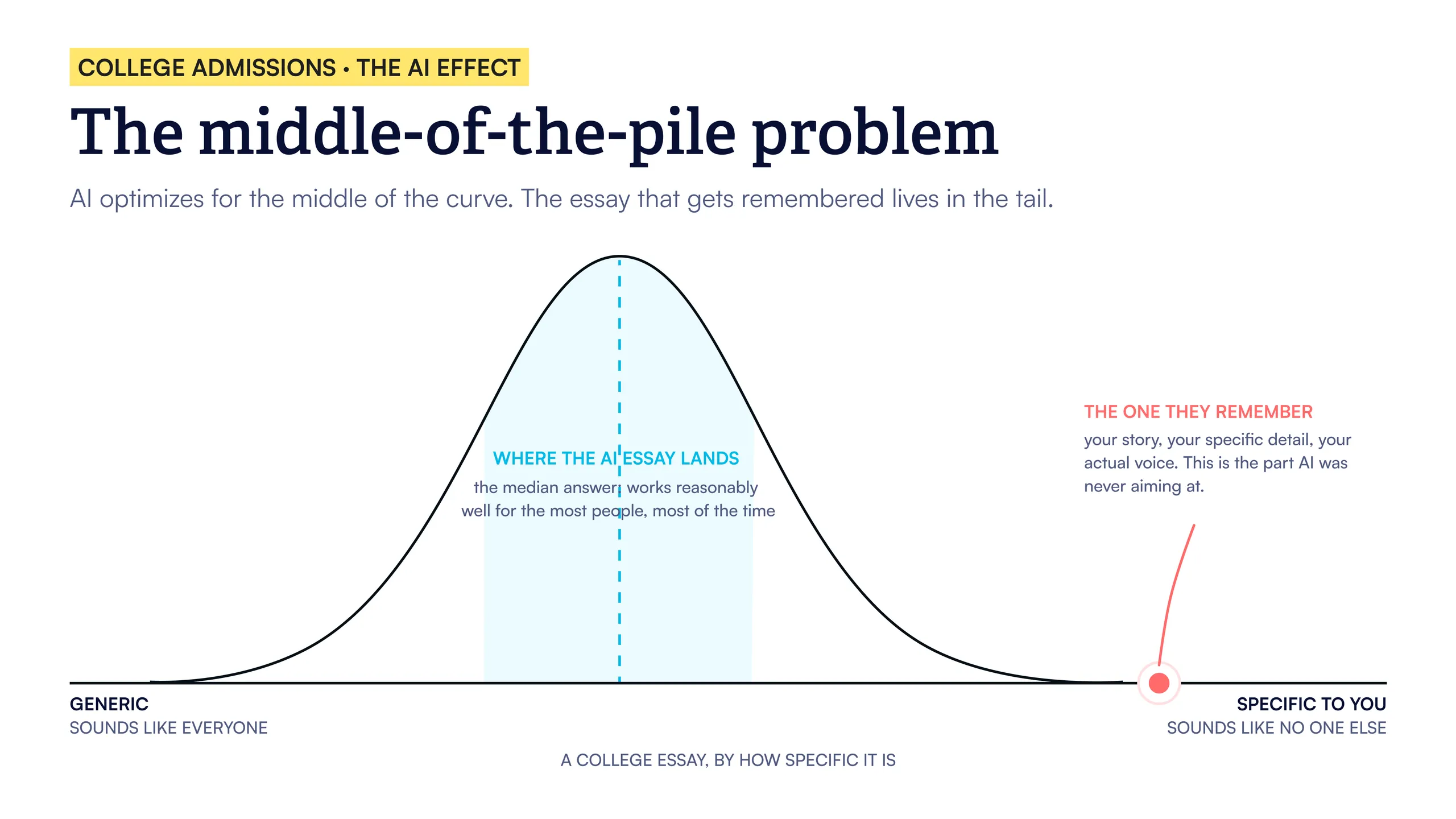
Let me give the essay detractors their due, because they have a point. Homogenization is a problem with AI. Open ChatGPT, type a lazy prompt, and out pops something confident, clean, and completely indistinguishable from the next kid’s clean response. Admissions readers are drowning in what I call the middle-of-pile problem.
But you don’t fix it with fewer essays. You fix it with better readers and better writers. Teach readers to spot the “machine voice,” which any competent reader can mostly do already.
And further upstream, teach students how to actually write. That second fix is the real one, and I’ll be straight with you: it’s hard. You’re asking a high school English teacher, who’s already buried, to bolt a “how to write a college essay” lesson into a curriculum they don’t control. It sounds simple. But building that lesson with real bells ringing every fifty minutes is really difficult. It also happens to be completely worth it.
Let’s return to the problem: why do AI essays disappear into a blur? Because AI tools are built to spoon-feed you a median response. Ask one for a college essay, and it aims straight for the middle of the pile.
The essay that actually gets remembered lives way out on the edge. Your kid’s real story. Their specific voice. That odd little detail nobody else would think to include. The stuff that’s unmistakably them. That’s the stuff AI misses because it was never aiming there. It has its sights set on the middle-of-the-pile.
Yes, it’s a mountain of work. Let’s make it a hill.
Now let me concede the biggest point because it’s true, and I watch students go through it every year. Applying to a long list of schools with supplements is a brutal amount of writing. We can’t wish that fact away.
You have to be strategic about them. The students I work with start every summer writing their UC Personal Insight Questions (PIQ). That’s intentional. One of those PIQ responses becomes the basis for the Common App Personal Statement. Instead of starting at yet another blank page, students take an already strong 350-word response and expand it by 300 words.
The other PIQs seed the supplements. And the supplements pretty much repeat across schools. It’s always some version of “Why do you want to study here” that shows up over and over. A good college counselor helps a student build one strong draft, keep about 80% of it, and just rework the 20% that will change for the school. This isn’t a copy-paste operation. Readers can smell that from a mile away. But starting from a strong base beats starting from zero every day of the week.
A student who learns to reuse and adapt their own writing, with the right guidance, walks away better prepared for college than a student who was not required to write.
Final thoughts
So what are we really deciding? We’re choosing whether to keep the only part of the application process where a young person gets to be a young person — in their own words and on their own terms. Yes, the AI stuff is messy. The stress is real.
But none of that is a good enough reason to eliminate the last human part of the application. Stop having machines judge student writing. And stop having students use AI to write middle-of-the-pile responses. But keep the essay. If we give it up, we might as well give everything away to the robots.
If your kid is staring down a stack of supplements and doesn’t know where to start, book a free consultation with Empowerly. We’ll help them create essays that actually win over admission officers.