Applications
CU Boulder vs. Colorado State University

The CU vs CSU decision usually comes down to your major, your budget, and your daily fit.
CU Boulder is the state's flagship and a major research engine. It enrolls about 31,000 undergrads and reports $684.2M in research awards. CU Boulder is now ranked #103 in National Universities by U.S. News for 2026 and is a member of the prestigious Association of American Universities (AAU).
Colorado State is Colorado’s land-grant university, with broad applied research and field-based programs. CSU reports 33,648 total students and $498.1M in research expenditures. CSU sits at #178 in National Universities in the 2026 U.S. News rankings.
You can thrive at either school. Your best fit depends on your major, budget, and learning style.
Quick Decision: Pick CU Boulder if You Want
CU Boulder is a strong match when you want a flagship feel and research-heavy pathways. You’ll see this most clearly in engineering, business, and tech-adjacent majors. CU also benefits from Boulder’s startup culture and the broader Denver metro job market.
You should also consider CU if you want a campus with a strong persistence signal. CU’s first-year retention is at 90%, and its graduation rate of 75%.
Here are the clearest “CU Boulder fits you” signals:
- You want a research-first environment with deep lab options.
- You like big-school energy and lots of pathways.
- You want strong STEM and business momentum.
- You want Boulder’s lifestyle with Denver access.
Quick Decision: Pick Colorado State University if You Want This
CSU is a strong match when you want applied learning and hands-on programs. That shows up in natural resources, agriculture, animal sciences, and many lab-and-field majors. CSU is also known for breadth, with 146 majors available.
CSU can also feel more college town than city-adjacent. Fort Collins tends to be more relaxed than Boulder, while still being active and outdoorsy.
Here are the clearest “CSU fits you” signals:
- You want fieldwork, clinics, labs, and applied projects early.
- You’re considering pre-vet, animal science, or sustainability tracks.
- You want a slightly smaller student-to-faculty ratio. CSU sits at 17:1.
- You want a campus system with a major physical footprint. CSU spans five primary campuses on 4,773 acres.
CU Boulder vs CSU at a Glance
This table gives you a fast baseline. Use it to spot the big gaps. Then use the later sections to decide what matters most for you.
| CU Boulder | Colorado State University | |
|---|---|---|
| Acceptance rate | 81% | 89% |
| Middle 50% SAT (submitted) | 1180–1390 | 1060–1280 |
| Middle 50% ACT (submitted) | 27–33 | 22–29 |
| Student-to-faculty ratio | 19:1 | 17:1 |
| First-year retention | 90% | 85% |
| 6-year graduation rate | 75% | 67% |
| Avg. net price (after aid) | $22,640 | $19,828 |
| In-state tuition (2025–26) | $14,205 | $11,610 |
| Out-of-state tuition (2025–26) | $44,990 | $34,560 |
| 2026 U.S. News National Ranking | #103 | #178 |
| Athletic Conference | Big 12 | Mountain West |
If your budget is tight, CSU often wins on price. If you want higher retention and a flagship research brand, CU often wins.
CU Boulder vs CSU Admissions
Both schools admit most applicants. The real selectivity happens by college and major. Engineering and business tend to be tighter at CU. Some science tracks and pre-vet pipelines can be tighter at CSU.
Here's what changed for 2026: CU Boulder's overall admit rate ticked up slightly to ~81% as the school received fewer applications than projected this cycle, but the gap between general admission and direct admission to engineering or business has actually widened. Translation? Getting in is doable. Getting your top program is the harder game.
CU Boulder’s admitted students' ranges for 2025 show how the bar rises by college. For example, the College of Engineering and Applied Science lists higher score ranges than the overall campus.
At CSU, the published profile emphasizes that most admitted students are in a 3.3 to 4.0 weighted GPA band. CSU also flags that competitive majors can fill, which makes timing matter more than people expect.
CU Boulder Admitted Student Ranges: Use These the Right Way
CU’s 2025 first-year ranges are best used as directional guidance, not strict cutoffs. Test-optional policies also mean the score ranges reflect students who submitted scores.
CU reports an unweighted high school GPA range of 3.66–4.00 for admitted first-years. For those who submitted, CU lists an ACT range of 30–34 and a SAT range of 1290–1460 across all majors.
If your scores are below those ranges, you can still be competitive. You just need a stronger transcript story and a clearer fit case.
CSU Admitted Student Ranges: What Matters Most
CSU’s profile is simpler because it’s more access-oriented overall. CSU lists most admitted students in the 3.3–4.0 weighted GPA band.
If you’re applying to programs that fill early, you can’t be the one who applies later. CSU is clear that early planning helps for competitive majors.
Test-Optional Does Not Mean Test-Ignored
CU is test-optional for first-year applicants, and that gives you flexibility. CU still publishes score ranges for students who submit, which helps you decide if scores strengthen your file.
CSU also reports score ranges, but your transcript and course rigor still drive decisions.
If your score sits clearly above the middle 50%, submit it. If it doesn’t, build your case through rigor, grades, and fit.
CU Boulder vs CSU Academics: The Day-To-Day Difference
On paper, both are large public universities with many majors. In real life, the classroom feels different.
At CU, you’ll likely start with larger lectures in popular majors. Later, you can plug into labs, faculty projects, and specialized electives. CU’s scale supports deep research networks, and it reports high research awards totals.
At CSU, you’ll still see some large intro lectures. CSU’s applied culture often pushes you into labs, field sites, and hands-on spaces earlier. CSU’s land-grant mission also shows up as extension work and community-facing research.
If you learn best by doing, CSU can feel more natural. If you want research breadth and a flagship platform, CU can feel stronger.
If you learn best by doing, CSU can feel more natural. If you want research breadth and a flagship platform, CU can feel stronger.
Honors, Internships, and Undergraduate Research: What’s Available at CU & CSU
If you want “extras” beyond your major, both campuses have them. Honors programs, internships, study abroad, and undergraduate research are available study options at both CU Boulder and CSU.
What changes is the pathway into those opportunities. At CU, many opportunities flow through big departments and research institutes. That can mean more options, but you may need to be proactive.
At CSU, opportunities often flow through applied projects, labs, and field sites tied to the land-grant mission. That can make it easier to see where you fit.
CU Boulder's standout honors offering is the Norlin Scholars Program — a small (~50 students per cohort), interdisciplinary scholars community with priority research funding. CSU runs the University Honors Program with around 1,500 students total — much larger, with dedicated honors housing and an emphasis on community service projects.
Best-Fit by Major: Where Each School Is Clearly Stronger
Your major is the cleanest tiebreaker. It affects admissions expectations, internship pipelines, and what your four years look like.
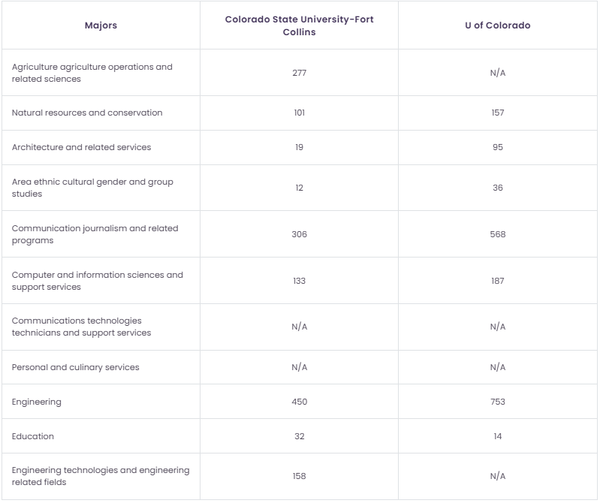
CSU vs CU Boulder: Majors
Below are the most common CU Boulder vs CSU major decisions. Use them to shortlist. Then confirm with each department and your own goals.
1. Aerospace and Space-Adjacent Engineering
CU is hard to beat for aerospace and space-adjacent work in Colorado. CU reports it is the No. 1 public university recipient of NASA awards and highlights deep federal research ties.
If you want to build a career tied to aerospace labs, defense contractors, or space systems, CU’s research ecosystem can help. It’s not just reputation. It’s the probability of landing funded work with mentors in that world.
CU Boulder's Smead Aerospace Engineering Sciences Department continues to rank top 10 nationally and has expanded its undergraduate research opportunities through the CU Spaceflight Lab, which gives undergrads hands-on experience building actual satellite payloads.
CSU can still work for engineering. CU’s space identity is the differentiator.
2. Veterinary Medicine and Animal Health Pathways
If you’re serious about veterinary medicine, CSU is the obvious starting point. CSU’s institutional profile highlights that its veterinary medicine program ranked #2 in the nation.
Even if you are not applying to vet school, CSU’s animal science and biomedical spaces create more real exposure. That matters for shadowing, research, and strong recommendation letters.
CU can support pre-health paths, but CSU is more specialized here. CSU's College of Veterinary Medicine and Biomedical Sciences (CVMBS) launched a new One Health Initiative undergraduate research track in 2025, blending veterinary, public health, and environmental sciences — particularly attractive for pre-vet applicants who want a competitive edge in DVM admissions.
3. Natural Resources, Conservation, and Sustainability
Both campuses talk about sustainability. The difference is the backbone.
CSU’s land-grant structure and scale support natural resources work across multiple campuses and field sites. CSU explicitly notes its multi-campus footprint and statewide research and extension sites.
CSU explicitly notes its multi-campus footprint and statewide research and extension sites. CSU's Warner College of Natural Resources is consistently ranked among the top three natural resources colleges in the country, with its forestry, fish/wildlife/conservation biology, and ecosystem science and sustainability programs all leading nationally.
CU is also strong in environmental research and climate-adjacent work. CU’s research fact sheet highlights large federal agency research totals and examples tied to emerging technology. CU's Cooperative Institute for Research in Environmental Sciences (CIRES) — a partnership with NOAA — gives undergrads access to climate science research at a level few other public universities can match.
Choose CSU if you want field-forward training. Choose CU if you want policy, research, and interdisciplinary climate pathways.
4. Business and Entrepreneurship
CU’s business path is often about scale and proximity to the Denver metro economy. Boulder’s startup culture can be a real advantage if you want internships in tech, finance, or product roles. CU also highlights startup activity through programs like the New Venture Challenge, one of the largest collegiate entrepreneurship competitions in the country.
CSU’s business programs can still prepare you well, especially if you want a more grounded, community-driven environment. CSU’s majors breadth is large, and Fort Collins has its own business ecosystem. CSU's College of Business is AACSB-accredited and known particularly for its supply chain management, real estate, and financial planning programs.
If you want “startup meets flagship,” CU is usually the better bet.
5. Communications, Media, and Public-Facing Careers
CU can be a strong match if you want media, communication, and public-facing careers tied to a larger metro network. Boulder’s location can also make it easier to tap into Denver opportunities during the year.
CSU can still support communication majors. The bigger question is which city network you prefer. Boulder leans more toward tech and startups. Fort Collins leans more local-community, and campus-driven.
Research and Experiential Learning: What You Can Touch as an Undergrad
This is where your daily experience can diverge quickly.
CU:
- Reports $684.2M in research awards and $485.8M in federal agency funding.
- Also reports $495.4M from federal agencies for research and creative work in FY2024.
- Houses 12 federally funded research institutes, including JILA (joint with NIST), CIRES, and the Laboratory for Atmospheric and Space Physics (LASP) — the only academic institution to design, build, and operate hardware on a NASA mission to every planet in the solar system.
CSU:
- Reports $498.1M in total research expenditures (FY2023).
- Also reports $577M in sponsored project expenditures (FY24) on its research page.
- Strongest research output is in agricultural sciences, atmospheric sciences (home to the CIRA atmospheric research institute), infectious disease, and clean energy.
At either school, you can find labs, grants, and faculty mentors. The difference is that CU often leans research-and-theory first. CSU often reviews applications first.
CU Boulder vs CSU Cost: What You Should Compare
Sticker price is never the whole story. You should compare net price, debt, and what you can realistically earn in your field.
CU Boulder's average net price sits at $22,640 per year. In-state tuition for 2025–26 is $14,205, and out-of-state tuition is $44,990.
CSU's average net price sits at $19,828 per year. In-state tuition for 2025–26 is $11,610, and out-of-state tuition is $34,560.
That gap matters most for out-of-state students. Over four years, tuition differences can change what you can afford after graduation. Here's the bottom line for out-of-state students: CSU is roughly $10,000 cheaper per year in tuition alone. Across four years, that's $40,000+ in savings before factoring in any aid.
2026 Aid Updates Worth Knowing
Both schools refreshed their financial aid programs for the 2025–26 cycle:
- CU Boulder's CU Promise continues to cover full tuition and fees for in-state students from families earning under $65,000 annually.
- CSU's Commitment to Colorado program guarantees full tuition coverage for Colorado residents from families earning under $70,000.
- CSU also expanded its WUE (Western Undergraduate Exchange) discount, making it one of the most affordable out-of-state options for students from 16 participating Western states.
- CU offers automatic merit-based aid through its Esteemed Scholars Program, which can reduce out-of-state tuition by $5,000–$15,000 annually for top applicants.
Don’t Compare Net Price Without Your Income Band
The net price changes significantly by household income. CU’s average net price ranges from about $11,251 per year for households under $30k to about $30,549 for households over $110k.
CSU’s net price ranges from about $11,333 per year for households under $30k to about $28,684 for households over $110k.
Two students can attend the same school and pay very different amounts. Always run each school’s Net Price Calculator.
Debt at Graduation: A Quick Pressure Test
Debt isn’t always bad, but it needs a plan. CU’s typical debt at graduation sits at $26,355. CSU’s typical debt at graduation sits at $30,309.
A few thousand dollars may not decide your whole life. It can still change your first-job flexibility, especially in lower-paying fields.
Student Life: CU Boulder vs CSU Feels Different
You can find your people at both schools. Still, the social vibe is not identical.
CU Boulder’s culture is shaped by flagship scale, Boulder’s outdoors lifestyle, and major school spirit traditions. The school’s live mascot program, including Ralphie’s run at Folsom Field, is a well-known piece of campus identity.
CSU’s culture leans more toward a college town with heavy club involvement and a community-centered feel. CSU reports 500+ student organizations, which gives you lots of ways to plug in quickly.
If you want more big-stage energy, CU often fits. If you want a more grounded community vibe, CSU often fits.
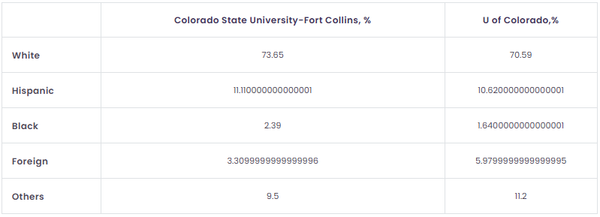
Student Life in CU vs CSU
Boulder vs Fort Collins: Which Setting Fits Your Lifestyle
Location is not just scenery. It shapes your weekly routine, your internship options, and how you decompress after hard classes.
Boulder often feels fast-moving and career-adjacent. You’ll see more tech meetups, startup energy, and students who treat internships like part-time jobs. If you want to network during the school year, Boulder can make that easier.
Fort Collins often feels more self-contained. The city is classically built around CSU. Many students spend weekends in Old Town, on trails, or at campus events, and you can build a full social life without leaving town.
If you’re unsure, use a simple test. Picture a random Tuesday night in November. If you want a busy town with many options, lean toward Boulder. If you want an easy rhythm and a tighter college-town loop, lean toward Fort Collins.
CSU vs CU Boulder: Athletics and School Spirit
If sports matter to you, this part can influence your daily experience.
- CU officially completed its move back to the Big 12 in July 2024, joining the conference alongside Arizona, Arizona State, and Utah. Boulder's first Big 12 football season under Coach Deion "Coach Prime" Sanders has dramatically raised the school's national profile and applicant interest.
- CSU competes in the Mountain West Conference, which shapes rivalries and travel.
Both schools have strong traditions. They also share the Rocky Mountain Showdown rivalry in football, which dates back to 1893. The Rocky Mountain Showdown is set to return on a multi-year schedule starting in fall 2026 after a hiatus, making this rivalry feel sharper than ever.
You don’t need to be a sports fan to feel this. Big games change the mood of the campus.
Outcomes and Academic Support: What the Numbers Suggest
Outcomes are never just about the school. Your major, internships, and grades matter a lot. Still, campus metrics can hint at student support and momentum.
- CU has a 90% retention rate and a 75% graduation rate.
- CSU has an 85% retention rate and a 67% graduation rate.
CSU also reports that 90% of Rams secured plans or offers by December of their graduation year (three-year average).
Use these numbers as signals, not guarantees. Your daily habits will decide the rest.
How To Choose Between CU and CSU
If you’re still torn, walk through these seven decisions in order. You’ll usually find your answer by step four.
1. Start With Your Top Two Majors, Not Your Dream Job
Majors shape advising, course sequences, and internship timing. They also shape where you’ll spend most of your week.
If you are picking between engineering research and applied environmental work, you are picking between schools. That is normal.
2. Decide How You Learn Best
Be honest here. Do you learn best from big lectures and independent work? Or do you learn best by doing labs and fieldwork early?
CU often rewards self-direction in large systems. CSU often rewards hands-on learners who want structured application.
3. Compare Net Price Using the Same Inputs
Use each school’s Net Price Calculator and plug in the same information. Then compare four-year totals. Do not compare sticker price headlines.
If you’re out of state, pay special attention. Tuition differences can dominate.
4. Check Program Capacity and Timing
Some majors fill earlier than you expect. CSU warns about competitive majors and planning early. CU also shows higher admitted ranges in certain colleges, which signals tighter competition.
If you wait too long, you can lose your best options.
5. Decide Which City You Want for Four Years
Boulder and Fort Collins are both outdoors-forward. They still feel different.
Boulder is more career-adjacent and metro-connected. Fort Collins is a more classic college town.
6. Use Retention and Graduation Rates as a Tie-Breaker
If everything else feels equal, use the academic support signals.
A higher retention rate can hint at stronger first-year transition systems. It can also reflect a stronger student fit.
7. Visit, Then Decide Within 48 Hours
Visiting a college can clear up confusion fast. If you can’t travel, do virtual tours and student panels. After each visit, write three pros, three cons, and one gut-level note.
Cost of Living: Boulder vs. Fort Collins
Now, here's something most college guides skip over — and it can change your real out-of-pocket cost by thousands of dollars per year.
Boulder has become one of the more expensive college towns in the country. Median rent for a one-bedroom apartment near the CU campus runs $1,800–$2,400/month, particularly in popular student neighborhoods like The Hill and Goss-Grove. Groceries and dining run noticeably above the Colorado average. The trade-off? Boulder's job market and proximity to Denver's metro tech and finance hubs is unmatched among Colorado universities.
Fort Collins, in contrast, is one of the most affordable mid-sized college towns in the West. Median rent for a one-bedroom apartment near CSU runs $1,200–$1,600/month — often $600+/month cheaper than equivalent Boulder housing. Groceries, restaurants, and entertainment all cost noticeably less.
Here's the math: if you live off-campus for three years (the typical pattern at both schools), you could be looking at $15,000–$22,000 in additional rent costs at CU Boulder over your college career compared to CSU. That's a meaningful chunk that often gets buried in tuition-only comparisons.
Climate, Outdoor Access, and Lifestyle: A Real Differentiator
Let's talk about something rarely covered in head-to-head comparisons: weather and outdoor access. Both schools sit at the foot of the Rockies, but the daily lived experience is genuinely different.
Boulder sits at 5,430 feet elevation with the Flatirons rising directly behind campus. You're 30 minutes from world-class hiking, climbing, and cycling — Boulder is one of the most cyclist-friendly cities in America. Winter brings ~80 inches of annual snowfall, with reliable access to Eldora Mountain Resort (45 minutes away) and easy day trips to bigger resorts like Winter Park, Copper Mountain, and Vail. Summers are warm but dry, with low humidity and 300+ days of sunshine per year.
Fort Collins sits at 5,003 feet elevation with the Cache la Poudre River running through town and Roosevelt National Forest within 20 minutes. The terrain is slightly more open and less dramatic than Boulder's Flatirons, but the access to the Poudre Canyon, Horsetooth Reservoir, and the Front Range is just as strong. Winter snowfall is roughly half what Boulder gets (~50 inches), making campus life less weather-disrupted but ski access slightly farther — closest resorts are 90+ minutes away.
If skiing/snowboarding is core to your college experience, CU has the edge. If you prefer cycling, hiking, fly-fishing, and general outdoor lifestyle without the heavy snow, CSU's setting may suit you better.
What Current Students Actually Say
Let's hear from the people who would know best — current students. Here's a synthesis of recurring themes from 2025–26 student reviews on Niche, Reddit, and Unigo:
On CU Boulder:
- "Boulder is gorgeous, but expensive. Plan for housing early — sophomore year leases get signed in October."
- "If you're in engineering or aerospace, CU's research ties are insane. I worked on actual NASA hardware as a sophomore."
- "Coach Prime brought a different energy. Game days feel like SEC schools now."
- "Big complaint: classes can be huge in early years. You have to work to stand out."
On Colorado State:
- "Fort Collins is the best college town nobody talks about. Old Town is everything, and the rivers, breweries, and trails are unbeatable."
- "Animal science and pre-vet here are no joke — students publish, present, and get into vet school at high rates."
- "The community is tight. Professors actually know my name in my upper-division classes."
- "Best honest pitch: if you'd rather have hands-on access than research prestige, CSU wins."
The consistent thread? Students at both schools generally love their experience — but for different reasons. CU wins on prestige, networks, and big-game energy. CSU wins on community, access, and value.
If You Apply to Both: An Admissions Strategy That Works
Applying to both CU Boulder and CSU is common. It can also be smart, because it gives you options across two strong systems.
First, build a clear academic story. Your transcript should match your intended direction. If you say engineering, your math and science rigor should show it. If you say environment, your course choices and activities should support it.
Second, treat essays like a fit argument, not a summary. Pick one or two moments that show how you think. Then connect that to what you will do on campus.
Third, apply early when you can. Earlier timing helps you lock housing, aid timelines, and program space.
Financial aid has its own calendar, even when admissions feels flexible. CU Boulder’s priority aid date is Feb. 15, and CSU’s is Mar. 1. If you miss a priority date, you can still apply, but you usually lose the strongest consideration.
CU Boulder vs CSU Is About Fit, Not Prestige
You can build a great future from either campus. Start by choosing the environment that will make you do your best work.
Pick CU Boulder if you want flagship scale, research intensity, and Boulder-to-Denver momentum. Pick Colorado State if you want applied learning, field-forward programs, and a community-driven college town.
Here's the simplest way to decide: CU is the better choice if you're aiming at aerospace, finance, tech, or research-heavy STEM, and you value flagship resources. CSU is the better choice if you're aiming at veterinary medicine, animal sciences, natural resources, sustainability, or any applied STEM track — particularly if cost is a major factor.
If you want help making the call, we can help you pressure-test your plan. Empowerly counselors help you compare majors, admissions odds, and real financial fit, so you build a balanced list with confidence.
FAQs: CU Boulder vs Colorado State University
Is CU Boulder or CSU harder to get into?
CU Boulder is generally more selective overall. 81% acceptance rate for CU and 89% for CSU. Program selectivity can still flip this in specific majors. Direct admission to CU's College of Engineering and Applied Science or Leeds School of Business is significantly more competitive than the overall admit rate suggests.
Are CU Boulder and CSU both good for engineering?
Yes, both can work for engineering. CU's advantage is scale and research branding — particularly in aerospace, where CU is the No. 1 public university recipient of NASA awards. CSU's advantage is applied learning and a strong campus infrastructure, with standout programs in mechanical and biomedical engineering. Your best choice depends on your engineering field and learning style.
What if I’m pre-vet or want animal science?
CSU is usually the better starting point. CSU's veterinary medicine program is ranked #2 in the nation, and the school's new One Health Initiative undergraduate research track gives pre-vet applicants a competitive edge in DVM school admissions. You can also find more direct animal-health exposure on campus.
Which school is more affordable?
CSU is usually cheaper on average, especially for out-of-state students. CSU's net price sits at $19,828, and CU's at $22,640. The gap widens significantly for non-residents — CSU's out-of-state tuition is roughly $10,000/year less than CU's. Still run both net price calculators, because your aid can change this.
Which campus has a more “college town” feel?
Most students describe CSU and Fort Collins as a more classic college town. CU feels more like a flagship campus inside a high-demand city environment. If you want quieter routines, CSU can fit better.
Does test-optional change the strategy?
It changes what you emphasize. Both CU and CSU remain test-optional for the 2025–26 cycle, even as many flagships nationally have returned to test-required. If you don't submit scores, your grades, rigor, and fit become even more important. CU's admitted ranges show the score bands for students who did submit.
Is CU Boulder still in the Pac-12?
No — CU Boulder officially moved back to the Big 12 Conference in July 2024, joining Arizona, Arizona State, and Utah. CU's first Big 12 football season under Coach Deion "Coach Prime" Sanders raised the university's national profile significantly and contributed to a noticeable jump in applicant interest.
What's new at CU Boulder and CSU for 2026?
CU Boulder expanded its CU Spaceflight Lab (real NASA hardware experience for undergrads) and continues to grow its Big 12 athletic profile. CSU launched the One Health Initiative undergraduate research track and expanded its Commitment to Colorado financial aid program for in-state families earning under $70,000. Both schools also expanded their honors offerings for the 2026 cohort.