



Three years ago, an admissions officer reading your college essay was looking for your voice. Today, they are also looking for proof that the voice is actually yours.
That shift is not theoretical. In 2024, the Common Application updated its Fraud Policy to classify any submission of AI-generated content as plagiarism, a definition that now binds applicants across more than 1,000 partner colleges. Brown University and Yale went further, publishing their own statements warning that AI-written essays can result in admission revocation, or expulsion after enrollment.
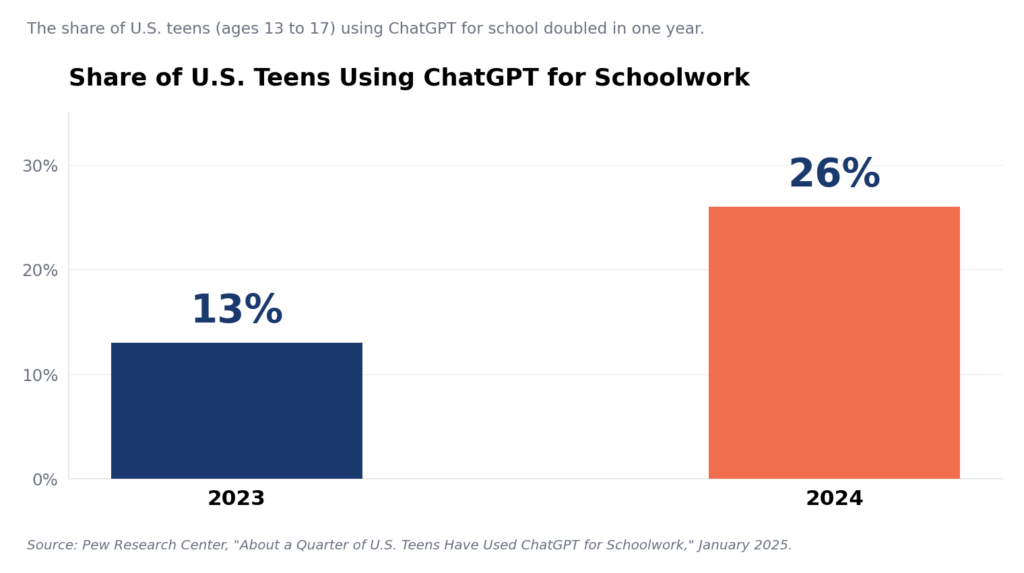
Meanwhile, the number of students reaching for AI is climbing fast. According to the Pew Research Center, the share of U.S. teens using ChatGPT for schoolwork doubled in a single year.
This guide breaks down what has changed inside admissions offices, what officers are now trained to spot, and how you can still use AI tools responsibly without putting your application at risk.
How the Common App’s Fraud Policy Changed the Game
The Common App is the form behind most U.S. college applications. Over 1,000 schools accept it. In 2024, the platform expanded its Fraud Policy to cover what it calls “the substantive content or output of an artificial intelligence platform, technology, or algorithm.” Translation: if AI wrote it, it counts as plagiarism. Every applicant signs an affirmation that the work is their own, factually true, and honestly presented.
What happens if you fail that test is not a polite warning. The Common App can open an investigation, alert every school on your list, and ban you from the platform.
Brown, Yale, and a few Ivy peers have echoed the rule. Yale’s goes one step further. Essays composed by text-generating software, the policy reads, “may result in admission revocation or expulsion” once you enroll.
What Admissions Officers See When They Open Your Essay
During peak season, an admissions officer reads 30 to 50 essays a day. Over a few cycles, that adds up to thousands of personal statements per reader. The job grows an ear, and that ear has shifted.
Here is what they say they notice now.
Flat sentence rhythm.
AI drafts settle into two or three sentence lengths and stay there. Real student writing is messier. It has short bursts, longer reflections, and the odd sentence fragment that breaks the flow.
Generic emotional beats.
“This experience shaped who I am today.” “I learned the value of perseverance.” These lines tend to show up in roughly the same paragraph of AI-generated essays. After enough reads, officers start spotting the template.
Vocabulary that does not match the rest of the application.
If your essay reaches for words your teacher recommendations and short answers never touch, the gap stands out fast.
A polished tone with no specific detail.
AI is good at writing essays that sound right. It is not good at writing essays that mention the specific diner where your grandmother taught you how to braise lamb on a Sunday.
Inside the AI Policies of America’s Top Universities
Most top schools have published policies, and they fall into three rough buckets. Total prohibition. Limited use for brainstorming or grammar. Or no explicit policy yet. Here is where the most selective institutions sit.
| School | Policy Position | What Is Allowed |
| Brown University | Total prohibition for content | Spelling and grammar review only |
| Yale University | Aligned with Common App fraud policy | Grammar, topic suggestions, brainstorming |
| Caltech | Limited use with disclosure | Research, brainstorming, grammar checks |
| Carnegie Mellon | Limited use | Grammar, vocabulary, structural suggestions |
| Georgia Tech | First U.S. university to publish AI policy (2023) | Brainstorming and editing with disclosure |
| Duke University | Stopped numerical essay ratings | No formal AI ban, reduced reliance on essay scores |
| Common App (1,000+ schools) | Treats AI content as fraud | No substantive AI-generated content |
Sources: Common Application Fraud Policy; Yale Admissions AI Statement; Brown Integrity in the Application Process.
What AI Detection Tools Are (and Aren’t) Catching
A 2026 Cornell research paper looked at post-ChatGPT admissions essays and pulled out a number that should worry anyone planning to lift content wholesale. Classifiers separating human from AI text scored an F1 of 0.998 across the major models, including GPT-4o, Claude Sonnet, Mistral Large, and Llama 3.1.
The catch: those classifiers were trained on essays from a single prompt, with no human editing. Real student behaviour is messier. A draft gets written, rewritten, then edited again. The signal weakens, but it never disappears.
The same study found the median post-ChatGPT applicant essay carrying about a 4 percent AI-influenced lexical signature. Even partial AI use leaves traces. A 2023 industry survey put the share of four-year colleges already using AI detection at roughly 40 percent, with another 35 percent adopting it in the 2024-25 cycle. Most schools, though, treat detection scores as one signal among several. Not as a verdict.
The Smart Way to Use AI Without Triggering a Red Flag
Most admissions experts have landed on the same baseline: brainstorming with AI is fine, as long as the final words are yours. The Common App’s fraud policy goes after substantive content, not early idea work.
Used well, AI is a useful sparring partner. It can pull you out of writer’s block, sharpen a draft, or test a thesis. The trick is to keep it in the planning lane and out of the writing lane.
A simple framework that keeps applicants on the safe side
Use AI to brainstorm topics.
Ask AI for angles based on your background, interests, and the school’s essay question. A free ChatGPT prompt generator like Phrasly’s can turn a half-baked idea into a structured prompt, which draws sharper responses out of any AI tool. Useful when you are staring at a blank document.
Outline by hand.
Once you have an idea worth chasing, build the structure yourself. The bones of the essay have to come from you.
Write the first draft cold.
No AI assistance. No thesaurus deep dives. Just write what you remember and what you meant the first time.
Edit with AI carefully.
Use AI only for grammar and clarity. Never for sentence rewriting that changes your voice. Yale, Caltech, and Carnegie Mellon all explicitly allow grammar checking. None of them allow content generation.
Three Habits That Keep Your Essay Reading as Authentic
Write the way you talk, then tighten.
The strongest essays sound like a real student, not a polished press release. Admissions officers will tell you outright. They would rather read a slightly imperfect sentence in your voice than a flawless one that could belong to anybody.
Anchor every claim in a specific moment.
“I love science” is hollow. “I sat in the back row of AP Chemistry watching Mr. Reeves drop sodium into water on a Tuesday in October” cannot be generated. Specifics are how admissions readers verify authorship without a detector.
Read your essay against your teacher recommendations.
If the voice in your personal statement does not line up with the way your recommenders describe you, that gap gets noticed. Consistency across the application is what admissions officers quietly call a green flag.
Frequently Asked Questions
Can colleges actually detect ChatGPT in essays?
Sometimes. Cornell’s 2026 research showed near-perfect classifier accuracy on one-shot AI essays. Real student edits weaken the signal. Reviewers also rely on attestation, voice consistency, and personal detail to verify authorship. It is rarely one check. It is several stacked on top of each other.
Will my application be rejected if my essay is flagged?
Not automatically. Admissions officers treat detector scores as one signal among many. Real consequences only kick in after a fraud investigation, which the Common App can extend across every school on your list.
Is using AI for brainstorming considered cheating?
No, according to most top-school policies, including Yale and Caltech. Topic ideas, research prompts, and grammar checks are allowed. Writing the actual essay with AI is where the line is.
What if my school does not have a published AI policy?
You are still bound by the Common App’s fraud policy if your school accepts the Common App. That covers more than 1,000 institutions in the U.S. and abroad.
Are Grammarly and spellcheckers also considered AI?
Most top schools draw a clear line between grammar tools and content-generation tools. Grammarly-style spelling and grammar suggestions are universally allowed. Anything that writes or rewrites your sentences for you is not.
The Bottom Line
Admissions officers in 2026 are still reading essays the way they always did. For voice. For character. For the specific detail that gives a real person away. What has changed is the layer of scepticism underneath. The Common App’s fraud policy has given them legal teeth. Cornell-level research has given them sharper tools. Years of pattern recognition have given them an instinct for what AI sounds like.
The takeaway is simple. AI can help you think. It should not write your essay. Your voice, your story, and the specific way you remember the moments that shaped you are still the parts of your application that nothing can replicate. Spend the time making those parts strong.

