



Why Today’s Students Need More Than Good Grades
A decade ago, strong grades and a well-known college name were often enough to unlock career opportunities. Today, that reality has changed – dramatically.
According to the World Economic Forum, more than 50% of all employees will need reskilling by 2030, and employers increasingly report that many graduates are academically prepared but workplace-unready. The gap isn’t intelligence or effort. It’s a lack of high-demand skills.
The careers of tomorrow will belong to students who can:
- Communicate ideas clearly
- Collaborate across teams and cultures
- Adapt quickly to change
- Use technology confidently, not fearfully
As employers move toward skill-based hiring, understanding which skills matter and how to build them early has become essential for long-term career development and professional growth.
This guide explores the most in-demand skills for success, blending soft skills, technical skills, and future-ready skills, with clear, actionable ways students can start their skill development journey now, well before internships or first jobs enter the picture. It’s written for high school students, college students, and parents who want clarity, not confusion, about preparing for the future workplace.
1. Why Skills Matter More Than Ever
Here’s a simple truth students and parents need to hear early:
Degrees open doors. Skills determine how far you go.
A LinkedIn Global Talent Report found that 92% of hiring professionals say soft skills matter as much as or more than technical skills. Employers consistently struggle to find candidates who can communicate clearly, think critically, and adapt to change.
What Employers Are Really Hiring For
Across industries, employers are prioritizing:
- Problem-solving ability
- Willingness to learn new skills
- Strong workplace and professional skills
- Comfort with technology and collaboration
This shift toward “skills employers look for” rather than credentials alone means students who actively build job skills gain a measurable advantage not just in hiring, but in confidence, independence, and long-term growth.
For parents, encouraging early skill development supports:
- Smoother transitions into college
- Stronger internship readiness
- Better early-career performance
In today’s economy, skills to succeed are no longer optional add-ons; they are foundational.
The Out-of-the-Box Angle: The Student Skill Stack
Instead of treating skills as a checklist, it’s more helpful to think of them as a stack, something students build layer by layer over time.
The Student Skill Stack:
| Skill Layer | What It Includes | When Students Build It |
| Foundational Skills | Communication, Teamwork, Adaptability | Middle & High School |
| Confidence Skills | Creativity, Emotional Intelligence, Initiative | High School |
| Career Skills | Coding, Data Literacy, Productivity Tools | Late High School & College |
| Differentiation Skills | AI Literacy, Projects, Leadership | College & Internships |
This framework works because it:
- Makes skills memorable
- Helps parents visualize progress
- Explains why timing matters
- Reflects how skills actually develop in real life
How Skills Compound Over Time (Why Starting Early Matters)
One reason skills matter more than grades alone is compounding. A student who starts building skills at 14 (age) often:
- Communicates more clearly by 16
- Leads group projects by 17
- Has a small portfolio by 18
- Feels confident in interviews by 20
Now compare that to a student who waits until college to begin upskilling. Skills don’t just add up; they multiply. This compounding effect explains why early exposure to useful skills to learn creates long-term advantages in academic performance, career confidence, and professional development.
Skills vs Grades: What They Unlock
When students rely on grades alone, their college readiness is often only partial, leaving gaps in real-world preparedness. Internship confidence tends to be low, interviews can feel uncertain and unstructured, and career flexibility is limited early on. Long-term growth may happen, but often at a slower pace.
In contrast, students who combine strong academic performance with well-developed skills are far better positioned for success. They enter college more prepared, approach internships with confidence, communicate clearly and strategically in interviews, and enjoy broader career flexibility. Over time, this blend of skills and grades leads to faster, more sustainable growth – academically, professionally, and personally.
This is why the importance of skills for students can’t be overstated; skills turn potential into performance.
2. Soft Skills Are the Hidden Curriculum of Success
Schools teach math, science, and history, but soft skills are the hidden curriculum students are expected to “just pick up.” These career success skills shape how students learn, collaborate, and lead, yet they’re rarely taught directly.
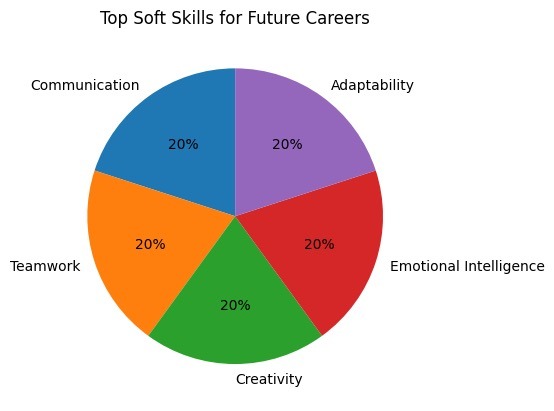
The Soft Skills Employers Value Most:
- Communication
Strong communication helps students express ideas clearly in writing, presentations, and interviews. It’s one of the most transferable professional skills across all careers.
- Teamwork
From classroom projects to extracurriculars, teamwork builds collaboration and leadership, essential workplace skills.
- Creativity
Creativity isn’t just artistic. It’s about thinking differently, connecting ideas, and navigating ambiguity.
- Emotional Intelligence
Students with high emotional intelligence manage stress better and respond constructively to challenges, which is critical for improving work performance later on.
- Adaptability
Careers change quickly. Adaptable students become adaptable professionals, ready for the future workplace.
These soft skills often determine long-term success more than technical knowledge alone.
3. Core Technical Skills Every Student Should Explore
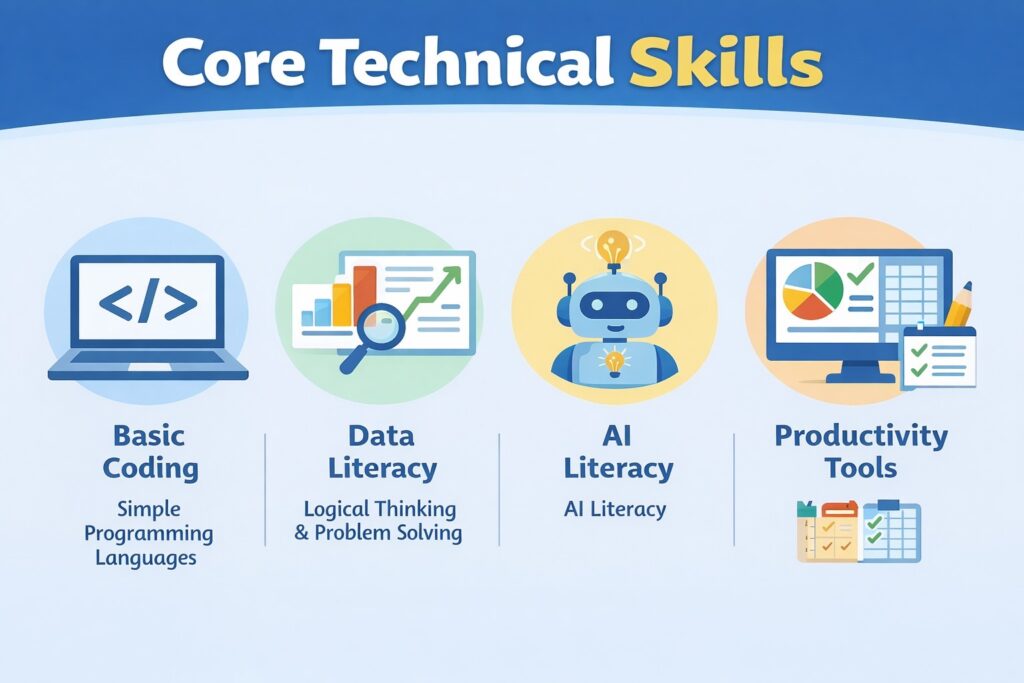
Technical skills are not about becoming an Engineer. If soft skills shape how students work, technical skills shape what they can do.
Core Technical Skills That Matter Early:
| Skill | Why It’s Valuable |
| Basic Coding | Supports research, decision-making, and analysis |
| Data Literacy | Supports research, decision-making, analysis |
| AI Literacy | Encourages responsible use of emerging tools |
| Productive Tools | Strengthens readiness for college and jobs |
This distinction matters especially for parents.
- Coding teaches structured thinking, not just syntax
- Data literacy supports essays, projects, and research
- AI literacy is about using tools wisely, not replacing learning
For beginners, online skills to learn, such as introductory coding, spreadsheet essentials, or beginner data tools, offer a low-pressure entry into technical skills and high-value skills.
Simple courses like Basics of Python, Power BI, or even MS Excel Essentials offer a no-pressure way to build confidence. These are practical skills to put on a resume early and build confidence through real use.
4. How to Build These Skills Inside and Outside the Classroom
Skill development doesn’t happen overnight. It grows through consistent exposure and practice.
High-Impact Ways Students Build Skills
- Joining clubs, competitions, or student organizations
- Participating in internships or volunteering
- Completing project-based learning
- Taking short skill development courses or micro-credentials
These experiences support career development skills, professional development, and early exposure to high-income skills without overwhelming students.
5. Demonstrating Skills in College Applications & Early Jobs
Having skills is powerful. Showing them clearly is what makes them count.
How Students Can Stand Out
Instead of listing skills, students should:
- Describe real experiences
- Highlight initiative and problem-solving
- Share examples of leadership, teamwork, or creativity
A small portfolio – projects, presentations, volunteer work helps translate skills for CV use into tangible proof.
A Quick Skill Readiness Check
Ask yourself:
- Can I explain my ideas clearly?
- Have I worked on a project outside of class?
- Do I know at least one digital tool well?
- Can I adapt when plans change?
- Can I describe my strengths with examples?
What Most Students Get Wrong About “Career Skills”
Ask students what skills they need for the future, and many will answer with the most in-demand keywords: Coding, AI, Data, and Automation. Important? Yes.. Complete? Not even close.
The real mistake students make is assuming skills work in isolation. In reality, skills succeed in combination.
- A student who knows coding but can’t explain their work struggles in interviews.
- A student who communicates well but avoids technology hits a ceiling quickly.
- A high achiever who never experiments outside the syllabus often freezes when problems have no clear instructions.
Modern careers reward skill pairing, not single strengths.
For example:
- Coding + Communication = Product Thinking
- Data literacy + Curiosity = Better Decision-making
- Creativity + Adaptability = Innovation Under Pressure
- Emotional Intelligence + Leadership = Trust and Influence
This is why employers often choose candidates who are good across many areas over those who are technically strong but inflexible.
For students, this changes the strategy. You don’t need to master everything. You need to connect what you already do well with one new skill at a time. For Parents, this reframes success. Progress isn’t about perfection but Balance.
Careers today are no longer ladders you can see every step of the way, but a skill ecosystem, wandering and finding a way out. And students who learn to connect skills early don’t just keep up, they stand out.
Conclusion: Skills Are the New Advantage
The most successful students aren’t the ones who knew everything early. They’re the ones who learned how to learn, adapt, and grow.
Ultimately, the ideas shared in this article align closely with Empowerly’s mission to prepare students for an evolving academic and professional landscape. By breaking down essential skills for success into clear, approachable guidance, students gain confidence and parents gain a practical framework to support long-term growth.
For readers who want a broader perspective, the skills expected to dominate the next 10 years, future-skills reports, and analyses offer helpful context and reinforce why building these abilities early creates a lasting advantage.
Developing high-value skills, investing in continuous upskilling, and focusing on both soft and technical skills ensures students are not just college-ready but future-ready.
The goal isn’t perfection. It’s progress.
