



The Challenges of College Prep
Preparing for college is one of the biggest challenges in many people’s lives, and managing the pressure can be just as tricky as mastering the content.
- Information overload: Lots of textbooks, notes, and slides.
- Tight schedule: classes, after-school study, and personal obligations.
- Distractions everywhere.
The combination of these and many other factors can lead to something I refer to as “suboptimal studying”, meaning that the effort invested into studying is often wasted because a significant portion of the content is not retained.
Everyone knows how frustrating it feels when you simply forget the material studied less than a week ago, but the truth is that it usually happens simply because the study methods were not the best ones.
Among the causes of this problem, a frequent mistake is trying to memorize content without understanding the context or the bigger picture. Studying becomes easier to manage when you step back and organize information meaningfully. Taking a moment to look at the content and identify the overall context and how everything connects is the key to what cognitive psychology defines as “meaningful learning. The opposite of it is exploring content as a collection of fragmented pieces.
Why explore different studying strategies?
Traditional study methods involve: rereading notes, highlighting important parts, answering test questions, and so on. All of these are important habits of anyone trying to master a subject. However, as we already discussed, it is easy to read an entire chapter a couple of times only to realize that very little has been retained, a sign that alternative and complementary strategies may be helpful.
Why experiment with new study methods?
- Switching up techniques keeps your brain active and less bored.
- If you master more than one way to approach material, you become much more flexible in exams and projects.
Visual learning strategies, in particular, tend to increase engagement and comprehension. This happens because a shift in how information is viewed can make complex topics easier to understand and remember, as cognitive fit theory and other important theories of cognitive psychology explain.
Why mind maps are a must-try approach to studying for college
A simple technique introduced by Tony Buzan decades ago is used by many of us without even knowing it. It all starts by placing a central idea on a blank page and branching out related topics. Mind maps can dramatically change how information is processed. While it may look like doodling at first, mind mapping proves to be a powerful method for organizing thoughts.
A mind map begins with a central concept, topic, or idea. Then, branches are created, and the main node points towards core-related subtopics. This process might be repeated on each subtopic, building multiple layers of information. Instead of merely storing information, it visually demonstrates how ideas connect.
For college prep, this approach can help because:
- By seeing the big-picture view, you don’t get lost in the details, focusing on what matters most.
- You recall facts better when you see how they relate; the connections mimic how our brain accesses information.
- It’s easy to add new nodes, making your notes flexible as you keep learning.
- By combining images, keywords, and colors, it is easier to keep attention high. Much more engaging than traditional and linear notes.
Students who use mind maps often answer synthesis-based questions with more confidence because they build understanding, not just memorization.
Mind maps can be both visually engaging and rich in content.

Mind maps can be both visually engaging and rich in content.
How to create mind maps? First, pick a tool.
Of course, you can always use pens and a blank sheet of paper if this hands-on approach feels comfortable and satisfying. However, as your notes expand and you need to keep them all organized and easy to share, you may discover that digital tools can be very helpful.
Some digital mind mapping tools let you add multimedia, link resources, and reorganize your map as your study or work grows. This is powerful because instead of rewriting the content, you can paste it or add links to it on your mind map. Besides, it also makes it easier to share with other students.
There are lots of mind mapping software out there. What matters most is that the tool helps you see the structure in your learning. If you like seeing things laid out visually with space to expand, you’ll probably find a tool that matches your style.
How to brain dump ideas into your mind map
One effective process always starts the same way: a blank page and a “brain dump.” This can be especially helpful when topics start feeling too large and scattered. Put the main subject or exam title in the center, then let thoughts spill outward, no matter how messy.
To brain dump a mind map, you don’t self-censor or judge if an idea fits at first; you just write down every related concept, fact, or question you remember. As you go, you can group and sort these into branches and add supporting points.
- Start with a clear main topic or question in the middle.
- Draw out the first branches—these are your key subtopics.
- Expand outward with related facts, examples, or definitions.
- If you remember an image, formula, or example, add it right under the relevant branch.
- Circle, highlight, or use color for especially difficult or high-priority points you want to review again.
The process can feel freeing. You’ll likely notice gaps — questions you can’t answer. Those become your targets for more study, and you can leave placeholders in your map to revisit later.
Mind mapping is thinking on paper — with room to move and grow. The magic happens when you want to remember information, and just by remembering where it was placed, you recall the needed information.
An extra suggestion: Take a look at Tony Buzan’s mind maps. He is known as the creator of this whole mind mapping idea, and his maps are extremely colorful, with variations of density and size.
Breaking down complex subjects with mind maps
We have already seen that mind maps can be used as a way to make big subjects manageable, letting us chunk big topics into smaller, organized pieces. For example, when you’re facing a dense biology chapter, one of the hard parts is figuring out how to break it into parts. You might write “Cells” in the middle of the page and branch out to structure, function, types, and processes. Under each branch, you keep going: listing organelles, defining terms, giving examples.
Now, let’s suppose we are studying history, it would be interesting to mind map an era with main events, key figures, causes, and effects (this example showcases Leonardo Da Vinci’s mind map). For math, we could start with a major theme (like calculus) and break it down into integral calculus, derivatives, and so on. The possibilities are endless.
It is important to highlight that the central node is the most important one; it should be the topic that you want to master and must be carefully selected.
What really helps is seeing everything at once, no flipping through pages or switching across many browser tabs. Visual thinking feels like “seeing” your knowledge on the whiteboard.
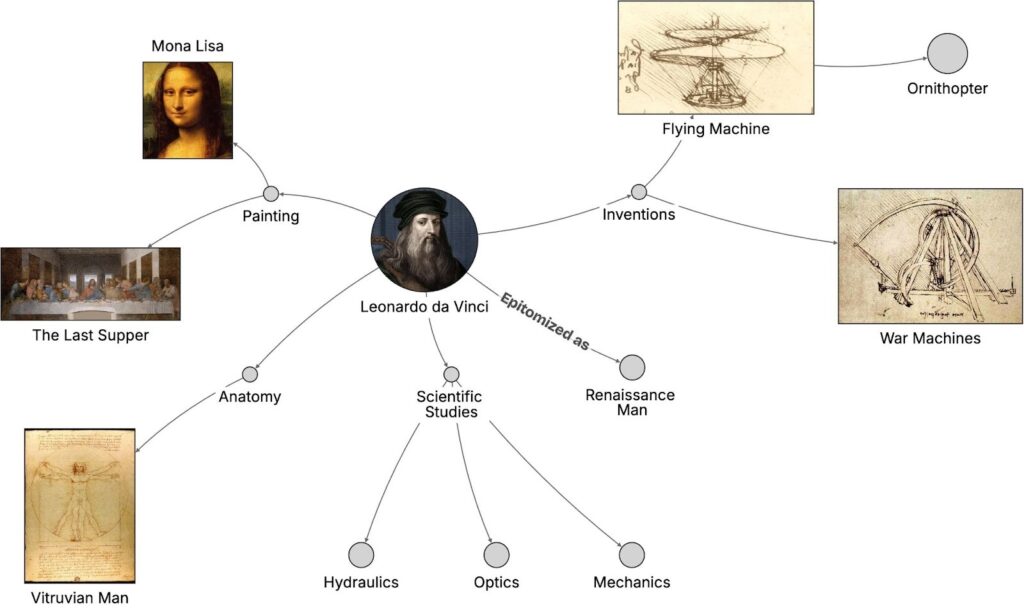
Mind Map showcasing Leonardo da Vinci’s Brilliance (made with Nodeland)
Using mind maps to summarize textbooks and lectures
If one advantage had to be picked that stands out, it would be how mind maps make it easier to summarize long readings. Instead of rewriting bullet-point lists or highlight after highlight, it’s possible to finish a chapter and make a map in just 20 minutes.
Summarizing with a mind map means you must focus on main ideas and relationships, not every minor detail. That shallow scan of content is valuable because it forces you to choose what is important to remember.
When listening to lectures or classes, it is helpful to jot down keywords and information, without worrying too much about being organized. Then build a mind map after, linking them to the major themes. If a teacher shares an example or a story, you can add it to the related branch as a quick sketch or bold note. This keeps notes alive and easy to revisit, unlike static outlines.
- After reading a chapter, pause and quickly sketch the main structure—topic, themes, subthemes.
- Add facts, diagrams, and connections as you recall them, not as a copy-paste job.
- Ask yourself: how do these ideas fit together? Can I explain it from the map?
When going back to review, many students find it much easier to recite what they’ve learned just by looking at the map. It becomes a true memory trigger.
How mind maps help memorization and recall
Many college entrance exams don’t just ask for facts—they require quick recall and connections. Mind maps can become a secret weapon because of how they mirror the brain’s own pathways.
The act of building and revisiting a mind map strengthens memory more than passive rereading ever will. When you branch out ideas, you make physical links in your notes and mirror them by enforcing mental connections in your mind.
If you add images, color, or drawings for certain facts, those visuals create a memory “hook.” For example, a red mitochondrion drawing on a biology map can help recall its function on the test. It is interesting to notice how, when trying to recall information from the map, you might first remember where it was placed.
- Spaced Repetition: Review your mind map at spaced intervals — first after you make it, then a day later, then a week later.
- Mnemonics: Link challenging concepts with memorable symbols, drawings, or even short mnemonics in your map.
- Cognitive Fit: Some information is easier to understand when it is visualized. As humans, we are constantly using mental models (mind maps included) to make sense of the world.
Every review gets faster; every connection grows stronger.
Quick Tips to make your mind maps more effective
Mind mapping is flexible. After years of testing what works, these tips can make maps more powerful:
- Keep branches short—use keywords and not whole sentences.
- Mix in small sketches, icons, or color coding to help memory.
- Leave space to add information later as you find gaps.
- Connect related branches with lines, arrows, or symbols if there’s overlap.
- Don’t aim for perfect art—focus on meaning, not looks.
- Try to build your mind map after you’ve finished reading, not just copying from a book. This will force you to recall what the most important parts were.
- Don’t worry about your mistakes; they will show you what to review and study again.
Conclusion: building a lasting understanding with mind maps
Mind maps can change the way students prepare for tests, write essays, and study complex topics during college prep. They help reveal connections, accelerate recall, and organize ideas that would otherwise get lost in long notes.
If you feel stuck or overwhelmed with your study routines, mind maps can offer a fresh start and a powerful learning support tool. Even giving this approach a try for one subject or project can make a real difference.
The more they are used, the more confident and prepared learners tend to feel—not just for exams, but for learning itself.
