



Looking at Boston College this year? Let’s start with the numbers.
The school officially announced a 13% percent admission rate for the Class of 2029, meaning they extended only 5,000 offers to a pool of nearly 40,000 applicants. To put it simply: if you’re considering applying these days, you’re facing a highly selective applicant pool with very strong academic profiles.
What makes it so popular among students? For those who align with the university’s faith-based mission, BC is a unique home that blends a Jesuit liberal arts core with access to Boston’s thriving academic and career network. Not to mention strong sports teams and vibrant school spirit.
So, how does BC stand out from other colleges in the area? What makes BC different? To learn more, let’s dive into the BC acceptance rate for 2025 and what it takes to gain admission!
About Boston College (BC): at a glance
Of course, there’s more than just Boston to enjoy life as an Eagle. With an intimate learning environment (with an average 10:1 student faculty ratio), students are given the best of both worlds.
- Campus: Private Jesuit research university in Chestnut Hill, Massachusetts. Undergraduate enrollment is around 9,600.
- Application timeline: ED I due November 1. ED II due January 2. RD due April 1.
- Essays: BC requires the Common App plus one supplemental response of up to 400 words. (Human-Centered Engineering applicants answer a dedicated prompt.)
- Testing policy: BC remains test optional. Students who do not submit SAT or ACT receive full consideration. That said, many still choose to send scores.
Architecture enthusiasts, be sure to check out the gorgeous Gothic buildings that make up the views around campus:
What else should you know?
Boston College’s undergraduate experience spans four schools: Morrissey College of Arts and Sciences, Carroll School of Management, Lynch School of Education and Human Development, and Connell School of Nursing. Make sure your application reflects alignment with your intended school’s offerings, no matter your choice.
The BC acceptance rate in 2025
Looking at the Boston College admission data, here’s what we’re seeing.
What the last five cycles show:
- Class of 2029: 13.9 percent, after waitlist and updates.
- Class of 2028: 14.7 percent.
- Class of 2027: about 15 percent.
- Class of 2026: about 16 percent.
- Class of 2025: about 18.9 percent.
While the numbers may vary slightly, the trends are the same. Selectivity has tightened from roughly 19 percent to about 14 percent in five cycles, driven by sustained application volume and strong academics among admits.
Class of 2029: average accepted student profile
Curious how the new Class of 2029 stacks up? At decision release for 2029 admits, here’s how they stand:
- 95 percent ranked in the top 10 percent of their class.
- 74 percent submitted standardized test scores despite test optional.
- Among those who submitted, the average scores were SAT 1503 and ACT 34.
For enrolled first years, the university’s census snapshot lists an average SAT of 1471 and ACT of 34, aligning with a highly prepared cohort.
Curious about transfer or international applicants?
BC accepts transfer students, though space is limited. Competitive transfer applicants typically have a strong college GPA and alignment with BC’s Core Curriculum. International students are evaluated with the same rigor, and financial aid is need-aware. Confirm English proficiency requirements and consider submitting SAT/ACT scores if you can to strengthen your profile.
What does all this mean for you?
Expect competition similar to other top private universities. Recent BC pools have been large, and academic profiles at the top end remain strong year over year.
Even better? Plan your testing and Early Decision strategy early and keep your narrative tightly aligned to BC’s values.
How to build a successful BC application
Let’s get to specifics. How can high school applicants to Boston College use this information to strategize going forward?
Align with BC’s academic core
If you want to give yourself the best odds, show rigorous coursework in English, history, math, lab science, and world language. Use your activities and essays to highlight curiosity across disciplines. The Core Curriculum shapes all degrees, so connect your interests to BC’s intellectual community.
Use the 400-word supplement purposefully
Don’t waste your essays! Answer each prompt with a clear story and a concrete outcome. If you apply to Human-Centered Engineering, focus on design thinking, impact in health, energy, or environment, and teamwork.
Know your round strategy
If possible, decide on your preferred application round well before senior year. For BC in particular, ED I or II can raise your odds… that is, if BC is a true first choice (and cost works for your family). These rounds are notified in December and February. Regular Decision applicants hear by April 1.
Understand BC’s aid philosophy:
BC meets the full demonstrated financial need of all admitted domestic students, but does not offer merit-based scholarships for undergraduates. Make sure to submit FAFSA and CSS Profile forms by the published deadlines. If affordability is a major concern, factor this into your ED vs RD decision, since ED is binding.
Plan your testing approach
BC remains test-optional through 2025. Still, most admitted students submitted scores last cycle and the averages were high. If your SAT or ACT strengthens your profile, include it. If not, invest that time in coursework, graded samples for certain majors, and the supplement.
Document impact beyond titles
BC pays attention to what you did, not only what you joined. Track results, hours, people you served, and any recognition tied to your work. Then translate that into a short, specific activities list that reads like outcomes.
Mind the details that signal fit
Love Boston College? Know that you would thrive there? Show that you care! Reference BC programs, centers, or courses that match your goals, like the Schiller Institute or a specific Carroll School curricular feature if you aim for management. More than anything else, keep it specific and authentic.
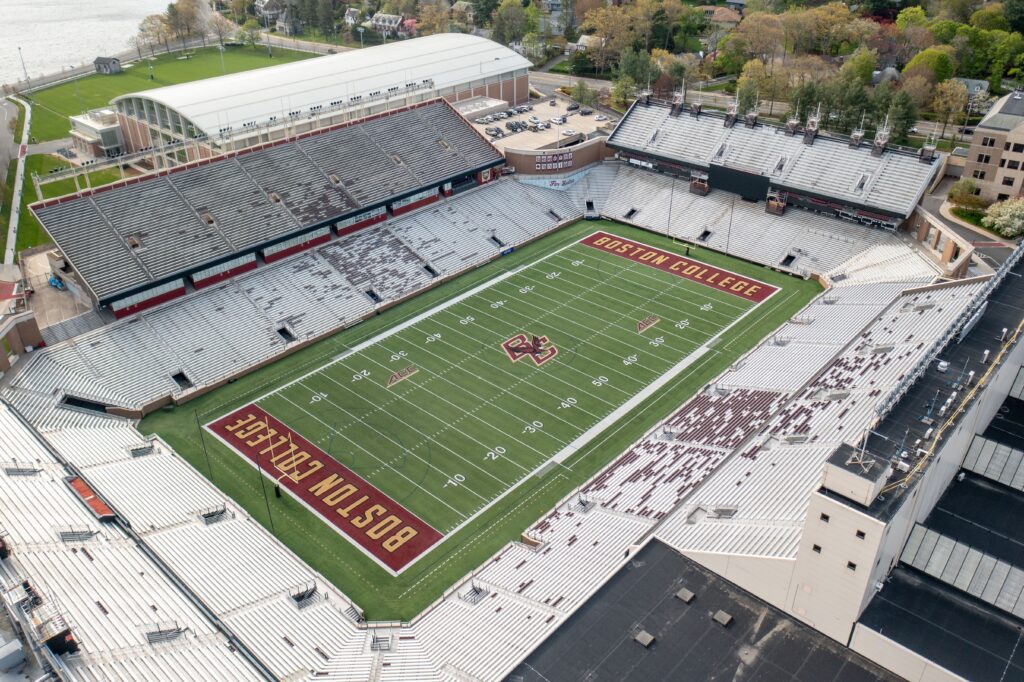
Life at BC
What does it look like, on the ground?
Academic experience
Students complete the Core while exploring majors in Morrissey, Carroll, Lynch, and Connell. Human-Centered Engineering adds project-based learning on real problems in health, energy, and environment. This mix of core breadth and focused study is a BC hallmark.
Career outcomes
Six months after graduation, 96 percent of the Class of 2024 were employed, in graduate school, or in a service or fellowship role. The median starting salary reported was about 74,500 dollars. These outcomes reflect strong advising and industry ties.
Campus culture
Students engage in service, student organizations, and Division I athletics. Proximity to the city of Boston expands internship and research options year round, with the university’s network supporting job searches through the Career Center.
The bottom line
If you’re hoping to gain admission to Boston College as a student, it won’t be easy. But all the best things in life are worth the work!
When it comes to odds, BC sits in the highly selective range (with a five-year trend toward more applications and lower admit rates). The Class of 2029 combines strong academics with a broad mix of interests, and the university’s Boston location adds internships and research that lead to strong outcomes.
If you plan to apply, build a course plan that shows rigor, write a focused 400-word supplement, and choose the round that matches your readiness and budget.
What to do this month (for juniors and seniors):
- Juniors: Research BC’s four schools and find a few classes or faculty that align with your goals.
- Seniors: Lock in your application round, finish your supplement draft, and prep materials if you’re applying test-optional.
- All students: Review BC’s mission and reflect on how your service, academics, and goals show alignment.
Want help building a BC-ready application strategy, including your supplement and round choice? We can help. Talk with an Empowerly coach to map your plan and move forward with confidence.

