Applications
UVA Acceptance Rate 2026: GPA, SAT Scores & Admissions
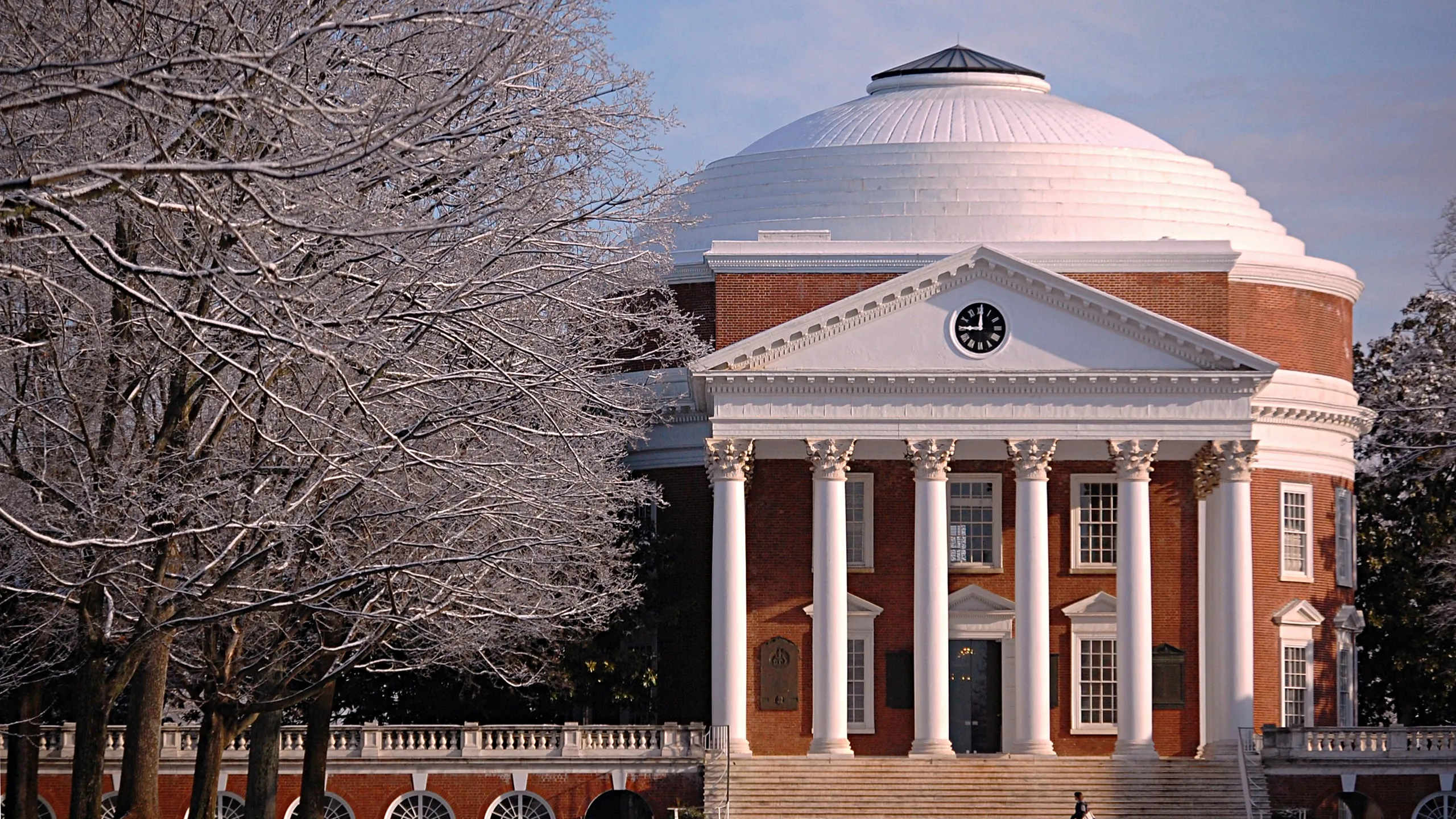
With a record-low 12.53% acceptance rate for the Class of 2030, the University of Virginia is now one of the most competitive public universities in the U.S.
Founded in 1819 by Thomas Jefferson, it's ranked #4 public school in the U.S. Just based on that, you know it's not easy to get into UVA.
Now, here's something most prospective students don't realize about 2026: UVA just experienced the largest single-year application surge in its history. Applications jumped 27.4% in one cycle — from 64,463 for the Class of 2029 to a staggering 82,118 for the Class of 2030. Picture this: more than 82,000 students competing for roughly 3,970 spots. The takeaway? UVA has transformed from a selective public school into one of the most sought-after universities in the country, public or private.
In this guide, you'll learn how to get into UVA, what GPA and SAT scores you'll need, and what the admissions team really looks for in applicants.
How Competitive Is UVA in 2026?
UVA received a record 82,118 applications for the Class of 2030 — an all-time high. Only 10,287 students were admitted, making this year's UVA acceptance rate just 12.53%.
That's a significant drop from just a few years ago:
- Class of 2024: 22.6%
- Class of 2026: 18.7%
- Class of 2028: 16.3%
- Class of 2029: 15.4%
- Class of 2030: 12.53%
If you're applying to UVA soon, know this: UVA has grown more selective each year. And as more students from across the U.S. and around the world apply, your application needs to stand out.
Here's the deal — the Class of 2030's 27.4% application surge wasn't random. UVA officials pointed to a significant change in application requirements (UVA dropped certain barriers to applying), combined with the university's surging national reputation as a "Public Ivy." Whatever the cause, the result is clear: record applications and a record-low acceptance rate. and around the world apply, your application needs to stand out.
In-State vs. Out-of-State Admission
UVA is a public university, which means Virginia residents get an edge. For the Class of 2030:
- In-state acceptance rate: 22%
- Out-of-state acceptance rate: 10%
UVA aims to maintain a roughly two-thirds in-state, one-third out-of-state balance, as required by the Virginia state legislature. That said, out-of-state applicants are still admitted in large numbers — they just face stiffer competition.
Want to know just how stark the gap gets? In the Regular Decision round for the Class of 2030, out-of-state applicants faced a brutal 6.97% acceptance rate (1,423 admitted from 20,390 applicants), while Virginia residents saw a 7.4% RD rate. The bottom line? If you're an out-of-state applicant, the early rounds matter enormously — more on that below.
UVA Rankings and Reputation
Ranked #4 among public universities by U.S. News, UVA attracts high-achieving students from all 50 states and over 100 countries. It's also ranked:
- #24 among all U.S. universities (public + private)
- #3 best value public college (Forbes)
- Top 10 for undergraduate business and engineering programs
- The only university in the U.S. designated a UNESCO World Heritage Site
UVA's appeal? A rigorous academic culture, strong career outcomes, and a vibrant campus community. As both a "Public Ivy" and a "New Ivy," UVA delivers elite academics at a public-school price point — especially for Virginia residents.
GPA and Class Rank Expectations
UVA doesn't publish a minimum GPA, but the numbers speak for themselves:
- 75% of admits had a GPA of 4.0 or higher
- 85% ranked in the top 10% of their high school class
- Nearly all admitted students had taken AP, IB, or honors courses
To stay competitive, aim for a 4.3+ weighted GPA and take the most challenging courses your school offers.
Here's the kicker: with the Class of 2030's acceptance rate dropping to 12.53%, the GPA bar is effectively higher than ever. A 4.0 unweighted GPA is now closer to the baseline expectation than a standout credential — especially for out-of-state applicants who face single-digit acceptance rates in some rounds. Course rigor is what increasingly separates admitted students from the rest.
SAT and ACT Score Guidelines

UVA is test-optional (through at least the 2025-2026 cycle), but submitting strong scores can boost your chances.
- 25th percentile: 1410
- Median: 1450
- 75th percentile: 1510
- 25th percentile: 32
- Median: 33
- 75th percentile: 34
UVA superscores both tests — meaning they'll take your highest section scores across multiple sittings.
Our expert tip:If your SAT is 1450+ or ACT is 33+, send it. If it's lower, your essays and transcript matter more.
Now, here's something worth watching: with peer institutions like MIT, Harvard, Yale, Stanford, Brown, Dartmouth, and the University of Michigan all reinstating test requirements, there's growing speculation that more public flagships could follow. For now, UVA remains test-optional — but submitting a strong score has become an increasingly valuable way to stand out in a record-breaking applicant pool. When in doubt, a competitive score helps far more than it hurts.
What UVA Looks for in Applicants

UVA uses a holistic admissions review. There's no algorithm, rubric, or formula. Instead, admissions officers consider:
- Course rigor (AP, IB, dual enrollment)
- GPA and class rank
- Personal and supplemental essays
- Teacher recommendation (1 required)
- Optional counselor recommendation
- Extracurriculars and leadership
- Background, experiences, and personal growth
They also look for "fit" — how well you align with UVA's values of leadership, community, and intellectual curiosity.
Want to know what's changed since the 2023 Supreme Court decision on affirmative action? UVA can no longer consider race or ethnicity in admissions decisions, and it no longer has access to demographic information on applications. In response, the University added a required essay prompt that gives applicants the opportunity to discuss their personal background and experiences — including, if they choose, how race or ethnicity has shaped them. Translation? Your essays are now an even more critical vehicle for conveying your full identity and story.
UVA Application Requirements
Here's what your UVA application should include:
- Common App + personal statement
- UVA supplement (1 required, 1 optional)
- 1 teacher recommendation
- Mid-year transcript
- Final transcript (if admitted)
- SAT/ACT scores (optional)
- Arts/architecture portfolio (optional)
Suggested high school coursework:
- 4 years of English
- 4 years of Math
- 2–4 years of Science
- 2–4 years of Foreign Language
- 1–3 years of Social Studies
Take advanced classes wherever possible. UVA wants to see that you've pushed yourself.
UVA Application Deadlines
The UVA Application Deadlines apply to both first-year and transfer applicants. Here are the dates:
- Early Decision (ED): Nov 1
- Early Action (EA): Nov 1
- Regular Decision (RD): Jan 5
- ED Notification: By Dec 15
- EA Notification: By Feb 15
- RD Notification: By Apr 1
- Enrollment Decision Due: May 1
Early Decision is binding and has a higher acceptance rate. For the Class of 2030, ED acceptance was 24% — roughly double the EA rate and more than triple the Regular Decision rate.
Should You Apply Early to UVA?

If UVA is your first-choice school and you're ready to commit, Early Decision gives you a better shot.
Here's the breakdown for the Class of 2030:
- ED acceptance rate: 24%
- EA acceptance rate: 12.4%
- RD acceptance rate: 7.08%
But be sure UVA is the right academic, social, and financial fit — because if you're admitted to ED, you're committed.
Picture this: for the Class of 2030, Early Decision was the "great equalizer" between in-state and out-of-state applicants. The residency gap in the ED round was just two points (25% in-state versus 23% out-of-state) — compared to a massive gap in Early Action, where in-state applicants (22.8%) were admitted at more than double the out-of-state rate (9.8%). The takeaway? For out-of-state families, Early Decision is the single pathway where Virginia residency matters least. If UVA is genuinely your top choice and you're an out-of-state applicant, ED is your strongest play.
Here's a striking statistic: roughly 75-78% of admitted UVA students now apply through one of the early rounds. For the Class of 2026, 7,355 of 9,503 admits (78%) came through Early Decision or Early Action. If you wait for Regular Decision, you're competing for a shrinking pool of spots.
UVA Essay Tips
UVA's supplemental prompts help the admissions team understand your values, perspective, and personality.
Prompt 1 (100 words, optional):
Share any personal or historical connection to UVA — such as a family member who graduated or past involvement with university programs.
Prompt 2 (250 words, required):
Describe how your background, experiences, or identity will contribute to UVA.
- Show how you think, not just what you've done
- Avoid clichés — be specific and personal
- Reflect on how your values align with UVA
- Don't waste the optional prompt — use it if relevant
Key Stats for UVA Applicants
| Stats (Class of 2030) | |
|---|---|
| Applications | 82,118 |
| Admitted | 10,287 |
| Acceptance Rate | 12.53% |
| In-State Rate | 22% |
| Out-of-State Rate | 10% |
| ED Acceptance Rate | 24% |
| EA Acceptance Rate | 12.4% |
| RD Acceptance Rate | 7.08% |
| SAT Range (Mid 50%) | 1410–1510 |
| ACT Range (Mid 50%) | 32–34 |
| GPA: 4.0+ | 75% of admitted students |
| Top 10% Class Rank | 85% |
How UVA Compares to Other Top Public Universities
Want to know how UVA stacks up against its peer public flagships in 2026? Here's the deal — UVA competes for the same applicants as a handful of elite public universities, and understanding the landscape helps you build a smart college list.
For starters, here's how UVA compares to its closest public-university peers:
- UVA vs. UC Berkeley: Berkeley (acceptance rate ~11%) is larger and located in a major metro area, with powerhouse STEM and research programs. UVA offers a more intimate, residential experience with a stronger emphasis on undergraduate teaching and a tight-knit honor culture.
- UVA vs. UCLA: UCLA (acceptance rate ~9%) is the most-applied-to university in the country, with a huge student body and strong programs across the board. UVA is smaller, more residential, and offers a stronger in-state advantage for Virginia residents.
- UVA vs. University of Michigan: Michigan (acceptance rate ~15%) is a larger research university with Big Ten athletics and a sprawling campus. Michigan reinstated test requirements for 2026-27, while UVA remains test-optional. Both are considered "Public Ivies."
- UVA vs. UNC Chapel Hill: UNC (acceptance rate ~17% overall, but far lower for out-of-state) is UVA's closest regional peer. Both are elite Southern public flagships with strong in-state preferences. UNC caps out-of-state enrollment at 18%, making it even harder for non-residents than UVA.
- UVA vs. Georgia Tech: Georgia Tech (acceptance rate ~16%) is STEM-focused and reinstated test requirements in 2025. UVA offers broader liberal arts and business programs alongside its strong engineering school.
- UVA vs. College of William & Mary: Also in Virginia, William & Mary (acceptance rate ~33%) is smaller and slightly less selective. Many Virginia students apply to both as in-state options.
The takeaway? UVA's combination of a strong in-state advantage, three distinct application rounds (including binding ED), a UNESCO World Heritage campus, and elite "Public Ivy" academics makes it distinct even among top public universities. For Virginia residents especially, UVA offers an exceptional value proposition that's hard to beat.
Common Mistakes UVA Applicants Make
Now, here's something most prospective students don't realize until it's too late. The biggest mistakes that derail UVA applications often have nothing to do with grades or scores — they're about strategy, fit, and execution.
Want to know what to avoid?
- Mistake 1: Out-of-state applicants ignoring the early rounds. With out-of-state Regular Decision acceptance rates at 6.97%, waiting for RD as a non-Virginian is the hardest possible path. If UVA is your top choice and you're out-of-state, Early Decision (where the residency gap nearly disappears) is dramatically more favorable.
- Mistake 2: Writing a generic "why UVA" essay. UVA's required 250-word prompt asks how your background and experiences will contribute to the community. Generic answers about "great academics" or "beautiful campus" waste this opportunity. Reference specific UVA programs, traditions (the Honor System, the Lawn, Final Exercises), or values.
- Mistake 3: Skipping the optional 100-word prompt. If you have any genuine connection to UVA — a family member who attended, a program you participated in, a meaningful visit — use the optional prompt. Leaving it blank when you have something authentic to share is a missed chance to show demonstrated interest.
- Mistake 4: Underestimating course rigor. With 85% of admits in the top 10% of their class and most having taken extensive AP/IB/honors courses, a strong GPA in easy classes won't cut it. UVA wants to see you challenge yourself with the hardest courses available at your school.
- Mistake 5: Treating UVA as a "safety" because it's public. With a 12.53% overall acceptance rate (and single-digit rates for out-of-state RD applicants), UVA is a reach school for nearly all applicants. Build a balanced college list and treat UVA accordingly.
- Mistake 6: Withholding a strong test score. While UVA is test-optional, a score at or above the median (1450 SAT / 33 ACT) is a meaningful asset in a record-breaking applicant pool. Don't withhold a competitive score just because you can.
- Mistake 7: Not demonstrating fit with a specific school. UVA admits students to specific schools (College of Arts & Sciences, Engineering, Architecture, Nursing, Kinesiology). Make sure your application clearly conveys why you're a fit for the specific school you're applying to.
The bottom line? In a year when UVA received a record 82,118 applications, execution and strategy matter more than ever. Every component — essays, course selection, application round, optional test scores — should reinforce a clear, compelling case for why you belong at UVA.
Empowerly's Role in Your UVA Application Journey
UVA isn't just looking for top students. They want thinkers, leaders, and contributors. Empowerly's college counseling helps you build a competitive, authentic application that highlights your best qualities.
From academic planning to essay editing, our expert team helps you:
- Strengthen your GPA and course rigor
- Decide whether to submit test scores
- Craft standout personal and supplemental essays
- Strategically select Early Decision, Early Action, or RD
- Showcase your leadership, impact, and goals
We've worked with thousands of students applying to top schools like UVA — and we'll guide you every step of the way.
Your UVA Application Process Starts Here
With the right application strategy and support, you can maximize your odds of joining the UVA community.
With the help of our expert college counselors (the highest-rated in the country), you can increase your admission odds dramatically. Book a free consultation today and let's begin the process.