Who uses legacy admissions, and how much do they impact students' acceptance odds?

When the Supreme Court found affirmative action unconstitutional in 2023, critics turned immediately to legacy preference. Legacy preference is the practice of giving children of alumni/ae special consideration in admissions. Critics contend legacy consideration undermines meritocracy and favors wealthy White students.
Court documents in the lawsuit from Students for Fair Admissions (SFFA) showed Harvard University admitted legacy applicants at more than five times the rate of regular applicants. A single institution makes for strong headlines but says nothing about how widespread the practice is, or whether we should be concerned about the number of students displaced by legacies.
In this report, we compare the 2021–2022 and 2024–2025 admissions cycles — the last before the Supreme Court ruling, and the most recent figures from Peterson’s Undergraduate Institutional Dataset. We will first report our findings, then discuss the extent to which legacies displace other applicants.
Legacy preferences fell, but are far from disappearing.
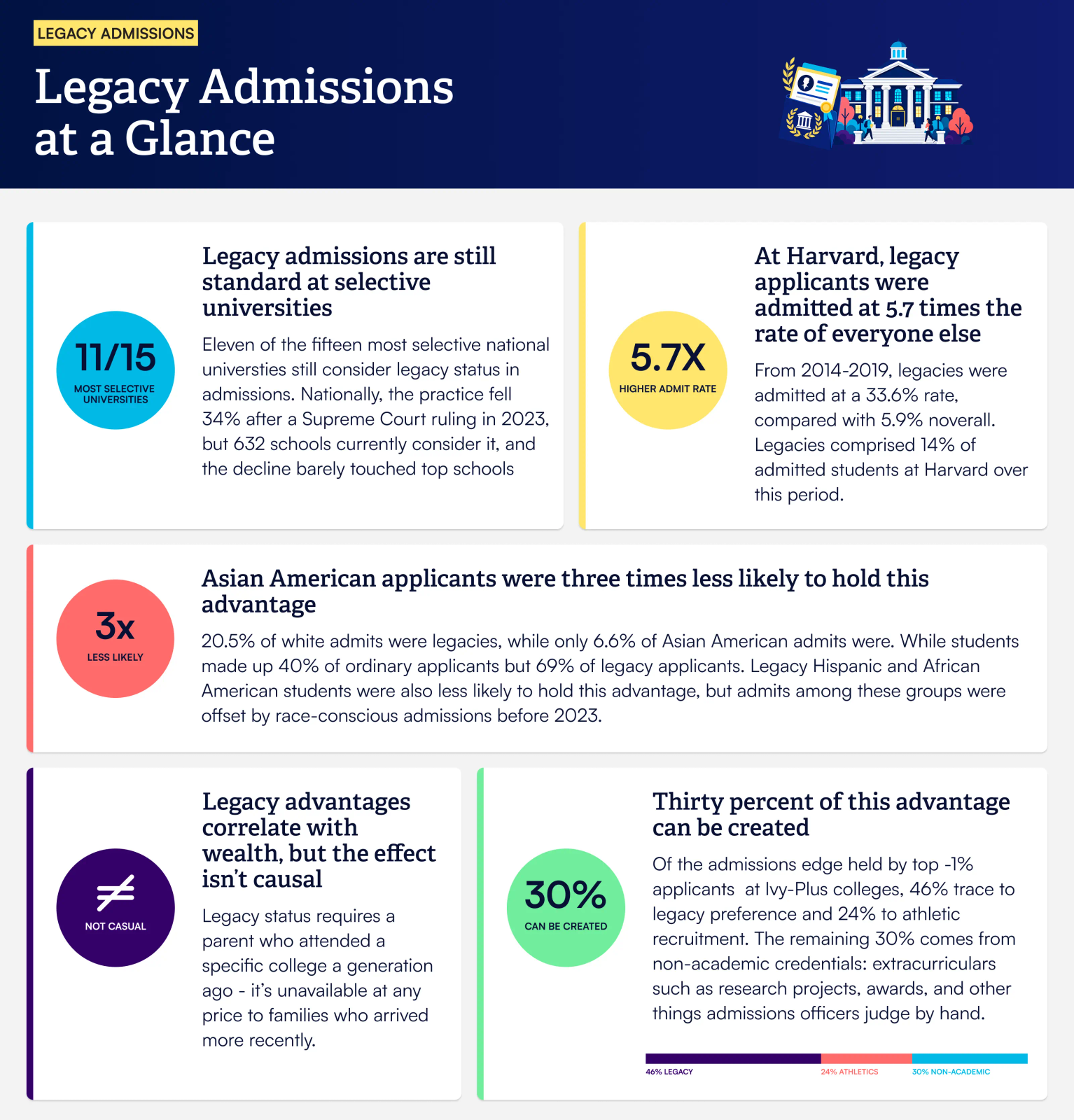
Across the 2,263 institutions that appear in both the 2021–2022 and 2024–2025 Common Data Sets (see Data below), the number of schools reporting that they consider an applicant’s alumni/ae relationship fell from 811 to 533, a decline of 34%. However, the headline number conceals movement in both directions: 361 schools abandoned legacy preference over this period, 83 began reporting it, and 450 carried it through unchanged.
Before the Supreme Court decision, race-conscious and legacy admissions traveled together.
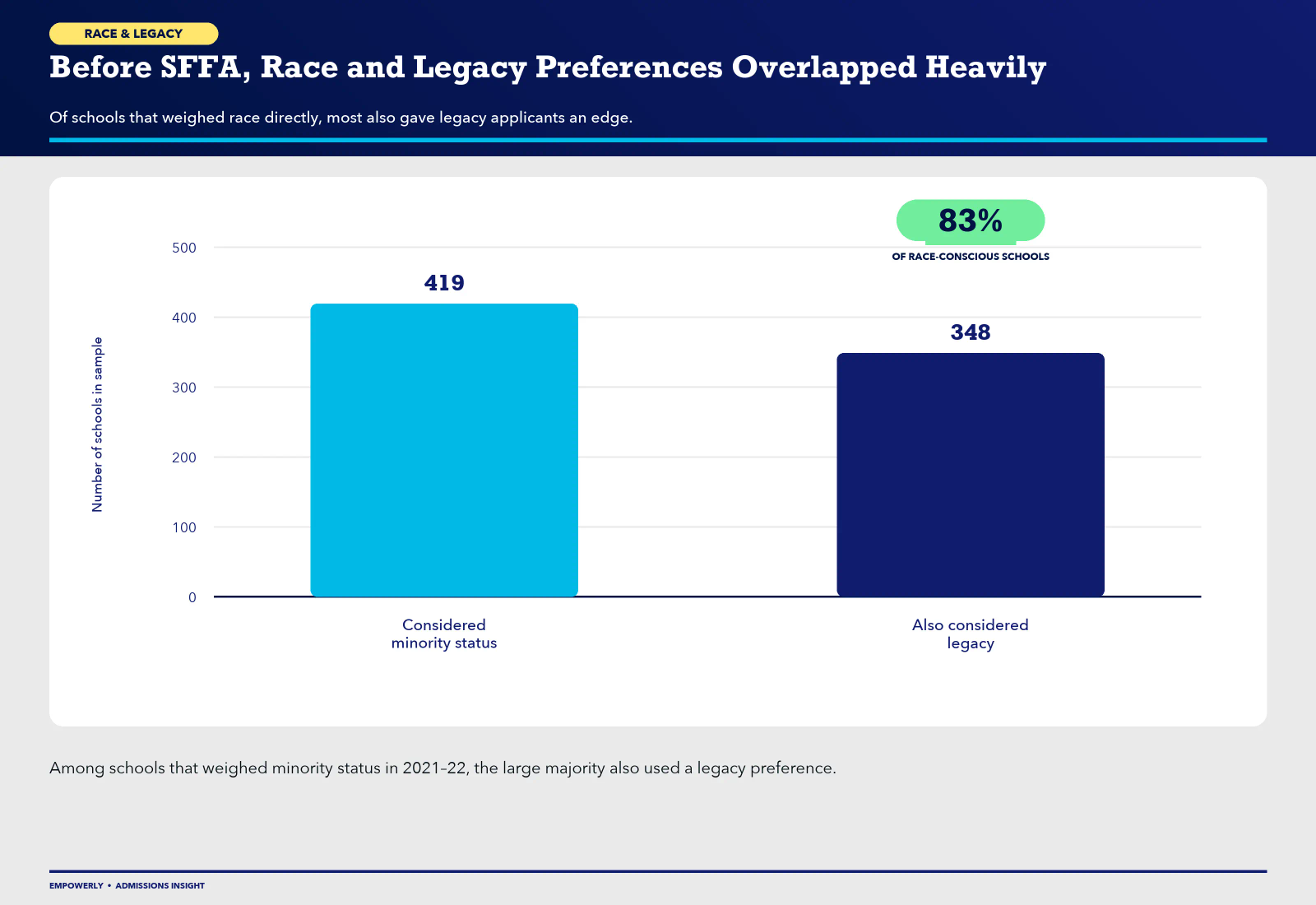
In the 2021–2022 cycle, among the 419 institutions that reported weighing minority or ethnic status, 348 (83%) also extended a preference to legacies. The schools most engaged in race-conscious admissions the Court would go on to prohibit were often the same schools extending a hereditary advantage.
Legacy preference is most concentrated at selective institutions.
Consideration of legacy is most common among schools that admit fewer than one in five applicants. Although it fell in every selectivity tier after the SFFA decision, it remains the norm at the very top. Of the fifteen highest-ranked national universities that could be matched to the data, eleven still considered legacy in the 2024–2025 cycle.
Legacy admissions impacts acceptance rates for certain racial groups.
After SFFA, the widely predicted rise in admission rates for White and Asian American applicants at highly selective schools was not borne out. Despite stronger average test scores and academic transcripts, enrollment for Asian American students grew by just 2%, with declines in enrollment at Yale, Harvard, Dartmouth, and Caltech.
This phenomenon can partly be attributed to structural disadvantages Asian Americans still face post-SFFA and legacy preferences. Opportunity Insights found that among applicants with comparable test scores from the top 1% of the parental income distribution, legacy preference accounts for 46% of the admissions advantage. Athletic recruitment accounts for another 24%. Asian American applicants largely don’t benefit from these advantages irrespective of income.
About the data
The figures in this report come from each school’s Common Data Set (CDS), collected and distributed as Peterson’s Undergraduate Institutional Data. The Common Data Set is a standardized questionnaire, developed by Peterson’s, the College Board, and U.S. News & World Report, that thousands of U.S. colleges and universities complete each year. Peterson gathers these institutional submissions and publishes them as a structured dataset, which is the form used here.
The most important section for this study is the CDS admissions factors (question C7 in the standard CDS layout). There, each institution classifies the weight it gives to a menu of up to 19 factors. The dataset encodes these factors (ALUM for relation or legacy; MINOR for minority or ethnic status; along with more familiar academic factors like GPA and test scores).
The Common Data Set rates each factor on a four-point qualitative scale: Very Important, Important, Considered, and Not Considered. Note: these are self-reported, which matters to our analysis. Schools may rate legacy status as “Considered" when, in practice, it functions as “Very Important” to avoid the charge of nepotism.
The two Common Data Sets used in our present analysis describe two distinct cycles: the 2021–2022 edition reflects the class that entered in the fall of 2021, while the 2024–2025 dataset reflects those entering in the fall of 2024. Peterson’s structured Undergraduate Institutional Dataset lags CDS publication. We used these datasets intentionally to capture all schools from the Common Data Set.
The timing also matters because of a single intervening event. Students for Fair Admissions v. Harvard and Students for Fair Admissions v. University of North Carolina were decided on June 29, 2023, ending the lawful use of race as a factor in admissions. The 2021–2022 cycle sits cleanly before the decision and the 2024–2025 cycle after it. We excluded 2022–2023, which the pending judgment may have already shaped. Because the end of race-conscious admissions may have changed how schools use legacy preferences, capturing both cycles matters. Every “before” and “after” comparison in this report traces this dividing line.
Legacy admissions persist at most selective institutions
Selectivity is measured here as the admit rate — admitted first-year students divided by first-year applications — drawn from the 2024–2025 cycle. Ranking institutions this way reproduces a familiar leaderboard, matching U.S. News’s 2026 Best National Universities List.
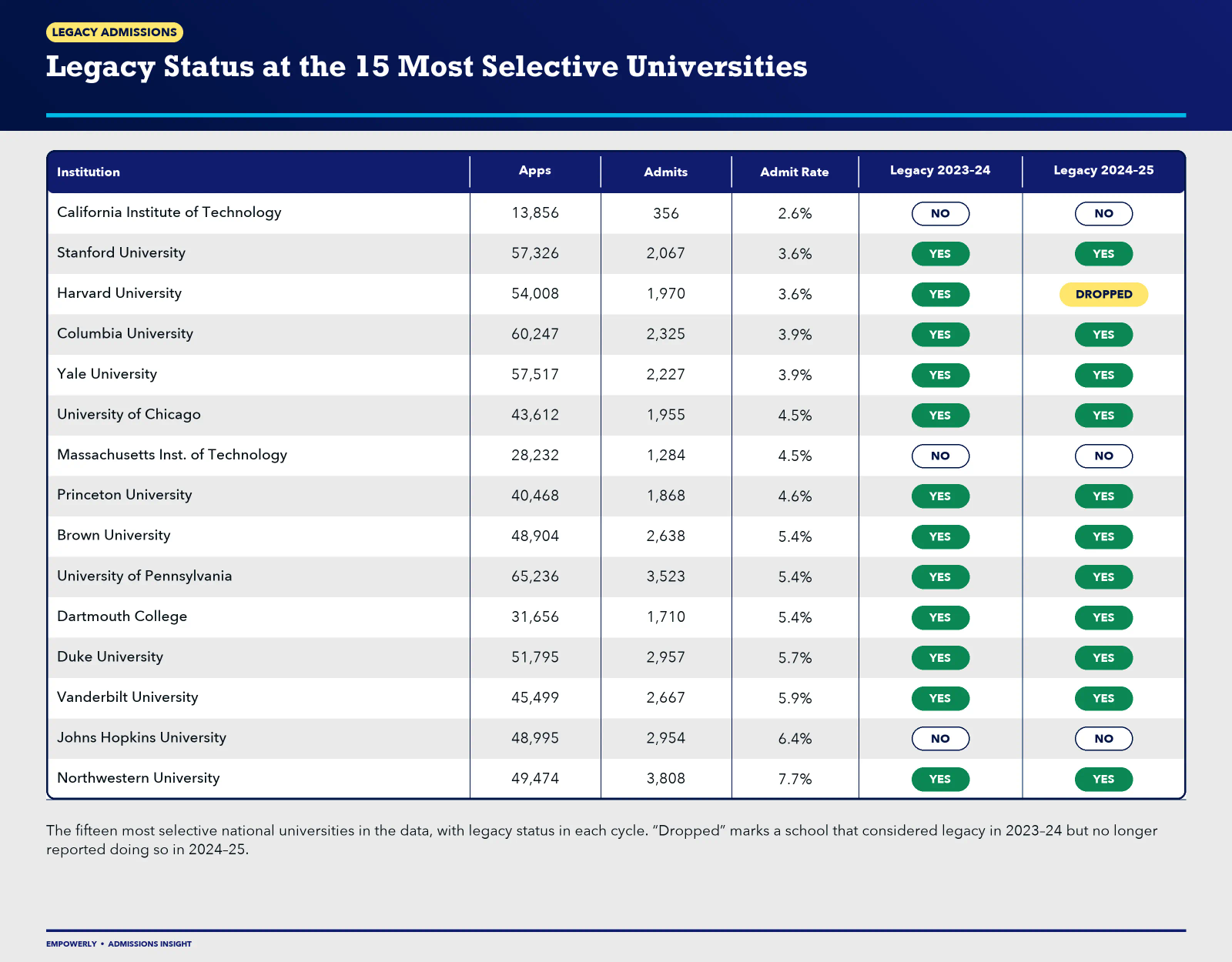
Across America’s fifteen most selective schools, giving legacies preferential treatment is the rule. Twelve of the fifteen weighed it in the 2021–2022 cycle, and only Harvard no longer reported considering it in 2024–2025. The three exceptions are all science- and engineering-focused: Caltech, MIT, and Johns Hopkins.
Within this group, the preference carries more weight precisely because acceptance rates are so low. These schools turn away valedictorians and those with near-perfect test scores every cycle. At sub-10% admit rates, the question is rarely whether admits are capable, but how to choose among a surplus of highly qualified applicants.
Why such a small set of schools warrants attention isn’t obvious — until you look downstream of graduation. Fewer than half of one percent of Americans attend these institutions. Yet, studies find that the twelve Ivy-Plus colleges account for more than 10% of Fortune 500 CEOs, nearly a quarter of U.S. senators, and around three-quarters of Supreme Court Justices appointed in the last half-century.
Whatever admissions decisions these colleges make at the margins, including “considering” alumni/ae relations, are amplified far beyond the size of their entering classes. The prevalence and persistence of legacy preferences at this tier, which we consider in even more detail below, is of analytical importance for the rest of this report.
Before Students for Fair Admissions: minority status overlapped with legacy preferences
In the 2021–2022 cycle (before the Supreme Court decision on race-based admission), 419 schools reported “considering” minority or ethnic status when evaluating applicants. One key finding of this report is the overlap of institutions weighing both minority status and alumni/ae relationships. As reported above, 83% (or 348 schools) also gave a legacy preference. The two policies were, therefore, not competing commitments held by different institutions. Instead, they were the joint practice of a single set of schools.
The schools that weighed both were, by and large, private. They also skewed selective: their median admit rate was 67%, against 77.7% across all institutions in the dataset, and 16% admitted fewer than one in five applicants.
In our words, the universities that layered legacy preference on top of race-conscious review were disproportionately selective private schools. This is critical context. The debate over what should replace race-conscious admissions is unfolding at the same schools that were, and in most instances still are, extending preference to alumni/ae families.
Legacy preferences are less common now, but still widely used
Legacy preferences remain a meaningful practice, even after SFFA. In the 2024–2025 cycle, 632 — this number differs from our earlier figure because it counts newly reporting colleges — of the 2,453 institutions (26%) reported considering legacy. That makes legacy preferences common among reporting schools, though not a majority practice.
-1600x950.webp)
This result deserves careful interpretation. It tells us how many schools consider alumni/ae relationships, but not what that consideration is worth. The CDS does not answer how often this factor changes admissions outcomes or displaces other students.
The level breakdown suggests a constraint: across both cycles, schools using legacy status overwhelmingly list this admission factor as “considered” rather than “important” or “very important.” On the face of it, legacy status looks like a contextual factor. But, as we noted above, admissions factors are not mathematical formulas. Inside the committee room, it’s impossible to know what tipped admissions odds in an applicant’s favor.
Post-SFFA, legacy preferences faced both reputational and legal challenges. Maryland House Bill 0004 passed on April 25, 2024. The law prohibits institutions of higher education that receive state funds — whether public or private — from considering a legacy or donor preference in admissions. Schools may still record familial relationships, but can’t use them.
Virginia’s Governor signed a similar bill in 2024, although more limited in scope: it prohibits considering legacy status only at state universities such as UVA and William and Mary. California went further that same year, extending its existing public-university ban to private nonprofit colleges.
We also shouldn’t dismiss voluntary institutional change: greater scrutiny of legacy preferences has driven some schools, like Harvard, to drop the practice. Yet legacy preference is still a factor at over a quarter of institutions of higher education. If it didn’t matter, institutions would presumably drop it completely to avoid public blowback. They haven’t. So, let’s turn our attention to why.
Why schools prefer legacies
Ask a college president why schools prefer legacies, and you’ll likely receive a short answer: tradition. But that isn’t the honest one. Schools prefer legacies because of money. The conventional wisdom is that parents are likely to donate more if their children (or even grandchildren) receive preferential treatment.
However, the evidence on whether legacy preference actually drives giving is mixed. When one group of researchers tested the donation/legacy preference correlation, the thesis of familial largesse didn’t hold up. In a landmark book, Affirmative Action for the Rich, researchers examined the Top 100 universities from 1998 to 2008. They found no statistically significant link between legacy preferences and total alumni giving after controlling for wealth.
Instead, they found a simpler explanation: selective private schools, in particular, tend to have wealthier alumni/ae. Georgetown University’s Center on Education and Workforce put the value of a four-year degree at America’s most selective schools at $3.30 million compared to $1.74 million for all colleges. These same schools are more likely than others to consider legacy status in admissions. But that’s correlation, not causation. The researchers in Affirmative Action for the Rich found that schools with legacy preferences receive higher donations because their alumni/ae have more to give in the first place.
But another study arrives at the opposite conclusion: in “Altruism and the Child Cycle of Alumni Donations” from the American Economic Journal: Economic Policy, the authors found that gifting increased as the children of alumni/ae neared application age. After a child was rejected, giving to the alma mater stopped. The thesis was that parents expect reciprocal benefits— preferential admissions treatment — in exchange for donations.
So, what’s the correct interpretation? Do alumni/ae donate more if their child receives preferential treatment? Or are universities confusing correlation (money) with causation (legacy admissions)? In practice, it doesn’t matter. Schools believe legacy admissions increase donations, so they keep admitting more legacies.
Another, perhaps even more important, factor in offering legacy preferences is yield rate. Yield is the share of admitted students who actually enroll once accepted. Universities care about yield because it means they don’t have to admit as many students to enroll a full class. A higher yield translates to a lower acceptance rate, burnishing a school’s credentials as an “elite institution.”
And legacies are a yield machine. Another study, “Through the Front Door: Why Organizations (Still) Prefer Legacies,” studied 16 years of admissions data at one elite northeastern college. It found legacy applicants enrolled at a 74% rate, compared with 47% for everyone else. They also skew to full-pay families. Locking up this group benefits colleges in two ways: predictable enrollment and predictable revenue.
Schools often mask these motives in an identity argument. When Texas A&M’s Board of Regents revisited the “Aggie Legacy” preference, one regent openly praised children “raised by” graduates as already knowing “what they’re getting into.” Even if that were true — and for the reasons above, we doubt it — does grounding legacy preference in identity make it any better? It certainly doesn’t make the decisions fairer. Which raises the question this report set out to answer: what happens to the students displaced — the applicants who lose a seat already earmarked for the child of an alum?
What legacy admissions do to your child’s chances
Most families don’t ask the question: if a college says it “considers” alumni/ae relations, how does that impact admissions odds? Is it simply a footnote to be quickly forgotten, or are legacies claiming a seat your child could have had?
For decades, nobody outside an admissions office could answer this question honestly. Then SFFA v. Harvard forced something unprecedented into the public record: 166,727 applications from 2014–2019, including Harvard’s own internal ratings of every single application. Three economists analyzed it in a working paper on how legacy and athlete preferences affect acceptance rates. First, let’s look at the size of the advantage for legacy applicants.
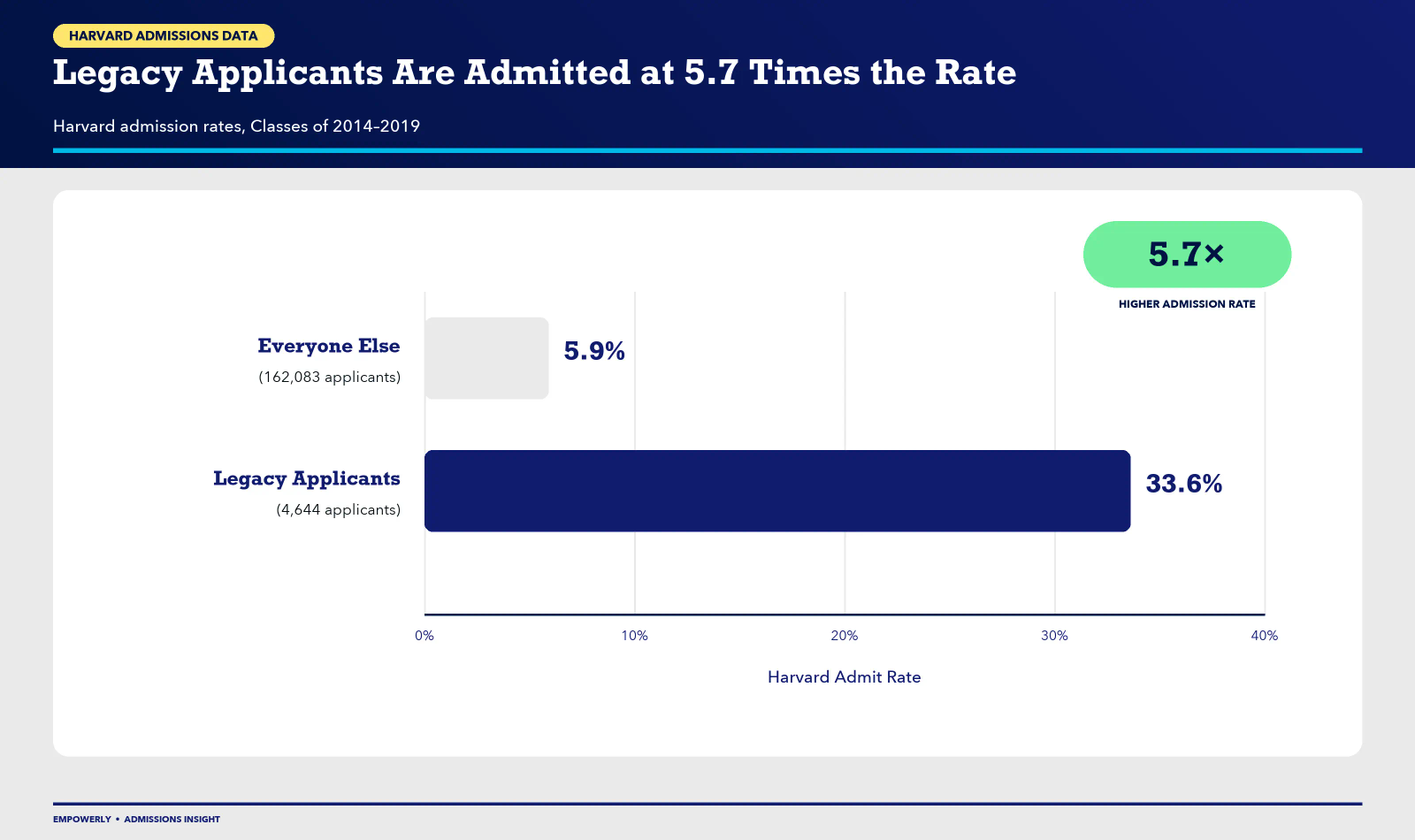
Legacy applicants were admitted at 33.6%, while everyone else was at 5.9%. That is 5.7x the regular admit rate — consistent with the fivefold figure quoted above. There were 4,644 legacy applicants in this pool, and legacies made up 14% of admitted students. This counts only children of alumni/ae, as defined in Harvard’s own admissions files.
That 14% is also the largest of four preferences Harvard tracked, ahead of recruited athletes at 10%, the “dean’s interest list” at 9.5% — an exclusive VIP list of major donors and other “special students” — and the children of faculty and staff at 1.3%. Legacy is the largest group in this category, both in applicants and admits. Counting all four preferences together would produce an even larger number, but we’ll focus on legacy preference for now. Next, we will ask: what do legacy admissions look like across racial and ethnic groups?
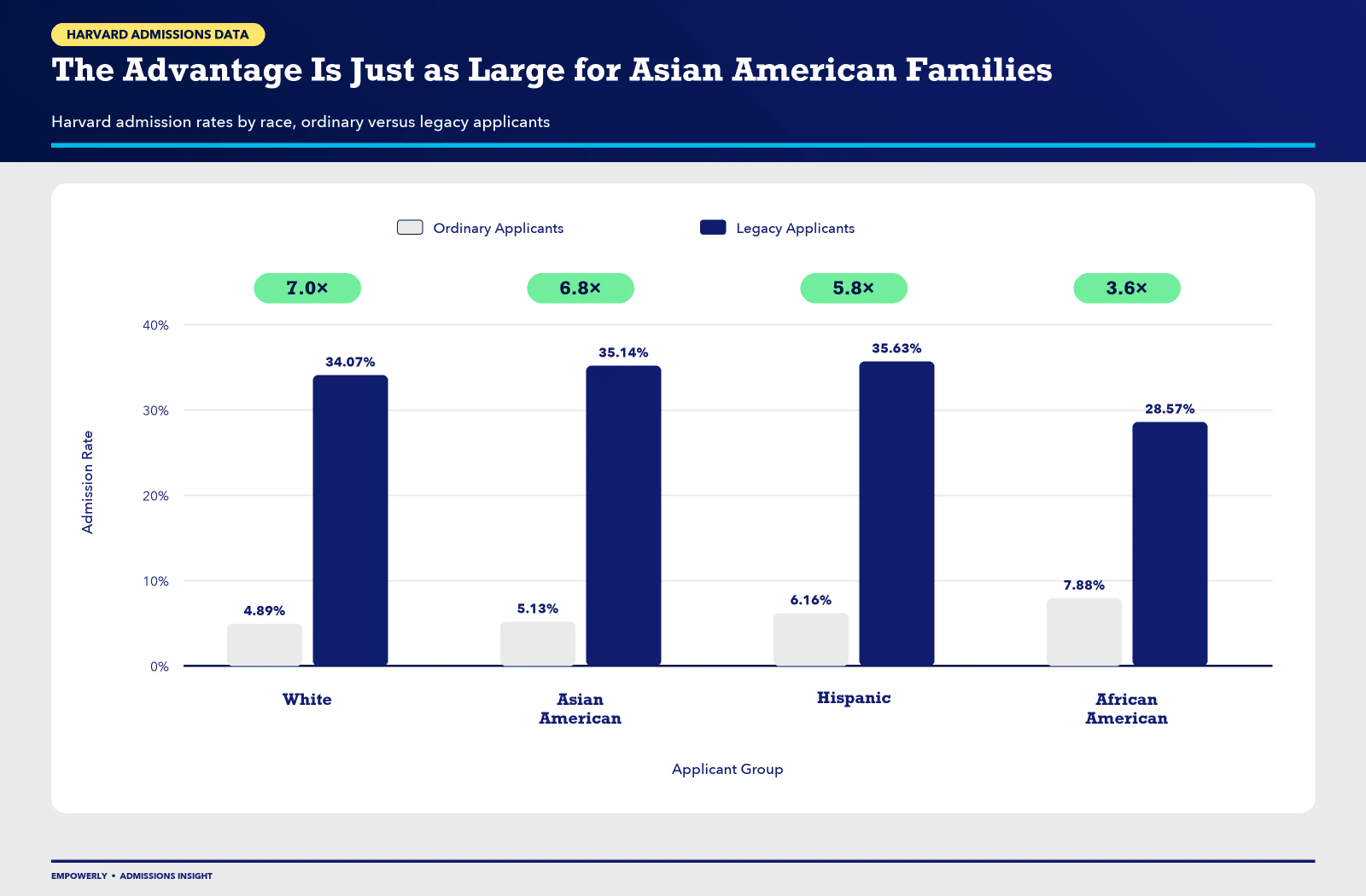
Legacy applicants were admitted at roughly 4x to 7x the rate of ordinary applicants across every racial group, with the two largest multipliers belonging to White applicants (7x) and Asian American applicants (6.8x).
Although take these numbers with a grain of salt: legacies are far more likely to be White, as we’ll see below, making these racially defined admission odds less relevant. The authors suggest Hispanic and African American students benefited less from legacy preference because Harvard was still practicing race-conscious admissions before the SFFA decision: many of these students didn’t need a legacy preference to gain entry.
Given the enormous advantage legacies receive, we need to ask: are legacy applicants simply better candidates? It’s a fair objection, and deserves an honest answer. Perhaps children of Harvard alumni/ae have more advantages — attending better schools and receiving more outside support.
Researchers tested this theory. They modeled Harvard’s admissions decisions against 370 variables, including Harvard’s own internal scores for academic strength, extracurricular achievement, athletic ability, and recommendations. They compared applicants who were identical on paper except for whether a parent had attended Harvard. The advantage remained the same. We can now conclude the following: take one applicant, change nothing except legacy status, and their odds rise roughly fivefold against an otherwise identical applicant.
Who holds the advantage?
Here is where the research turns and begins to matter for your family. A fivefold admissions advantage means nothing if you don’t have it.
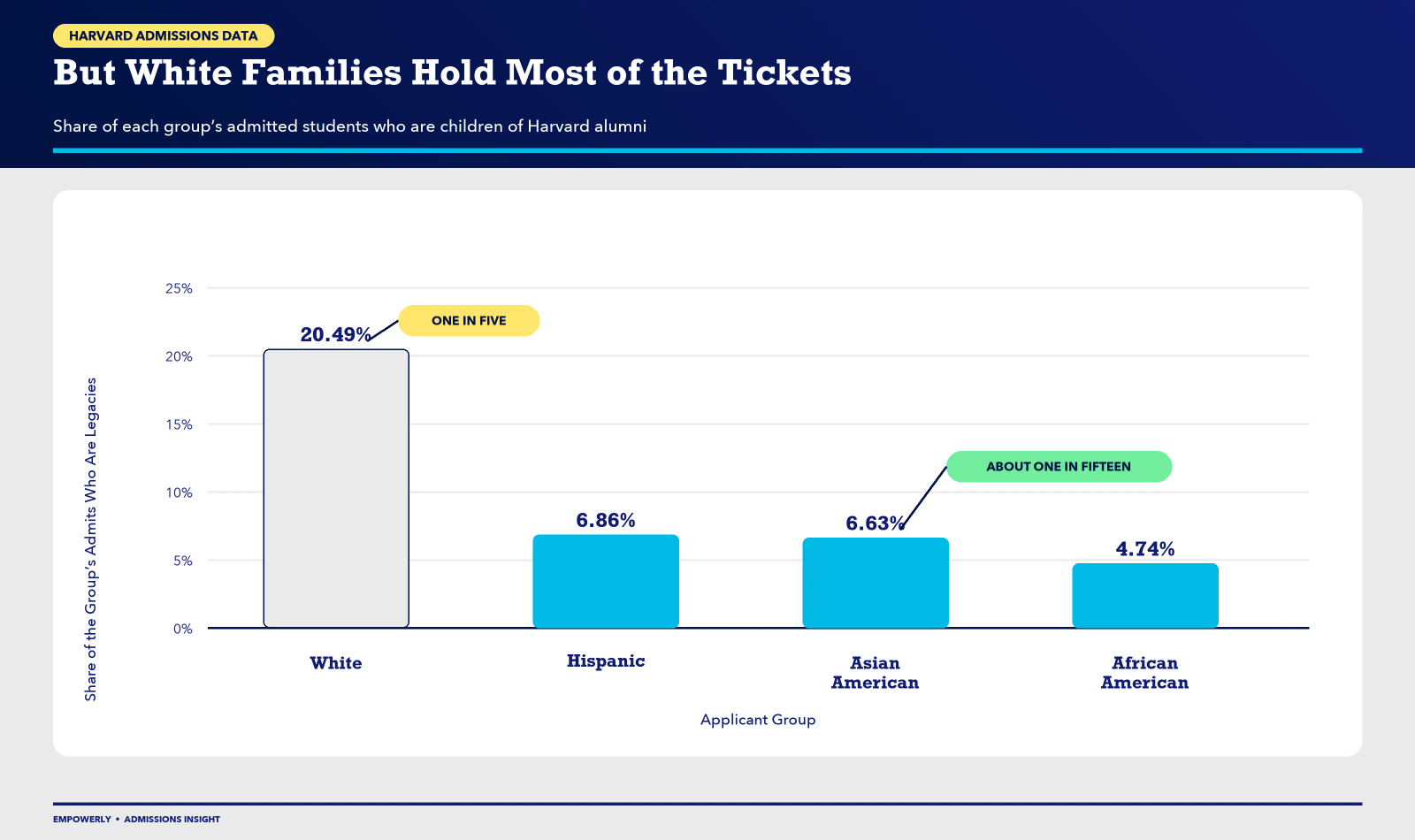
One in five White admits was a legacy, while one in fifteen Asian American admits was — 20.5% against 6.6%, a difference of 3.1x. Looking at it from the other direction: White students were 40% of ordinary applicants but 69% of legacy applicants. So the picture isn’t that the advantage is smaller for Asian American, Hispanic, or African American families. It’s that White families most often hold the legacy ticket.
And this particular ticket is unlike everything else on a college application. Your child can retake their SAT and raise a score. They can take more AP classes and raise their weighted GPA. Legacy status requires a parent who attended that specific college a generation ago — something no family that arrived more recently can acquire.
What would change if elite schools ended legacy admissions?
Harvard no longer reports considering legacy, though it has not announced ending the practice. But eleven of the fifteen most selective schools still consider it. How does this impact admissions odds at these universities? To answer this question, we can ask another one: what would happen if schools ended legacy preferences entirely?
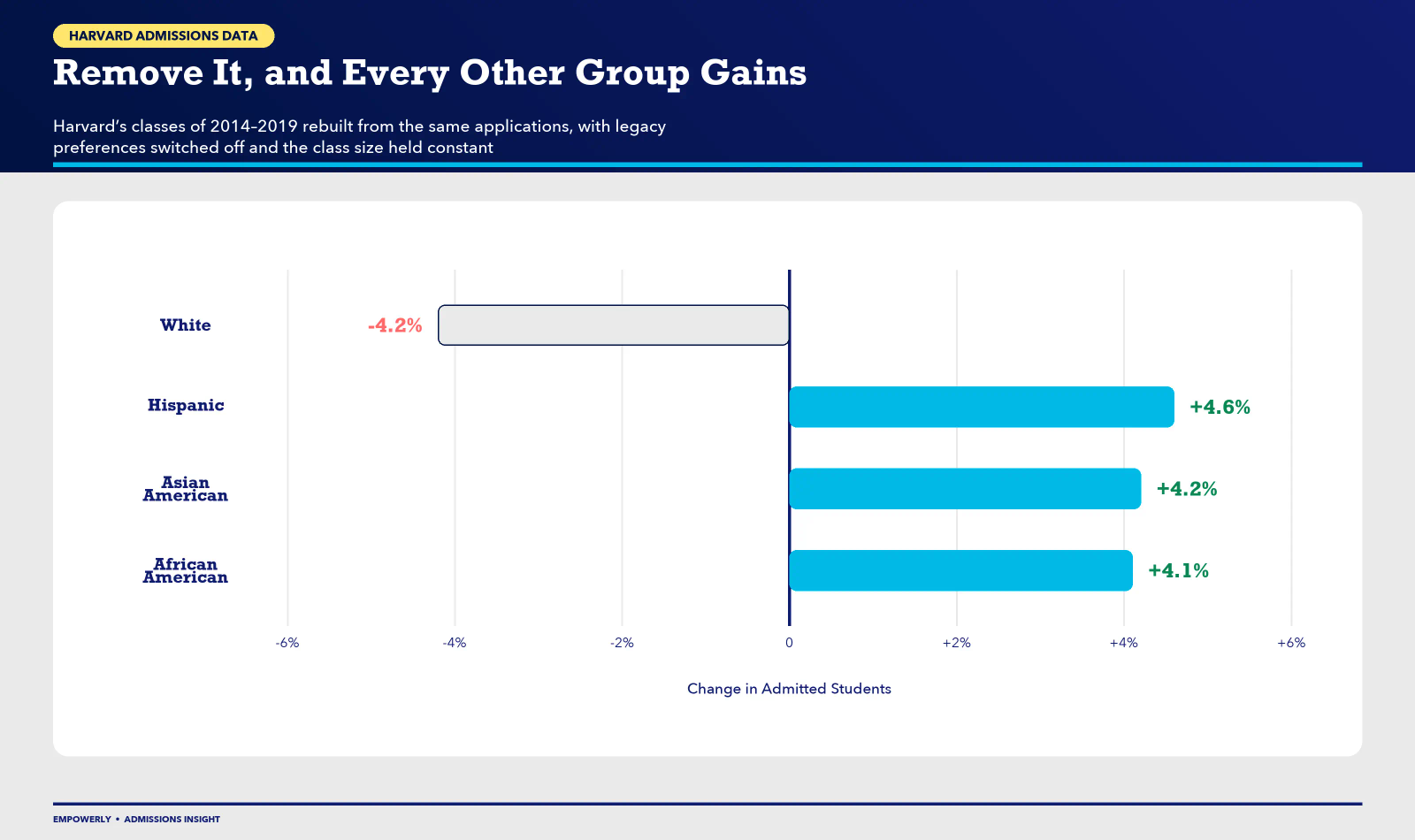
Remove legacy preferences, and White admits fall by 4.2%. Every other group rises: Hispanic applicants by 4.6%, Asian American applicants by 4.2%, and African American applicants by 4.1%. Removing legacy preferences increases admits for every non-White group.
These shifts are meaningful but not transformative. Four percent in either direction can’t be described as a reordering. But the authors say their figure understates the cumulative effects. For instance, removing athletic preferences alone would have raised Asian American admits by 9% because this group rarely participates in the sports — such as crew or fencing — that White applicants at selective schools do.
One last number captures the scale of all these preferences together. Across the four preference categories Harvard tracked — legacy, recruited athlete, the secretive dean’s interest list, and children of faculty — only a quarter of White applicants with these would have been admitted without one. This leaves us with an open question: what comes next for students applying to American colleges, especially highly selective ones?
Legacy preference works against your child by definition: some of those seats were spoken for before the reading began. No application, however strong, can put a parent’s name on a decades-old diploma. But let’s revisit the Opportunity Insights finding above that traced the Top 1 percent’s admission advantage. Among the students admitted to the Ivy League and other elite institutions, 46% of the edge came from legacy preference, and another 24% from athletic recruitment. These doors might be closed to you.
However, the remaining 30% came from non-academic credentials: extracurricular activities, research projects, and qualities admissions officers judge by hand. These are the things you don’t inherit or get recruited for. They’re what you build.
You have eight minutes to make an impression
The first admissions officer to read your child’s application will spend about eight minutes on it. Your child’s profile needs to pop off the page. Many families think admissions decisions are based on a student’s academic transcript — GPA, test scores, AP courses. That’s true of some colleges.
The median university — schools like Aurora University (IL), Husson University (ME), and Albion College (MI) — essentially only consider academics. The most recent survey from the National Association for College Admission Counseling (NACAC) asked colleges to rank admissions factors. Seventy-five percent of colleges ranked rigor of curriculum, AP and college-prep courses, as of “considerable” importance. GPA was close behind. Extracurriculars ranked far lower — only 6.5% of schools mark them as of “considerable” importance, while another 44% listed them as of “moderate” importance.
This ranking misleads families aiming for selective colleges. Forget the Ivy League. At schools across the Top 100, according to U.S. News Best Colleges Ranking, most applicants have high GPAs and carry tough course loads. Stellar academic transcripts get you a second look, not an acceptance. When everyone clears the same academic bar, it’s the “softer factors” — the non-academic credentials that account for 30% of an admissions advantage above — that separate one student from the next.
At selective universities, it’s what you did outside the classroom that counts. You have eight minutes to make an argument with your extracurriculars. And schools reward real depth in a few pursuits over a padded list.
Two students, one acceptance
Picture two students aiming for the same selective school. Both have the same GPA, AP courses, and test scores. Student One works from the old playbook: National Honor Society, Model UN, a few weeks of summer volunteering, and treasurer of two clubs. Genuinely solid extracurriculars — and completely indistinguishable from forty thousand other applicants.
Student Two pulls on one thread. Working with a PhD mentor through Empowerly’s Research Scholar Program, she spends a semester conducting an independent study of microplastics in her local watershed, culminating in a published college-level research paper. She then spends the summer of her junior year in an elite summer research program studying polymers, leading to yet another publication. This is the kind of depth and rigor that gets admissions officers' attention.
On the transcript, the two students are identical. In an admissions review, only Student Two has built the non-academic case. She answers the question schools are really asking: what will this student do with the opportunity?
-1-1600x1300.webp)
Maya earned a spot at Yale, Brown, Berkeley, and UCLA by building a T-shaped profile — depth in one field along with a broader set of extracurriculars — through independent research projects and rigorous summer programs identified by Empowerly. Her profile shows consistency and real achievement with publications and awards. When parents ask us why they should work with a college counselor, the answer is simple: we identify opportunities that transform a great application into a no-doubter.
Building this level of depth takes years, and someone has to chart the course. Every year, Yale rejects thousands of students with immaculate GPAs, impeccable AP coursework, and high SAT scores. At Maya’s schools, what you do outside the classroom is what separates you.
You can’t count on your high school guidance counselor for this kind of lift. The American School Counselor Association recommends one counselor per 250 students — NACAC found the national average is 376:1. Even elite private schools bury counselors in scheduling, testing, and a rising mental-health caseload. Actual college strategy falls by the wayside.
That’s why families are increasingly turning to private college counseling. One in five first-year Harvard students in the Class of 2025 reported using a private counselor — the remaining 80% likely didn't fill out the survey. What these families are paying for is access and knowledge of opportunities that create the extracurricular edge that selective schools demand.
Legacy admits occupy seats at your student’s dream school. But 30% of the advantage of wealthy admits at top-tier universities comes from the non-academic credentials any motivated student can build with enough runway. Empowerly pairs your student with dedicated counselors immersed in building holistic profiles while offering bespoke programs — our AI Scholar Program and Startup Internship Program — that give non-legacies a legitimate shot at the most selective schools. Begin early enough, and your activities list undoes most of the advantage that other students inherit.