Applications
UT Austin Acceptance Rate 2026: SAT, GPA & Admissions Tips
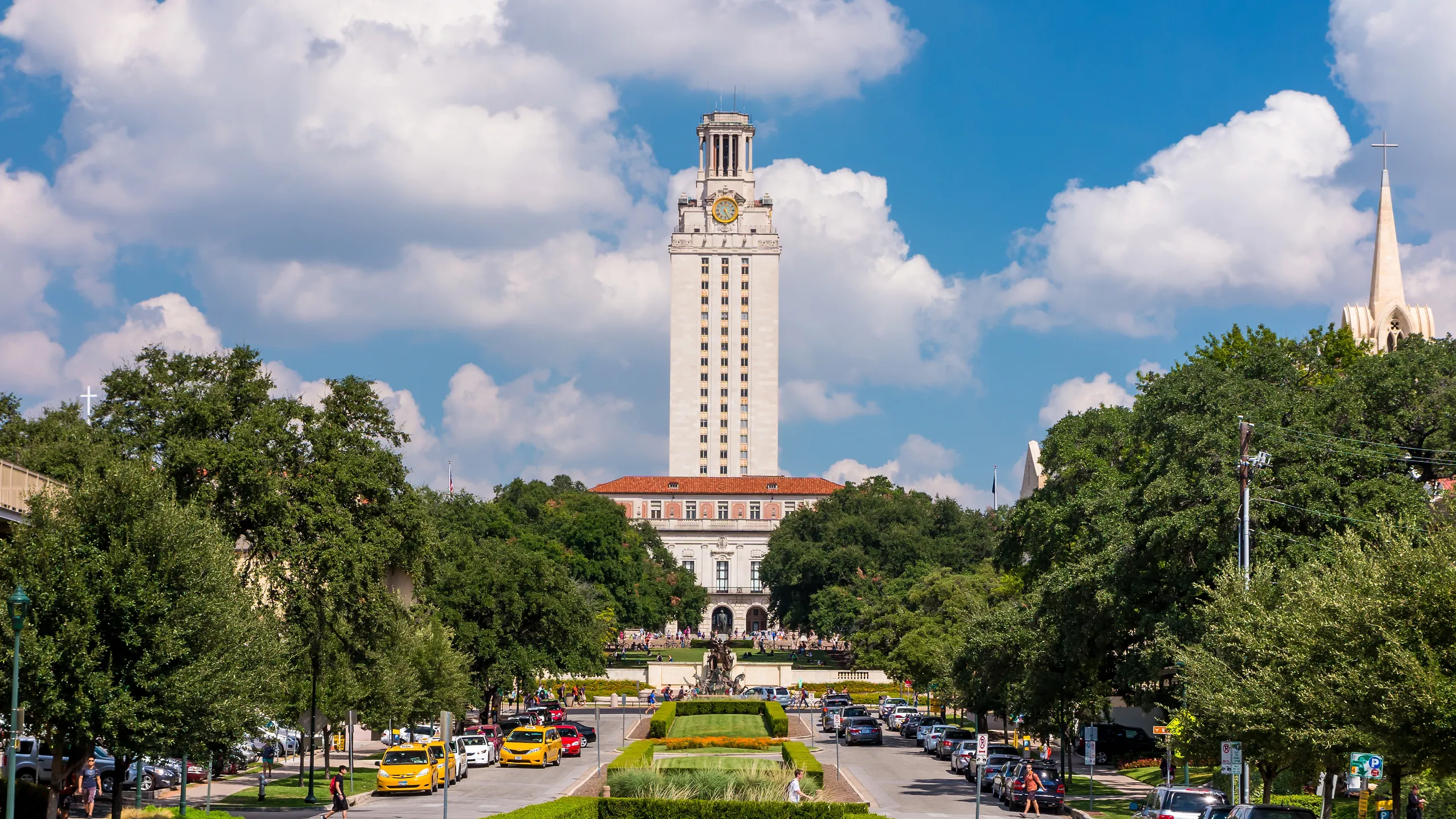
Looking for a major research university with electric school spirit, a uniquely blended tech-and-arts campus and city, and seriously impressive alumni outcomes? It's a tall order, but the University of Texas at Austin checks all three with style. The only problem is, the word is officially out about all of UT Austin's amazing offerings. And this year, interest surged, yet again.
If you're wondering, the numbers confirm it. UT Austin reported a record 90,690 freshman applications for Fall 2025, up 24% year over year and up 51% since 2022. The entering class is ~9,900 students, the largest in UT's history. That record pool produced a record-breaking 22.2% acceptance rate for the Class of 2029, with roughly 20,154 students admitted.
Translation: demand is at an all-time high, and selectivity keeps tightening.
Now, here's the headline change you need to know for May 2026: starting with the Fall 2026 cycle (the Class of 2030), UT lowered its automatic-admission threshold from the top 6% to the top 5% of a Texas high school class. Picture this — current juniors who were banking on the top 6% guarantee now face a tighter bar. The takeaway? UT Austin is getting harder to crack, and the rules are actively shifting. More on that below.
Why so competitive? Three big forces:
- State auto-admit law fills most in-state seats by class rank.
- Testing is back: UT requires SAT or ACT for Fall 2025 and Fall 2026 applicants.
- Soaring interest in Austin's economy, internships, and undergraduate research opportunities results in record app volume.
But what does it all mean for you? Let's unpack what the acceptance rate really means, and how to read it for your application strategy.
UT Austin at a glance
Let's get our bearings. What should prospective students know about the University of Texas at Austin? Here are the basics.
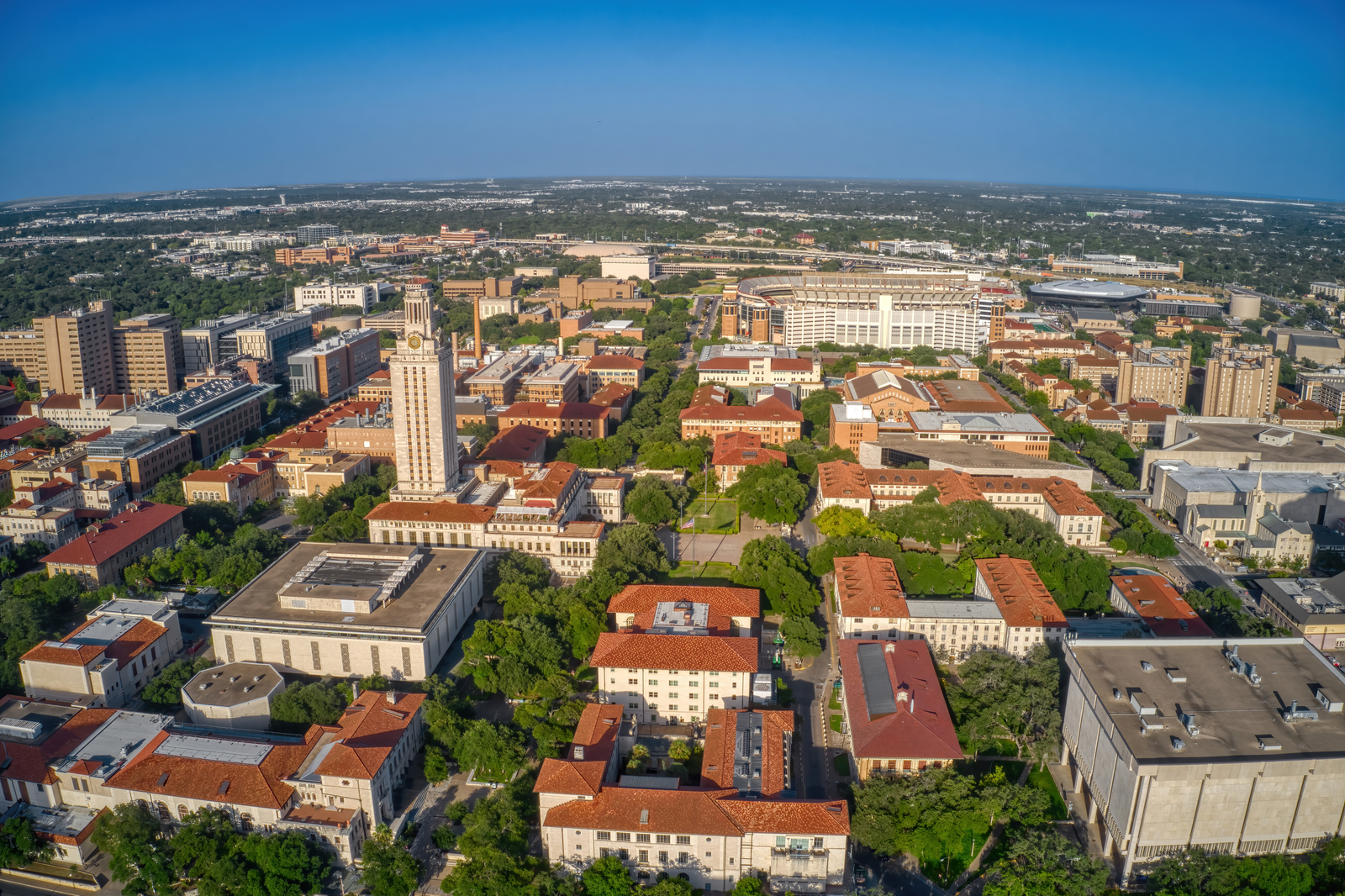
- Campus & location: Urban flagship campus in Austin, Texas.
- Size: ~55,000 total students; ~44,000 undergrads (Fall 2025).
- Application timeline: Early Action: Oct 15, Regular: Dec 1.
- Essays: Common App personal essay + UT short answers (two required, one optional in the 2025–26 cycle; varies by major/honors).
- Testing: SAT or ACT required for Fall 2025 and Fall 2026 entrants. Official scores must be sent.
- Automatic admission (Texas residents): By law, 75% of Texas resident admits are auto-admitted by class-rank threshold (top 6% for Fall 2025, dropping to top 5% for Fall 2026); the remaining ~25% of Texas offers are holistic.
- Special programs: Honors (e.g., Plan II, Turing, Canfield BHP), CAP (Coordinated Admission Program) pathway via select UT System campuses.
Want to see more? Check out this in-depth virtual campus tour to see if you connect with UT Austin's community vibe:
The UT Austin acceptance rate
Now, let's take a closer look at the competition you're up against as an applicant.
First, a reality check on "one number"
UT doesn't headline a single, all-majors acceptance rate each year on its website. Why? Because Texas law requires UT to fill 75% of Texas resident offers via auto-admit rank, and major placement is competitive.
In practice, your odds depend heavily on residency, class rank, and intended major (with programs like Engineering, Business, and CS among the most selective for holistic admits).
Here's the deal: that 22.2% headline rate for the Class of 2029 is an overall figure. Want to know what it hides? If you're an out-of-state applicant or a Texas resident who isn't auto-admitted, your real odds are far lower — closer to 10–15%, and out-of-state admit rates hover around just 10%.
What the official data does show
- Applications keep climbing: 90,690 freshman apps for Fall 2025 (+24% YoY), producing a record 22.2% acceptance rate with ~20,154 admitted.
- Class size rose to ~9,900 (Fall 2025), +7.5% year over year. (Yield management matters.)
- Testing requirement returned for the 2025 cycle and continues for Fall 2026, which can shift admit patterns (e.g., clearer comparative metrics alongside GPA and rank).
- Fall 2026 (Class of 2030): UT received a new record of roughly 73,000+ applications, and analysts project the overall acceptance rate could tighten further toward ~24% once official figures are released. (Note: UT had not yet published official Class of 2030 admission data as of spring 2026.)
Recent years' trend (how selectivity tightened)
Here's what we do know: over the last several cycles, UT's selectivity has trended tighter as applications outpaced capacity. Official UT releases document the application surge and enrollment ceilings; combined with the statutory 75% auto-admit cap for Texas resident admits, the result is increasing competition for the finite share of holistic seats, especially in impacted majors.
For context, the auto-admit threshold itself tells the story of tightening demand: UT lowered it from top 7% (2017) to top 6%, and now to top 5% for Fall 2026 — each cut a direct response to record-breaking application growth.
Bottom line: Even without a single universal "admit rate," official data confirms rising demand and stable class size. For students outside auto-admit (or targeting impacted majors), the effective admit rate is far lower than any overall number suggests.
Understanding the New Top 5% Auto-Admit Rule
Let's talk about the single biggest change to UT admissions in years. On September 19, 2025, UT Austin announced that the automatic-admission threshold would drop from the top 6% to the top 5% of a Texas high school graduating class, beginning with the Fall 2026 cycle (Class of 2030). Here's the deal — if you're a current Texas junior, this directly affects you.
Want to know why UT keeps lowering the bar? It's simple math. Texas law requires UT to automatically admit enough top-ranked students to fill 75% of its in-state seats, but it also lets UT cap auto-admits at that 75% line. As applications break records year after year, UT has to keep tightening the rank threshold to stay within that cap. The progression tells the story: top 8% a decade-plus ago, top 7% in 2017, top 6%, and now top 5% for Fall 2026.
For starters, here's what the new rule means in practice:
- The guarantee is harder to earn. A student ranked in the top 6% — who would have been auto-admitted last year — is no longer guaranteed a spot for Fall 2026. They now move into the holistic review pool.
- Auto-admit still only gets you in the door. Here's the kicker: even if you make the top 5%, that guarantees admission to the university, not to your specific major. Competitive programs like business, engineering, and computer science have limited seats and weigh essays, activities, and rank beyond the auto-admit line.
- More students now compete holistically. Every student who falls between the old 6% and new 5% threshold joins out-of-state applicants and other Texas residents in the holistic pool — making that pool even more competitive.
- Non-traditional applicants have a new pathway. Under Texas House Bill 3041, UT will automatically admit Fall 2026 and Spring 2027 homeschooled or non-traditional applicants who submit an SAT composite of 1570+ or an ACT composite of 36.
The takeaway? If you're a Texas student aiming for UT, calculate your class rank early and honestly. If you're near the top 5% line, treat your essays, test scores, and activities as if you'll be reviewed holistically — because you very well might be. And if you're targeting a competitive major, rank alone was never going to be enough anyway.
How to build a successful UT Austin application
If you have your sights set on Texas, then it's time to buckle down. Your best college application won't happen overnight!
1) Know where you stand on rank (and what it does and doesn't guarantee).
If you're a Texas resident and meet the auto-admit threshold (now top 5% for Fall 2026), you're admitted to the university, not automatically to your first-choice major. Highly selective colleges within UT admit by fit and preparation. Have a thoughtful major strategy (first and second choice) that aligns with your transcript.
Based on recent cycles and internal data, the most selective majors at UT include:
- Computer Science (College of Natural Sciences)
- Business Honors + Canfield BHP (McCombs)
- Engineering Honors (Cockrell School)
- Psychology and Biology (CNS, due to pre-med interest)
- Design and Architecture (due to limited capacity + portfolio review)
For these majors, admission is competitive even for in-state, top-ranking students. If you're applying, use both major choices strategically and showcase preparation in your essays and transcript.
2) Treat the SAT/ACT as a core component… because it is.
For Class of 2029 and Class of 2030 applicants, scores are required — UT is not test-optional. Build a test plan that leaves time for a retake before deadlines, and send official scores (SAT 6882; ACT 4240). If you're aiming for math-heavy majors, verify calculus readiness via scores or the UTMA and show rigorous math on your transcript.
There's no published minimum, but top programs often see middle 50% SAT scores around 1350–1530 and ACT scores from 30–35.
3) Lead with rigor + sustained impact.
Across colleges, UT reads for course rigor, grades by subject, and multi-year impact in activities. Prioritize depth (leadership, research, competition, work, service) tied to your intended field. Then connect the dots in your short answers.
4) Nail the short answers (they carry real weight).
Use the UT short answers to articulate fit: why this college within UT, how you've prepared (academically and experientially), and what you'll build in Austin. Keep tone direct and evidence-based. Show specifics (labs, studios, centers, courses, Austin-based opportunities).
5) Build a smart college list around UT.
Because holistic slots can be scarce (especially OOS and in impacted majors), craft a balanced list (reach/target/safety) and track deadlines carefully.
Can you get into UT without being auto-admitted? Yes, but it's much more competitive, so make sure your application shows exceptional academic rigor, testing, and essay fit.
How UT Austin Compares to Other Public Flagships
Picture this: you're building your college list and wondering how UT Austin stacks up against the nation's other top public universities. Want to know where it lands? Here's the deal — UT Austin sits firmly in the upper tier of public flagships, recognized as the #1 public university in Texas and among the top 30 nationally, but its admissions math is genuinely unique.
For starters, here's how UT compares to peer flagships:
- UT Austin vs. Texas A&M: Both are massive Texas flagships, but A&M has historically been somewhat less selective overall and uses its own top-10% auto-admit policy. UT's Austin location and tech-economy ties give it a distinct pull for business and CS applicants. (See our full UT Austin vs. Texas A&M comparison.)
- UT Austin vs. UNC-Chapel Hill, UGA, and UVA: These are UT's true peer group — elite public flagships with overall acceptance rates in a similar ballpark. The key difference is Texas's statutory auto-admit law, which fills 75% of UT's in-state seats by rank. UNC, UGA, and UVA use more conventional holistic review for all applicants.
- UT Austin vs. UC Berkeley: Both are top public research universities with strong CS and engineering. Berkeley is even more selective overall and uses a comprehensive holistic review with no auto-admit guarantee. For out-of-state students, both are reaches.
- What makes UT distinct: The combination of a binding auto-admit law, a 90%-Texas-resident requirement, and major-level selectivity means your odds at UT depend more on residency and rank than at almost any other flagship. An out-of-state applicant faces a dramatically different reality (~10% admit rate) than a top-5% Texan.
The takeaway? Don't compare UT to other flagships on overall acceptance rate alone — the auto-admit structure makes that number misleading. If you're out-of-state or not auto-admitted, treat UT like the reach it genuinely is, and build your list with peer flagships and strong targets alongside it.
Life at UT Austin
What's all this hard work for? What's the day-to-day life of a student like?
City as classroom.
Austin's tech, creative, and policy ecosystems make internships feel baked into campus life. Think startups along South Congress, state agencies near the Capitol, and major employers recruiting at career fairs.
Housing & community.
With enrollment highs, UT is investing in added capacity and leaning into learning communities and honors cohorts to make a big campus feel small.
Affordability.
The Texas Advance Commitment now fully covers tuition for Texas families up to $100,000 AGI (partial up to $125,000), contributing to access and the application surge.
Your college future: Texas and beyond
UT Austin is a public powerhouse in a booming city: big league research, elite programs, and a campus that turns ambition into action. But with record applications, a required SAT/ACT, and major-level selectivity, it's no cake walk. Success comes from planning the right strategy, not just chasing a headline admit rate.
If UT is on your list for the Class of 2029 or 2030:
- Lock your testing plan and submit official scores on time.
- Calculate your class rank early — and know whether you clear the new top 5% line.
- Align course rigor + activities to your target college/major.
- Write short answers that fit with Austin's opportunities.
- Keep a balanced college list, so you have multiple great options by February.
Want a second set of eyes on your UT strategy?
From major selection, essay angles, and testing timeline, Empowerly's advisors can help you turn this into an admit-ready plan. Book a free consultation to learn more about how we can support your dreams in becoming a reality.