Applications
Purdue Acceptance Rate 2026: SAT, GPA & Admissions Tips

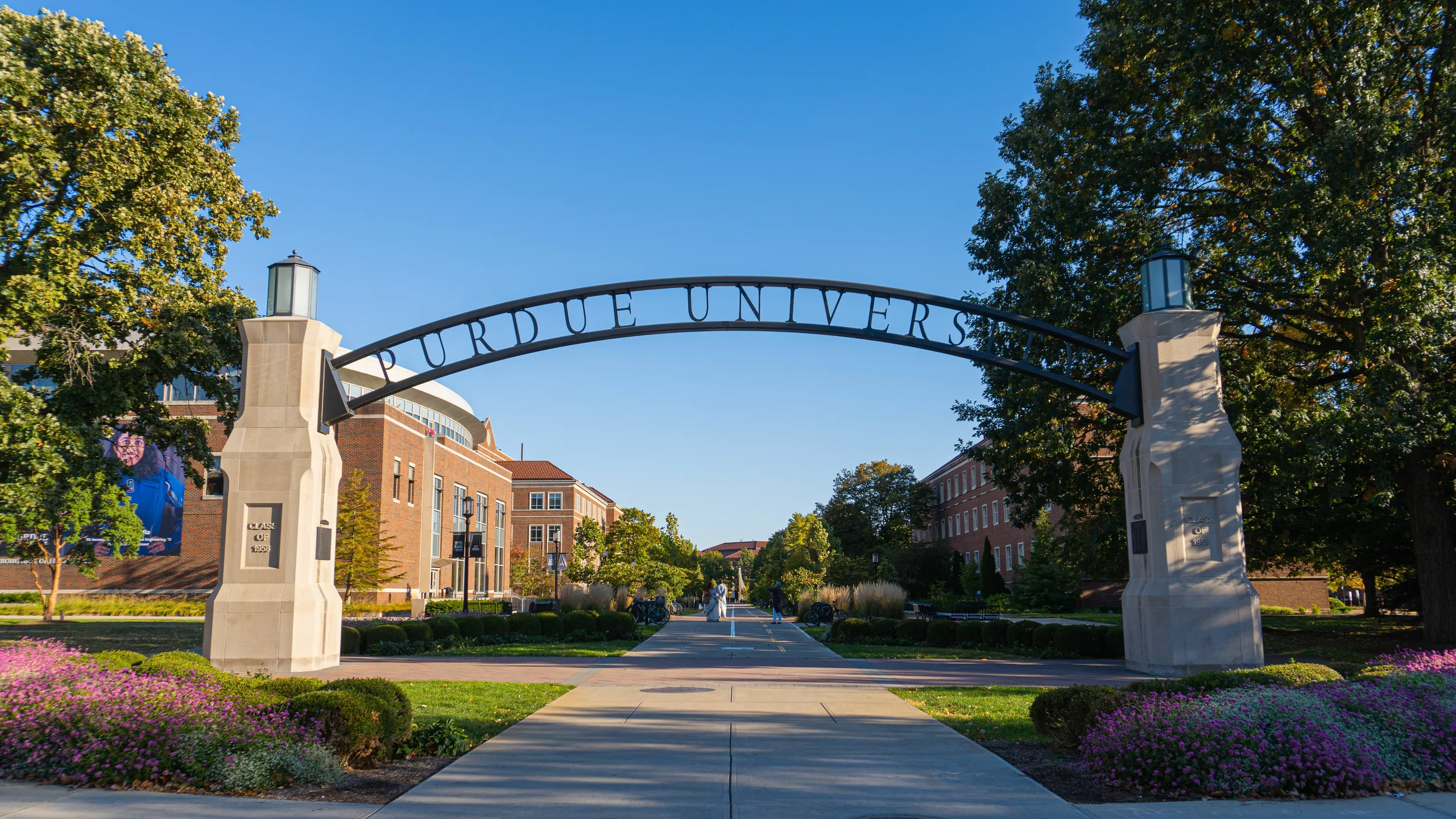
Looking for a STEM-strong public education with a dose of real career traction on the side? Purdue University in scenic West Lafayette, Indiana, might be the right place for you. This one-of-a-kind university pairs a range of nationally-ranked engineering, computing, and business programs with one of the country's largest co-op internship ecosystems.
The results are clearly working: this year brought record applications and rising selectivity (yet again). For Fall 2024, Purdue admitted 49.8% from a record high number of applicants; for Fall 2025, the main campus admit rate tightened further to a record-low 43.4%.
Now, here's something that signals a turning point for 2026: after 14 straight years of record-breaking application growth, Purdue's volume has finally begun to stabilize. For the Class of 2030, the university received roughly 62,060 Early Action applications — a slight 3.4% dip from the prior year's record. Picture this: a school that's grown relentlessly for over a decade is now deliberately managing its size. The takeaway? Selectivity isn't easing; Purdue is simply controlling enrollment more tightly than ever.
But what exactly does all that mean for your chances and your strategy? Let's take a closer look at the 2025 Purdue acceptance rate data for the incoming Class of 2029.
Purdue at a glance
Let's cover the basics first. What makes Purdue special? Here's what prospective applicants need to know.
- Campus & location: West Lafayette, Indiana, is the flagship campus.
- Size: ~57k total; ~43k undergrads (combined).
- Application timeline (first-year): Early Action: Nov 1 (priority for competitive majors and scholarships; Honors interest also due). Regular Decision: Jan 15 (decisions roll out Jan 15–Mar 31).
- Essays: Common App personal statement plus "Why Purdue"? and other Purdue-specific short answers.
- Testing policy: Purdue does ask for SAT and/or ACT test scores as of Fall 2025.
- Special programs worth noting: First-Year Engineering (special entry point to engineering), John Martinson Honors College (apply by Nov 1), robust co-op pathways via the Office of Professional Practice.
- Rankings & value: #9 among U.S. public universities (QS World 2026), #1 public university for graduating Fortune 500 CEOs, and #3 public for internships/co-ops. Purdue has also frozen tuition for 14 consecutive years.
If you're curious to see more, check out this virtual tour of Purdue's main campus sights:
Purdue acceptance rate, and what it means for you
There's no reason to beat around the bush. Here's the headline: Purdue has become steadily more selective since 2021, with another step-down in 2025.
- Fall 2023: 50% admit rate from 72,800 applicants.
- Fall 2024: 49.8% admit rate from 78,522 applicants.
- Fall 2025: 43.4% admit rate on ~86,953 applicants — the most selective incoming class on record.
Here's the deal on the Class of 2030 (Fall 2026): Purdue received roughly 62,060 Early Action applications, a slight 3.4% decrease from the previous year's record of nearly 64,000. After 14 consecutive years of record application growth, this stabilization reflects Purdue's strict test-required policy and its publicized push to rein in enrollment size. Experts expect the overall acceptance rate to land in the mid-40s, with out-of-state odds remaining highly competitive. (Note: Purdue typically releases full official class data in the fall, so the final Class of 2030 figures will firm up later in 2026.)
So what's driving this intense trend?
It's hard to give a definitive answer; there are several factors at play. First, there is a general demand growth across engineering, computer science, and business fields. These fast-growing industries draw more intense competition.
Additionally, the university policy at Purdue specifically shifted back to test-expected, which increased the expectations on applicants.
Finally, the admissions rate will continue to decline as long as the Purdue admissions office is concerned about capacity management, and Purdue signaled "further and significant reduction" in the admit rate to avoid over-enrollment, indicating that this trend may continue.
Want to know the single most important nuance most applicants miss? Purdue's overall rate is heavily skewed by residency. The in-state admit rate sits around 71%, while the out-of-state rate has dropped to roughly 39% (and the international rate is far lower, around 22.5%, with no merit aid for international undergraduates). If you're an out-of-state or international applicant, your real odds are meaningfully tougher than the headline number suggests.
- Takeaway: Overall admit odds now sit closer to low-to-mid 40% for Fall 2025, but vary widely by college and residency.
Average accepted student profile
Purdue publishes middle-50% academic ranges by college. Here are some highlights for the Class of 2029 data:
- University-wide(2025 snapshot): admit rate 43.4%. SAT 1220–1480, ACT 28–34. / 97% of admits submitted test scores. GPA 3.70–4.00. The enrolled class set records with an average SAT of 1,337 and average GPA of 3.81.
Here are some highlights by college (examples):
- Engineering: admit rate 34.7%; SAT 1380–1520; ACT 32–35; GPA 3.89–4.00.
- Agriculture: admit rate 55.8%; SAT 1120–1310; ACT 24.8–31; GPA 3.71–4.00.
- Education: admit rate 70.5%; SAT 1010–1210; ACT 21.8–29; GPA 3.47–4.00.

How to create a successful Purdue application
If you want to call Purdue your home, you need to put your best foot forward across the board. But what should you focus your energy on improving?
1) Nail the academics for your target college.
Purdue emphasizes major-fit rigor, especially math/science for Engineering/CS and quantitative prep for Business. Honors/advanced coursework and strong grades matter most.
International applicants: Be sure your transcripts are translated and verified. The TOEFL or IELTS may be required for non-native English speakers.
2) Treat tests as required, and be strategic.
With test-expected in place, aim to be at or above the middle-to-top of published ranges for your college. Retaking after focused prep can shift outcomes in competitive pools.
What does "test-expected" exactly mean, anyway? Purdue expects all applicants to submit SAT or ACT scores unless they face extenuating circumstances. While technically not "required," omitting scores without explanation may weaken your application. Purdue's admissions office has stated it expects most students to submit scores to stay competitive, especially for impacted fields.
3) Use the Purdue-specific questions to show fit.
Beyond the Common App personal statement, use "Why Purdue?" and program-fit responses to connect your experiences to concrete Purdue opportunities (labs, learning communities, co-ops, Indianapolis pathways, Honors).
4) Apply Early Action (Nov 1) if that timeline works for you.
U.S. citizens and permanent residents who apply by Nov 1 receive a mid-January decision, get priority for competitive majors, and are automatically considered for merit scholarships.
5) Consider multi-path strategies.
Some colleges/majors are far more selective. Applying to a well-matched alternate major (without misrepresenting interests) can keep options open.
6) Show momentum outside the classroom.
Purdue notes leadership, impact, and achievements in review. Quantify results (e.g., code shipped, research poster, business revenue, hours/lead roles).
How Purdue Compares to Other Top STEM Schools
Want to know how Purdue stacks up against the other engineering and CS powerhouses you're probably considering? Here's the deal — Purdue competes for many of the same applicants as schools like UIUC, Georgia Tech, and the University of Michigan, and understanding the differences helps you build a smart, balanced college list.
For starters, here's how Purdue compares to its closest peers:
- Purdue vs. UIUC (Illinois): Both are elite public engineering/CS schools in the Midwest with strong industry pipelines. UIUC's Grainger Engineering and CS programs are similarly competitive, and Illinois is also test-focused. Purdue's signature edge is its enormous co-op ecosystem and its 14-year tuition freeze; UIUC offers a slightly different campus culture and Chicago proximity.
- Purdue vs. Georgia Tech: Georgia Tech is often more selective overall (especially out-of-state) and is located in a major city (Atlanta). Both excel in engineering and CS. Purdue tends to offer somewhat better out-of-state odds than Georgia Tech and a strong co-op program, while Georgia Tech offers urban access and a tech-industry hub.
- Purdue vs. University of Michigan: Michigan is a larger, more comprehensive flagship with elite programs across many fields beyond STEM, and it's generally more selective for out-of-state students. Purdue is more STEM-concentrated and more affordable, with its tuition freeze and lower sticker price.
- Purdue vs. in-state option (Indiana University): For Indiana residents, IU and Purdue serve different strengths — Purdue for engineering, CS, and hard sciences; IU for business (Kelley), arts, and humanities. Many Hoosier students apply to both.
The takeaway? Purdue's distinctive combination of top-tier STEM programs, the nation's largest co-op system, exceptional career outcomes, and a 14-year tuition freeze makes it genuinely competitive with — and often more affordable than — its peers. Students laser-focused on engineering, CS, or business with real industry experience baked in often find Purdue hard to beat on value.
Life at Purdue: what it's like to be a Boilermaker
What is life like as a student on campus? What resources are available, and what experiences will you look forward to?
Hands-on from day one.
The Office of Professional Practice runs one of the nation's largest co-op systems. The program includes 12–22 months of paid, transcripted industry experience before graduation, often with the same employer across multiple terms. Many students graduate with a year or more of full-time experience.
A second home base in the state capital.
Purdue in Indianapolis (opened 2024) expands access to urban internships in areas like AI, biomedical engineering, data science, and sports tech… and new research/industry partnerships continue to grow.
Orientation that actually orients.
Boiler Gold Rush (BGR) brings new students to campus the week before classes for community, wayfinding, and campus-life onboarding; there's even BGRi for international students.
Big Ten energy.
From Mackey Arena to Ross-Ade, the campus blends research-heavy academics with D-I game days and 1,000+ clubs. Not to mention, Purdue also offers living-learning communities tied to majors and interests.
Career Outcomes and Return on Investment
Now, here's something that should factor heavily into your decision: what happens after you graduate. Want to know why Purdue's value proposition is so strong? It comes down to a rare combination of low cost and high career payoff.
Here's the deal on Purdue's outcomes and ROI in 2026:
- Career outcomes: Roughly 89.9% of Purdue graduates achieve a career outcome (employed, in grad school, etc.) within six months of graduating, with about 83% employed full-time.
- Internships are the norm: Over 82% of students complete at least one internship or co-op before graduating — a direct result of the Office of Professional Practice's massive employer network. Purdue ranks #3 among public universities for internships and co-ops.
- The tuition freeze is real money: Purdue has frozen tuition for 14 consecutive years. For families, that means predictable costs and meaningful savings compared to peers whose tuition rises annually. Non-resident tuition sits around $28,794/year — competitive for a top public research university.
- Strong earning power: Purdue is the #1 public university for graduating Fortune 500 CEOs, and engineering graduates in particular command strong starting salaries. The co-op model means many students enter the job market with a year or more of real experience already on their resume.
- Financial aid: Many students receive need-based aid; complete the FAFSA early (Purdue's priority date is typically in February). Note that international undergraduates are generally not eligible for merit-based aid.
The bottom line? When you weigh Purdue's relatively low, frozen tuition against its exceptional career outcomes and co-op pipeline, the return on investment is among the best in public higher education. For STEM-focused students especially, few schools offer this combination of affordability and outcomes.
Frequently Asked Questions About Purdue Admissions
Here are the questions prospective Boilermakers ask most once they understand the acceptance rate. Here are clear, current answers.
What is Purdue's acceptance rate for 2026?
For Fall 2025 (Class of 2029), Purdue's overall acceptance rate was 43.4% from about 86,953 applications — its most selective class on record. For the Class of 2030 (Fall 2026), Early Action applications dipped slightly to around 62,060, and the overall rate is expected to land in the mid-40s. Final Class of 2030 data is typically released in fall 2026.
Is it harder to get into Purdue from out of state?
Yes, significantly. Purdue's in-state acceptance rate hovers around 71%, while the out-of-state rate has dropped to roughly 39%, and the international rate is even lower (around 22.5%). The university manages enrollment carefully, so out-of-state and international applicants face meaningfully tougher odds than the headline rate suggests.
Does Purdue require SAT or ACT scores?
Effectively, yes. Purdue is "test-expected," meaning it expects all applicants to submit SAT or ACT scores unless they face genuine extenuating circumstances. For Fall 2025, 97% of admitted students submitted scores. Omitting scores without explanation can weaken your application, especially for competitive majors.
Which Purdue colleges are hardest to get into?
Engineering is among the most selective (about 34.7% admit rate, with admitted SAT ranges of 1380–1520). Computer Science and Business are also highly competitive. Less impacted colleges like Agriculture (55.8%) and Education (70.5%) admit at higher rates. Always check your specific college's middle-50% ranges.
What GPA and test scores do I need for Purdue?
University-wide, the admitted middle 50% sits at roughly 1220–1480 SAT, 28–34 ACT, and 3.70–4.00 GPA. The enrolled Class of 2029 averaged a 1,337 SAT and 3.81 GPA. For competitive colleges like Engineering, aim for the upper end (or above) of those ranges.
Should I apply Early Action to Purdue?
If the timeline works, yes. Applying Early Action by November 1 gets you a mid-January decision, priority consideration for competitive majors, and automatic consideration for merit scholarships. It's non-binding, so there's little downside for U.S. citizens and permanent residents who are ready by the deadline.
Your college future: Indiana and beyond
Purdue's story in 2025 is clear: demand keeps climbing, and admissions are tightening, particularly in Engineering, CS, and Business. Applying Early Action, submitting strong test scores, and tailoring your Purdue-specific responses to real opportunities (co-ops, research groups, Indianapolis options, Honors) can materially improve your odds.
You aren't in this alone!
Want a second set of eyes on your Purdue strategy? Curious how Purdue compares to UIUC, Georgia Tech, or UMich?
Whether you're applying to several top STEM schools or have eyes for Purdue only, Empowerly advisors can help you make sure your college strategy covers all the bases. Our team can help you match majors, prioritize deadlines, pressure-test your stats against Purdue's middle-50% ranges, and polish your Purdue-specific answers (before November 1). Book a consultation to learn how you can start your college plan with an advisor and build a college list calibrated to your profile and budget.