Revenge of the nerds: MIT unseats Princeton as America’s top university, according to U.S. News


For 15 years, Princeton reigned supreme on the U.S. News Best Colleges ranking. This year, however, the perennial No. 1 lost its title to MIT.
Not much changed at Princeton, MIT, or any other university that ascended or fell in the rankings. Instead, U.S. News changed its formula. Out went the previous metric of graduate indebtedness, and in came a new factor, “earnings by major.”
Earnings by major compares graduate earnings by fields of study. So colleges with more Art History majors don’t suffer — although maybe they should — compared to schools that print lots of quantitative finance degrees.
It’s no secret that MIT graduates earn a lot of money. The school not only produces many computer scientists and engineers, but its graduates end up working on Wall Street or at Big Tech firms with high starting salaries.
“STEM schools,” by and large, seem to have benefited from U.S. News’ new formula, with Caltech and Carnegie Mellon both climbing six slots. Like MIT, Caltech and Carnegie Mellon students enjoy high earnings post-graduation.
U.S. News’ rankings changes (2026 to 2027)
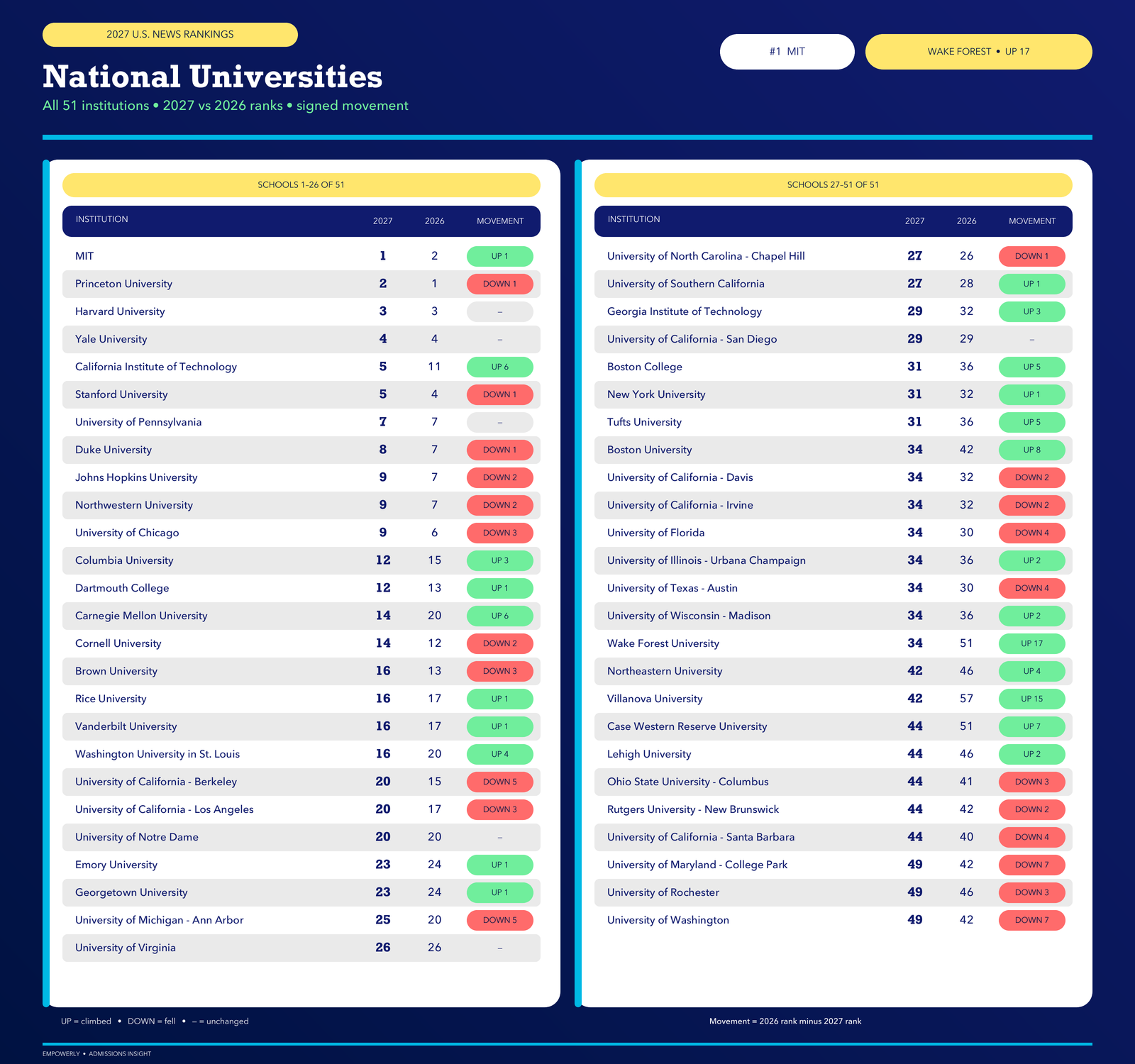
The losers are perhaps more interesting than the winners: UC Berkeley and the University of Michigan dropped five spots. Meanwhile, the University of Maryland and University of Washington fell seven spots, with Purdue dropping outside of the Top 50 entirely.
If you think you smell an anti-public university rat, you’re not alone. US News used data from the federal College Scorecard, which measures earnings after graduation for federal financial aid recipients.
This salary metric disadvantages large public universities with lower percentages of students receiving financial aid. These institutions already receive state subsidies, which keep in-state tuition costs down. The total cost to attend UChicago or Duke runs north of $100,000 per year. In-state at Purdue? Less than $10,000 per year. More families can bankroll their child’s tuition at the publics.
Of course, U.S. News has never lacked for critics, and hasn’t done much to win them over. When Columbia gained a coveted spot at #2 in the rankings in 2022, one of its own math professors challenged it. Columbia dropped to #18 next fall. Reed College quit sending U.S. News data in 1995, and claims the magazine still punishes them for it.
Meanwhile, university leadership plays both sides of the field. They know parents, trustees, donors, and others pay attention to the rankings. When a school drops, they invariably challenge the whole enterprise, insisting you can’t put a numerical value on a college. Yet when a school climbs, they’re quick to boast.
When I was a graduate student at Brown, moonlighting as an admissions reader, we all knew where we stood in the U.S. News rankings. But taking them seriously out loud was heresy at worst, and naivete at best.
Giving credence to a ranking system that arbitrarily changes its “formula” whenever it needs a splashier headline does indeed seem foolish. In 2023, the magazine decided to reward social mobility, and more than a dozen public universities shot up the list. Fresno State jumped 64 spots. This year’s version is sending publics the other way, based almost entirely on how families fund their children’s education.
Rankings shmankings
I’ll make a valiant effort to convince you to ignore the U.S. News rankings, along with every other attempt to rank colleges.
Let’s start with Purdue. Last year, Purdue celebrated its status as the only university in Indiana in the Top 50. This year, after falling out of the Top 50, its press release says U.S. News ranked its engineering programs eighth overall, with five programs in the top ten. Two Purdues, and two very different stories depending on your vantage point.
But what does this actually mean for families considering Purdue? Not a whole lot. Purdue was strong in engineering before U.S. News garlanded their programs.
For students considering becoming a Boilermaker, the most important thing isn’t its ranking. It’s whether you’re paying in-state tuition. It’s whether you can get accepted, either to the university at large or a particular program. It’s campus life and a thousand other things that have nothing to do with where Purdue appears on some list.
Then there’s my alma mater. At 16, Brown ranks below every other Ivy League school. I’m not going to say it doesn’t sting a little to lose to Cornell and Dartmouth.
But over the last four editions, Brown’s ranking has moved every time U.S. News changed its formula. After its 2023 overhaul, Brown ranked ninth. The next year, U.S. News reweighted again, and Brown slid to 13. This year, after adding earnings by major, it fell again to 16. Brunonians have seen a lot of action in the rankings over the past five years.
What didn’t change was Brown’s Open Curriculum. For a student who wants to design their own course of study, Brown remains the Ivy of choice.
Not much changed at the top of the list either. Most Princeton students still write a thesis. Every MIT undergraduate still takes two semesters of physics, philosophy majors included. The nerds got their revenge this year, courtesy of a three-word addition to U.S. News’ methodology: earnings by major. And the magazine is counting on us to wait with bated breath for next year’s sequel.